
VTech AM18447
4.0Editor score
Four-line business console
Expandable to ten stations
Per-line auto attendant
Customizable music on hold
A phone system for a dental office must do more than ring. It should route calls efficiently, support multiple treatment rooms, provide clear calls, record messages, block unwanted solicitations, and remain convenient for staff handling patients, appointments, insurance questions, and urgent concerns.
We compared ten business-oriented and expandable phone systems across line capacity, cordless range, answering-machine functions, Bluetooth cell connectivity, call blocking, conferencing, speakerphone access, display size, and expansion potential. The guide includes both analog office systems and a SIP cordless bundle for practices with compatible infrastructure.
Each selection reveals which workflows it suits best, from a compact two-line desk setup to multi-handset systems distributed throughout a clinic. Product specifications and availability can change, and prices fluctuate, so readers should verify current details and office requirements before making a final purchase.
4.0Editor score

4.2Editor score
4.3Editor score
As an Amazon Associate we earn from qualifying purchases.
The table below provides a side-by-side view of line capacity, expansion, call-management features, and connectivity. It highlights the major differences among analog multi-line systems, expandable cordless packages, speakerphone terminals, and the SIP-based Yealink bundle.


The AT&T DLP73590 earns the top position because it balances a substantial handset package with the management features a busy practice needs. It includes five cordless handsets, a large five-inch color base display, an answering machine, conference calling, intercom communication, and Bluetooth connectivity to a cell phone. Its 4.2 rating reflects a generally positive user history without suggesting perfection across every office.
We may earn a commission when you buy through this link, at no additional cost to you.
The five-inch color display is particularly useful for front-desk staff because it provides a clear central view of contacts, messages, call history, timers, and other functions. Assignable shortcuts reduce the steps needed to reach frequently used features. At the base, staff can begin a conference between an outside line and as many as four cordless handsets, while intercom functionality supports quick internal communication among treatment or administrative areas.
Call filtering is another practical strength. The Smart Call Blocker is designed to stop robocalls from reaching the landline before they ring, while one-touch blocking allows staff to blacklist an unwanted caller immediately. The system can store as many as 1,000 names and numbers on its block list. DECT 6.0 technology and the stated noise-filtering approach are intended to support reliable conversations and coverage, although actual results depend on the building and placement.
This system is a strong fit for a dental office that wants dedicated handsets at reception, treatment rooms, an office, and a consultation area without purchasing separate single phones. It is less suitable for practices requiring a documented multi-line auto-attendant or many simultaneous outside lines, since its feature emphasis is on cordless convenience, call control, and manageable expansion. For most small and midsize clinics seeking one flexible system, it is the most balanced recommendation in this guide.
The color base display gathers useful information in one place and places common tasks within reach of dedicated shortcut keys. That can simplify routine work at reception, particularly when staff need to retrieve messages, check call history, or contact a frequently dialed person.
Five DECT 6.0 handsets make it practical to place a phone in several work zones without building around a single corded desk. Internal intercom and conference functions also help staff coordinate between the front desk and clinical areas.
We may earn a commission when you buy through this link, at no additional cost to you.
The VTech AM18447 is the most complete small-office platform in this group, with four analog lines, an auto attendant, a digital answering system, intercom, music on hold, and expansion to ten stations. Its 4.0 rating is credible for a business phone package, and the feature set makes it particularly relevant for dental practices whose administrative workload justifies a dedicated console rather than a simple cordless bundle.
We may earn a commission when you buy through this link, at no additional cost to you.
Its auto attendant is designed to answer on each of the four lines, offer callers access to a company directory, route calls to extensions, and capture voicemail. This creates a more formal patient-facing experience than a basic two-line telephone. The digital answering system provides up to 180 shared minutes for incoming messages, announcements, and memos, while additional productivity features include a full-duplex speakerphone, large display, caller ID, call waiting, a 100-name phonebook, 32 speed-dial entries, headset support, and intercom.
Customizable music on hold adds a polished touch while callers wait. Installation remains relatively approachable: the main console connects to analog lines through RJ11, and compatible cordless handsets or desksets pair wirelessly with one-touch DECT 6.0 technology. The trade-off is dependence on the correct analog connection and service configuration. A practice also needs to ensure that the included components and optional stations are purchased deliberately rather than assuming all ten stations arrive in the box.
This is a strong recommendation for a growing practice that needs several lines, formal call routing, shared voicemail, and room-to expand. It is less attractive for a one-room office wanting a simple cordless phone, and practices already running a modern cloud platform may need to confirm how an auto attendant and multiple analog lines fit their existing communications workflow. Its breadth makes it a premium option for offices that value structured call handling.
The per-line auto attendant can greet callers, provide directory access, and route calls to extensions. These features create a consistent front-desk experience when the reception team is greeting a patient, scheduling appointments, or handling a busy queue.
Expansion to as many as ten stations allows the system to grow with additional staff and treatment rooms. Cordless handsets and desksets can be added through DECT pairing without replacing the main console.
We may earn a commission when you buy through this link, at no additional cost to you.
The AT&T TL86103 combines a corded base with cordless operation, two lines, a two-mailbox answering system, and Connect-to-Cell Bluetooth. It carries a 4.1 rating and offers one of the broadest stated handset-expansion paths in the guide, reaching up to 12 handsets. These qualities make it a practical option for small dental offices that want a desk anchor plus wireless endpoints in several rooms.
We may earn a commission when you buy through this link, at no additional cost to you.
Connect-to-Cell lets staff make and receive cellular-plan calls through the office system, potentially reducing the need to carry a personal phone between the front desk and treatment areas. Up to two cell phones and two landlines can be connected, and as many as 6,000 cellular phonebook entries can be downloaded to the cordless handsets. The dual-mailbox answering system provides up to 22 minutes per mailbox, allowing business and personal messages to remain separated when appropriate.
The corded base is designed around a large backlit display, speakerphone, and large-button keypad. Its line-power mode supports continued communications through the corded handset during a power outage, an important consideration for offices that want a desk phone to remain available. Two USB ports on the base can also charge two cell phones. As with other DECT products, actual wireless coverage depends on walls, equipment placement, and interference, so the stated 1,000-foot potential should not be treated as guaranteed performance in every building.
This is a good match for a compact practice with two incoming lines, a reception desk, and one or more staff members who need to move around. It offers more expansion than many compact two-line systems, although adding handsets requires additional purchases. Practices seeking a formal auto attendant, multiple voicemail departments, or sophisticated call routing should look elsewhere. For straightforward corded-cordless flexibility, however, it is among the most adaptable systems here.
The corded base provides a familiar reception-station anchor with a large display, speakerphone, and easy-to-read keypad. Cordless extensions add mobility without asking the office to abandon a wired desk phone.
Line-power mode is a meaningful availability feature for a reception desk. It allows the corded handset to retain line-service functionality during an outage, subject to the telephone service and other installed equipment.
We may earn a commission when you buy through this link, at no additional cost to you.
The Panasonic KX-TG9582B stands out for flexible mobile-device integration and three-way conferencing. It combines two lines, a corded base, two cordless handsets, an answering machine, call blocking, DECT 6.0, and Bluetooth Link2Cell functionality. Its 4.2 rating reflects a favorable balance of business features, and the system can link as many as four smartphones for calling through the office handsets.
We may earn a commission when you buy through this link, at no additional cost to you.
The three-way conference function is particularly relevant when a dental team needs to coordinate among a corded desk and two wireless endpoints. Conference conversations can be conducted hands-free through the base speaker and cordless handsets. Panasonic also applies noise reduction to suppress background interference and enhance voice tones, a useful attribute in busy offices where reception conversations may occur near printers, music, or open treatment areas.
A less common but useful capability is USB connection to a Windows-based business or home-office PC. The supplied information states that users can make outgoing calls to Outlook contacts and receive incoming calls with a single click. That feature may reduce friction for staff who already organize patient communication around Outlook, although it requires appropriate computer setup and compatible software. The handset display is a 1.8-inch monochrome screen, so the system prioritizes core calling over large visual interfaces.
The KX-TG9582B is a strong option for a small practice that relies heavily on staff cell phones and wants to route those calls through a more comfortable handset system. It also works well for internal conferences. Its two-line capacity and relatively modest screen make it less fitting for a clinic needing a sophisticated auto attendant or large call queues. For mobile-connected teams, however, its Link2Cell and Outlook integration create a compelling functional package.
Link2Cell can pair with as many as four smartphones and let staff make or receive cellular calls through the office system. This can centralize communication while allowing a phone to remain in an area with an optimal cellular signal.
Three-way conferencing and noise reduction support clearer coordination among reception and clinical staff. The corded base plus two cordless handsets gives the team several points from which to join a conversation.
We may earn a commission when you buy through this link, at no additional cost to you.
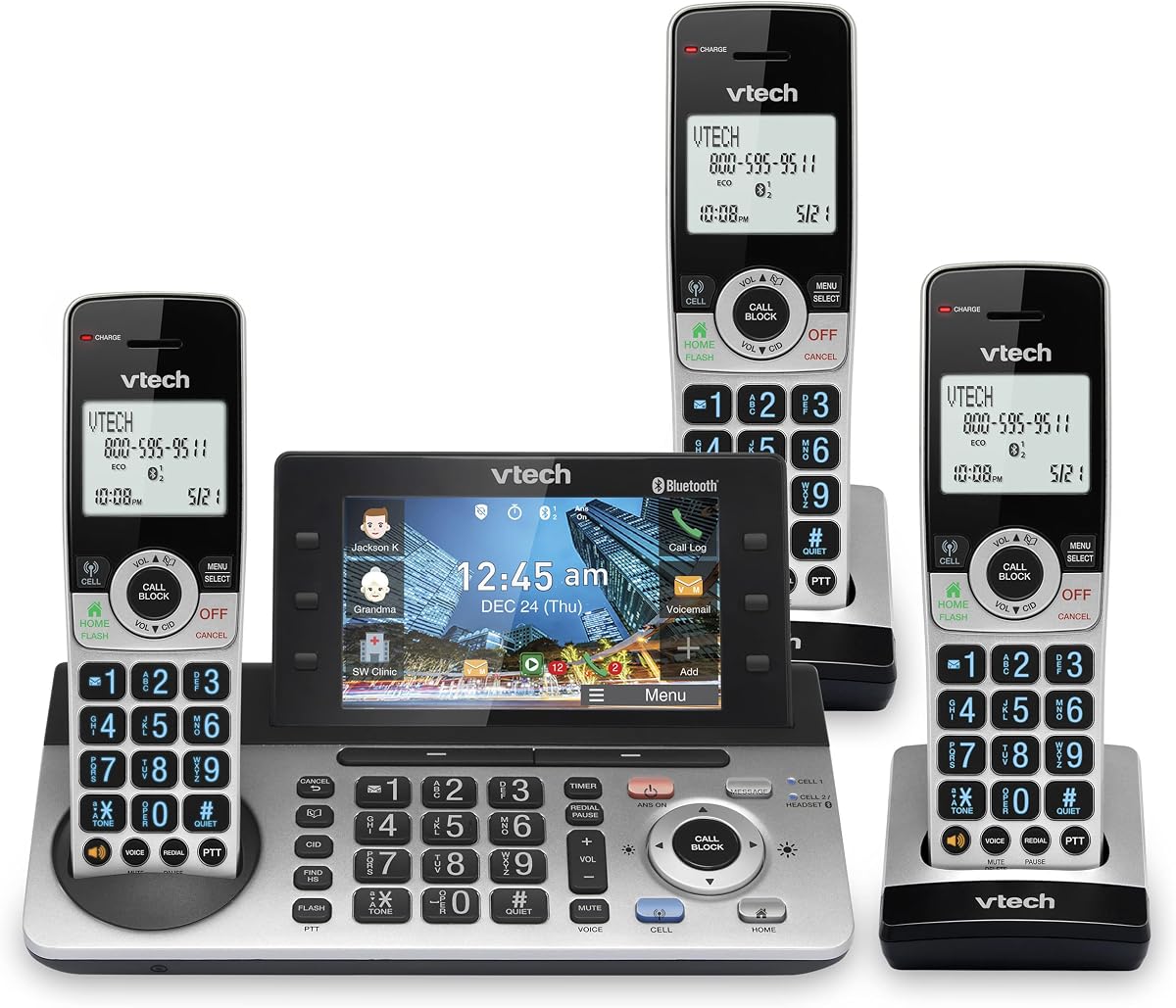
The VTech IS8251-3 is a capable business-grade cordless system with three handsets, a five-inch color base display, programmable shortcuts, a digital answering system, smart call blocking, and Bluetooth Connect-to-Cell functionality. Its 4.3 rating is the highest among the systems in this guide, making it a notable choice for readers seeking a well-regarded, feature-rich cordless package without a large multi-line console.
We may earn a commission when you buy through this link, at no additional cost to you.
The virtual two-line system can manage calls from a landline and a cellular line simultaneously. Users may pair up to two cell phones, or one cell phone and one Bluetooth headset, for use with landline calls. The base display also shows caller information for recorded messages, allowing staff to select which message to listen to first. Forty minutes of recording capacity provides more space than many compact answering systems in the group.
Large icons, a color screen, and programmable shortcut keys improve the daily user experience. One-touch access can be assigned to important contacts, and a dedicated function can return a caller from the displayed message list or call history. A timer is included for tracking work intervals. Smart Call Blocker is designed to stop robocalls on the landline before they ring, including the first attempted call, which is helpful in a clinic where interruptions can be disruptive.
This is a particularly good fit for a small or home-based dental office that needs several cordless locations and call screening but does not require four analog lines. The virtual-line design is important to understand: it should not be treated as equivalent to a four-line business console. It is also less suitable for an office that depends on a formal auto attendant. Subject to those limitations, the IS8251-3 combines strong rating, clear displays, and practical call management in an approachable package.
The five-inch color base display is easy to consult and presents information in a more visual format than a basic monochrome handset. It also makes recorded-message selection and shortcut navigation more approachable for daily users.
Simultaneous management of a landline and cellular connection is useful for a small practice where staff may need to move between a fixed office number and a personal mobile line. The option to pair a Bluetooth headset broadens hands-free use.
We may earn a commission when you buy through this link, at no additional cost to you.
The VTech DS6151-2 offers a straightforward two-line package with two cordless handsets, a digital answering system, separate mailbox support, and expansion to as many as 12 handsets. Its 4.1 rating makes it a credible, uncomplicated option for a solo dental practice or a small office that needs more than a single cordless phone but does not need a complex console.
We may earn a commission when you buy through this link, at no additional cost to you.
Each line can support its own mailbox, which helps separate calls arriving through different numbers. The system records up to 13 minutes and offers trilingual prompts in English, Spanish, and French. A 50-entry caller ID history provides a useful record of incoming contacts. Intercom communication between the handsets and base allows staff to move between rooms without relying solely on the external line.
The system supports conferencing between an outside line and up to two cordless handsets. That makes it easier to include the receptionist and a staff member in a patient call without placing everyone on a separate conference service. Its simplicity, however, is also the main limitation. Compared with the VTech AM18447, it does not offer a comparable four-line console, per-line auto attendant, directory routing, or shared voicemail capacity. Practices that need polished automated greeting workflows should look for a more specialized platform.
For a compact practice with two numbers, a clear need for line-specific voicemail, and an interest in adding cordless endpoints later, the DS6151-2 is a sensible option. It is particularly well suited to bilingual or multilingual teams because of its three prompt languages. The 13-minute recording limit may be tight during busy periods, so message volume and expected call traffic should be checked. Within that context, it delivers a clean, expandable core system.
A dedicated mailbox for each line keeps incoming messages organized when the practice uses one number for patients and another for business or personal calls. This is more useful than a single shared queue in many small offices.
English, Spanish, and French voice prompts make the system easier to configure and operate for staff members who prefer a different language. The uncomplicated menu structure also reduces training time.
We may earn a commission when you buy through this link, at no additional cost to you.
The VTech IS8128-51 differentiates itself with a stated operating range of up to 2,300 feet and a package of five DECT 6.0 handsets. It also includes an answering machine, call blocking, Bluetooth Connect-to-Cell, and intercom. With a 4.2 rating, it is a strong choice for a dental office spread across a larger building, multiple floors, or a campus where maximum cordless reach is a priority.
We may earn a commission when you buy through this link, at no additional cost to you.
The extended range is the central attraction. DECT 6.0 technology is designed to support long-distance cordless operation, while the product information specifically cites coverage extending into a yard or nearby property. In practice, walls, structural materials, electrical equipment, and interference can reduce actual reach, so a site test is sensible for a clinic with many thick walls. Even so, the stated specification exceeds that of the other cordless systems here.
Call screening is unusually robust. The Smart Call Blocker can screen unknown calls and robocalls, store as many as 1,000 names and numbers, and add a blocked caller to the list through a dedicated handset key. The answering system includes 22 minutes of recording capacity, a message indicator, a voice guide, and support for incoming messages, outgoing announcements, and memos. Bluetooth can connect two cell phones, or one phone and one Bluetooth headset, for landline calls.
This is a compelling option for a dental office that values wireless reach and distributed handsets more than formal call routing. The large two-inch handset display, three-and-a-half-inch backlit base display, high-contrast text, and illuminated keypad improve daily usability. It lacks a business-directory auto attendant and other multi-line console features, so a larger office should verify that it can be used as a direct patient-contact system. For broad coverage and five-room mobility, it remains one of the most distinctive picks.
The unusually high stated range can help when the base is separated from treatment rooms by multiple walls or floors. It may also allow staff to carry a handset into adjacent outdoor areas without losing the office connection.
A dedicated one-touch blocking key lets reception staff reject an unwanted caller without navigating a multi-step menu. The large block list is valuable for a practice that accumulates repeated solicitations over time.
We may earn a commission when you buy through this link, at no additional cost to you.
The AT&T ML17929 is a compact, two-line corded desk phone for offices that want dependable line control, hands-free calling, and headset support without a larger multi-handset system. Its 4.3 rating is among the highest in the guide, and the feature set focuses on core business functions rather than wireless expansion or automated patient routing.
We may earn a commission when you buy through this link, at no additional cost to you.
The built-in speakerphone has adjustable volume, allowing a receptionist or practitioner to keep both hands free while discussing an appointment or coordinating with a colleague. Three-way conferencing lets the user combine both active lines with another party, making it useful for transfer-heavy workflows. The large display presents caller information, and the caller ID history holds up to 99 names and numbers across the two lines, giving staff a useful reference for recent calls.
A major practical advantage is line-1 operation during a power outage. Because the unit is corded and line-powered on that line, it can continue making and receiving calls when electrical power is unavailable, subject to the external telephone service. Other details include line-status indicators, automatic line selection, last-five-number redial, headset compatibility, and a wall-mountable design. These are meaningful touches for a reception area where a dedicated desk location matters.
The ML17929 is best for a solo practitioner, small consultation office, or front desk that already has a separate voicemail system and needs a simple two-line terminal. It is not the right choice for staff who need to roam through treatment rooms, and it does not include a cordless expansion path or answering machine. Within its narrower category, however, it offers straightforward line handling, power-failure resilience, and an easily managed physical footprint.
The adjustable speakerphone supports multitasking without a separate headset, while dedicated headset support offers another hands-free option. Both can be useful in a small office where staff handle calls while typing or writing notes.
The power-failure feature provides continuity for calls placed through Line 1. That makes the terminal more dependable for urgent communication when the office loses electrical power.
We may earn a commission when you buy through this link, at no additional cost to you.
The Panasonic five-handset Link2Cell system offers a generous cordless package, Bluetooth mobile connectivity, call recording, one-ring scam alerts, and extensive call blocking. Its 4.2 rating indicates a well-received feature set, while five handsets make it straightforward to distribute a phone among reception, treatment rooms, and administrative spaces.
We may earn a commission when you buy through this link, at no additional cost to you.
Link2Cell pairs with up to two cell phones, allowing staff to make and receive mobile calls through the office system. This can be advantageous when reception staff need one central way to manage both office and cellular contacts. The answering machine's recording and playback functions also help staff revisit important details, and the audible Start Recording prompt can discourage suspicious callers. A one-ring scam confirmation screen adds another layer of protection by prompting users to reconsider returning a missed call.
The call-blocking system is particularly comprehensive. Automated Call Block pre-blocks robocalls, announced telemarketing calls can be filtered, and a one-touch handset button lets users add as many as 2,000 more blocked contacts. These functions are helpful in a practice where interruptions and fraudulent outreach can interfere with patient service, although the office should establish a policy for reviewing legitimate calls that may be filtered.
This system is well suited to a small or midsize dental office that values cellular bridging, multiple handsets, and call screening. It does not offer the directory-based auto attendant or multiple analog line console of the VTech AM18447, so it is less appropriate for formal automated routing. Its stated home-phone positioning does not prevent office use, but buyers should focus on the detailed features and confirm the number of components needed for their layout. For distributed cordless calling, it is a compelling package.
Automatic robocall filtering, announced-call blocking, and one-touch rejection reduce interruptions at the reception desk. The large blocked-contact capacity suits practices that want to preserve a growing list of unwanted callers.
Five included handsets make it easier to place a dedicated phone in each important work area. Pairing mobile calls through the system can also reduce the need for every staff member to carry a separate cell phone.
We may earn a commission when you buy through this link, at no additional cost to you.
The Yealink W73P Bundle is the only SIP-focused product in this guide. It combines a W70B base with W73H handsets and a color display, offering a cordless architecture that can support up to 10 DECT handsets, 10 SIP accounts, and 20 simultaneous calls. Its 3.6 rating is the lowest listed, but the specifications make it an important option for a dental office already invested in VoIP infrastructure.
We may earn a commission when you buy through this link, at no additional cost to you.
Because the system operates through SIP accounts, it can integrate more naturally with an existing voice-over-IP phone service or compatible business communications platform. The color screen and intuitive interface make the handset suitable for everyday call handling, while a 3.5 mm headset connection supports hands-free work at a desk. The W73P bundle is particularly attractive to offices that want multiple SIP lines without managing separate analog devices.
The main caveat is infrastructure. A buyer should confirm that the telephone service supports the required SIP account structure, that the W70B can be configured for the office network, and that the needed number of W73H handsets is included or will be purchased separately. The supplied information specifies a bundle containing a W70B base, a W73H handset, and one additional W73H handset. It should not be assumed to include five or ten handsets.
This is a strong pick for a technically managed dental practice with an existing VoIP platform, a need for many account or handset options, and a desire for 20-call capacity. It is less suitable for a small office that wants simple analog installation or a consumer-style cordless system. The lower rating may encourage caution, so compatibility, support requirements, and configuration should be verified before purchase. In the right technical environment, however, it provides the most scalable call-account capacity in this roundup.
SIP architecture can integrate efficiently with compatible business calling services. This makes the bundle more relevant for a dental office that has already standardized on VoIP than for one beginning with a simple analog installation.
Support for up to 10 SIP accounts, 10 DECT handsets, and 20 simultaneous calls offers room for a larger or more technically demanding office. The exact included handset count should be confirmed because the bundle does not provide the maximum configuration.
We may earn a commission when you buy through this link, at no additional cost to you.
The right dental office phone system depends on staff workflow, building layout, existing service, patient volume, and the degree of call routing required. Comparing these factors before purchasing helps prevent an underpowered system or unnecessary complexity.
Begin by distinguishing physical telephone lines from virtual two-line systems, cellular connections, and SIP accounts. A conventional four-line console can support multiple outside numbers, while a virtual two-line cordless system may only manage one landline and one cellular connection. The VTech AM18447 is built around four analog lines, the AT&T and Panasonic systems support two lines, and the Yealink model uses up to 10 SIP accounts. Choose capacity based on existing numbers and future needs, not on the number of handsets.
More lines can improve caller access but may also require more complex routing and service configuration. For a solo practice, one or two lines may be adequate; for a multi-provider office or busy appointment desk, additional lines and auto-attendant functions can be worthwhile. Count current numbers, consider staff or specialist requirements, and leave room for expansion without selecting unnecessary capacity.
Cordless range matters when a receptionist, hygienist, or office manager must answer a call away from the desk. DECT 6.0 appears across many of the included systems, while the VTech IS8128-51 advertises an unusually high range of up to 2,300 feet. Building materials, floor levels, wiring, and interference can change real-world results, so measurements and a placement plan are important. A system with fewer but well-placed handsets may be more useful than maximum theoretical coverage.
Test the intended base location and confirm that the handsets remain usable in every treatment and office area. Look for a handset that is comfortable to carry, has a readable display, and offers easy access to speakerphone, transfer, hold, and intercom functions. If the office is compact, a smaller two-handset package may prevent unused equipment while still providing reception and one secondary station.
A dental office may need automated greetings, extension routing, shared voicemail, a directory, or music on hold. The VTech AM18447 includes a professional auto attendant for each of its four lines, directory access, extension routing, shared recording time, and customizable music on hold. Most of the cordless packages emphasize personal answering-machine mailboxes and call screening instead. If patients commonly reach a busy reception desk, a structured routing system may be more valuable than another wireless handset.
Think about how a caller is identified, transferred, and returned. Caller ID history, message caller information, one-touch callbacks, and distinct line mailboxes can all improve follow-through. A more automated system reduces some routine handling, but the practice must still maintain accurate extensions, greeting messages, and staff procedures. Technology helps only when the routing logic matches how the office actually operates.
Corded phones remain useful at a fixed reception station because they are simple, stable, and may support line-powered operation during an outage. The AT&T ML17929 is a dedicated two-line corded speakerphone, while the TL86103 and Panasonic KX-TG9582B combine a corded base with wireless extensions. A mixed design offers a dependable desk anchor plus mobility, but it may require more setup and charging management than an all-cordless arrangement.
Consider staff habits and how handsets will be shared. A corded desk phone can be intuitive for someone who handles every call from one chair, while a cordless system suits offices with frequent internal movement. Check whether the package includes enough charging cradles, whether battery charging is manageable, and whether the receiving team prefers physical keys or menu-driven controls.
Connect-to-Cell and Link2Cell features allow cellular calls to travel through office handsets, which can make a mobile number easier to monitor. The AT&T TL86103 supports two cell phones, the VTech IS8251-3 can pair two phones or one phone and a headset, and Panasonic models also support Bluetooth mobile connections. These are valuable where staff already divide communication between a landline and personal devices. Compatibility with the office's cellular service and Bluetooth behavior should be confirmed before installation.
VoIP support is a different category. The Yealink W73P is designed around SIP accounts and can support up to 10 accounts, 10 DECT handsets, and 20 simultaneous calls. That makes it compelling for a technically managed clinic using a compatible hosted or on-premises phone platform. It also requires network configuration and careful handset provisioning, so a practice with no existing VoIP infrastructure may find an analog console simpler.
Robocalls, insurance solicitations, and fraudulent outreach can interrupt a clinical office. The strongest call-blocking systems include one-touch controls, automated robocall filtering, announced-call filtering, and large blocked-contact lists. The AT&T DLP73590 and VTech IS8128-51 list capacity for 1,000 blocked names and numbers, while the Panasonic five-handset model supports 2,000 additional blocked entries. These features help, but a practice should also decide who reviews filtered calls and how legitimate outside callers are recognized.
Voicemail capacity should match call volume. The VTech AM18447 offers 180 shared minutes, the IS8251-3 offers 40 minutes, and the IS8128-51 offers 22 minutes. More recording time reduces the chance of overwriting important messages, while separate mailboxes can keep business and personal calls organized. Consider how long callers typically wait before leaving a message and whether the practice needs distinct greetings for each line.
Reception staff may use the system all day, so displays, buttons, menu depth, and headset support matter. A five-inch color base display, as found on the AT&T DLP73590 and VTech IS8251-3, can present information clearly, while programmable shortcuts reduce repeated navigation. The Yealink W73H includes a 1.8-inch color screen for a more compact SIP handset. Cordless units with illuminated keypads and high-contrast text may be easier to use in dim rooms or by staff with different visual needs.
Multilingual prompts can also improve accessibility. The VTech DS6151-2 offers English, Spanish, and French voice prompts, which may reduce setup friction in a diverse workplace. Before buying, ask staff to handle a sample menu, place a call, retrieve a message, block a caller, and join a conference. A technically capable phone is only effective when the team can use it without confusion.
Verify what is included before calculating the complete setup. Some packages include one base and two or three handsets, while the AM18447 supports ten stations and requires compatible additions for a full deployment. The VTech IS8128-51 and Panasonic five-handset model include five cordless units, while the Yealink bundle includes a W70B base and W73H handsets as specified. Additional handsets, headsets, wall mounts, cables, and compatible desksets may be necessary.
Ask whether installation requires RJ11 analog connections, a compatible SIP network, or particular service features. Most cordless additions use one-touch DECT pairing, but professional installation may still be warranted for a large clinic with many rooms and lines. Record the planned location of each base, charger, and handset, and confirm that outlets, charging space, and network coverage are adequate before completing the purchase.
Start with a written setup plan that assigns each line, extension, handset, mailbox, and calling responsibility. Install the base in a central location with reliable line or network service, connect the required cables, and pair each cordless handset before placing it in a treatment room. Program the practice greeting, emergency instructions, voicemail access codes, music on hold where supported, and the schedule responsible for checking messages. A short test with every handset should confirm outgoing calls, incoming calls, transfers, speakerphone, intercom, and call blocking.
Establish a simple call-handling routine. Staff should identify the reason for each call, use the appropriate line or extension, and record complete information in a message before hanging up. If the office uses an auto attendant, review its routing choices frequently so patients are not sent to inactive extensions. For mobile-connected systems, document which staff member owns each paired phone and establish procedures for switching between landline, cellular, and headset calls. The Yealink SIP system should be configured and tested with the office's VoIP administrator rather than treated like a consumer cordless telephone.
For care, keep handsets and base units away from moisture, extreme heat, and unstable surfaces. Clean surfaces with a soft, lightly dampened cloth rather than spraying liquid directly into ports, buttons, or charging cradles. Replace handsets on their correct chargers and inspect cords, connectors, and battery performance periodically. Review blocked-number lists, voicemail capacity, greetings, speed dials, and contact directories on a regular schedule so staff changes and accumulated messages do not create avoidable communication problems.
The best choice depends on line count, room layout, and call volume. A compact two-line system may suit a solo practice, while a three- or five-handset package works better when staff need phones in several rooms. The AT&T TL86103 and VTech DS6151-2 are useful starting points for simpler needs, whereas the VTech IS8251-3 offers a larger display and more advanced call filtering.
Not every practice does, but multiple lines can prevent new calls from displacing active ones and help separate patient, business, and personal numbers. A four-line console such as the VTech AM18447 also provides more sophisticated auto-attendant routing. Smaller practices with one or two numbers can often manage with a two-line system, provided call traffic remains reasonable and voicemail capacity is sufficient.
Yes, and a cordless system can be especially useful when reception staff need to answer calls from treatment rooms or administrative areas. The DECT 6.0 models in this guide support wireless operation, while some also include a corded base. Dental practices should test coverage through thick walls and place chargers where handsets will remain available without obstructing clinical work.
Useful features include automatic robocall filtering, screening of unknown numbers, announced telemarketing detection, one-touch blocking, and a large blocked-contact list. The AT&T DLP73590, VTech IS8128-51, and Panasonic five-handset system provide particularly strong blocking tools. Practices should still establish a process for returning legitimate calls that may have been screened.
SIP is well suited to a practice already using a compatible VoIP phone platform and needing multiple accounts or handsets. Analog systems are generally more familiar and may be easier for a small office to install. The Yealink W73P offers up to 10 SIP accounts and 20 simultaneous calls, while the VTech AM18447 provides a straightforward four-line analog platform.
The number depends on which staff areas need simultaneous access. Reception, an office, consultation room, and several treatment rooms can justify three to five handsets, while a very compact practice may need only two. Include charging cradles, consider where staff actually work, and avoid buying more endpoints than the layout can support effectively.
Yes. An answering system can capture appointment requests, insurance questions, urgent concerns, and callback information when every staff member is occupied. The best capacity for a practice depends on call volume: the VTech AM18447 offers up to 180 shared minutes, while several compact cordless systems provide between 13 and 40 minutes. Clear greetings and a routine message-checking schedule are essential.
Staff should follow the practice's privacy, documentation, and security policies and avoid discussing sensitive clinical details where others can overhear. A business phone can provide call control, but purchasing equipment alone does not establish regulatory compliance. Practices should also evaluate their broader communications workflow, including devices, network security, staff training, and any required administrative or technical safeguards.
The AT&T DLP73590 is the most balanced overall recommendation, offering five cordless handsets, a large color display, call screening, conference functions, and intercom capability. Practices seeking a more formal multi-line system should examine the VTech AM18447, whose four lines, per-line auto attendant, shared voicemail, directory routing, and ten-station expansion provide a stronger administrative structure. The VTech IS8251-3 stands out as a capable cordless option with a high rating, three handsets, and a user-friendly display.
The right decision should begin with workflow rather than feature count. A solo office may need only a dependable two-line corded desk phone, while a larger clinic may benefit from multiple wireless endpoints, a formal auto attendant, or a SIP-based system. Count existing lines, map where staff work, estimate voicemail use, and decide whether cellular bridging or VoIP integration is genuinely necessary. This prevents a feature-rich but unnecessarily complex purchase and helps ensure every included function supports patient communication.
Finally, verify the current package contents, service compatibility, expansion requirements, and installation needs before ordering. Product configurations, ratings, and prices can change, so current listings should be checked during the purchasing process. With a clear office plan and realistic call-volume estimate, selecting from these ten systems becomes much easier—and the practice is more likely to choose a phone system that remains useful as the team and patient base grow.
