
2 Jar Rosin Soldering Flux
4.6Editor score
Two 35-gram jars
Controlled paste application
Suitable for multiple metals
Our guide compares the best soldering flux paste for electronics, including rosin formulas, no-clean options, syringe dispensers, and desoldering kits.
Soldering flux paste helps heat reach the joint, removes oxidation, and encourages solder to spread across a clean metal surface. The right formula can make a difficult repair faster, improve joint appearance, and reduce the risk of cold or poorly bonded connections on circuit boards, wires, and small components.
We compared all ten options by examining their stated flux type, intended metals and solder compatibility, dispensing method, residue claims, corrosion characteristics, and suitability for PCB, SMD, rework, or general hobby work. The list includes jars, syringes, liquid droppers, and combined desoldering kits.
Our top selections highlight a dependable rosin paste for broad electronics work, a value-focused pair of jars, and a precision syringe set for delicate repairs. The remaining picks expand the options for controlled dispensing, desoldering, component replacement, and larger projects; prices and availability can change over time.
4.6Editor score

4.7Editor score

4.5Editor score
The table below compares the ten products by format, flux type, application focus, and stated compatibility, making it easier to identify a paste for general soldering, fine PCB work, component removal, or a combined soldering and desoldering setup.




SRA Solder 135 is a semi-solid rosin flux paste with a 4.7 rating and a strong all-purpose profile. It is formulated for both lead-containing and lead-free solder, giving it broader utility than a product tied to only one alloy family. Its semi-solid consistency is the defining feature: it remains controllable on a pad, wire, or iron tip without behaving like a freely moving liquid.
We may earn a commission when you buy through this link, at no additional cost to you.
The product is described as a Type RA, or rosin-activated, flux with an active temperature range of 93–315°C. That broad operating range suits conventional hand-soldering situations involving circuit boards and copper electrical wire. The manufacturer also highlights its wetting performance, meaning the flux is intended to help solder move across oxidized metal instead of forming isolated beads or weak-looking interfaces.
Application is straightforward. A technician can dip a cleaned copper wire into the paste, brush flux onto a PCB pad, or transfer a small amount to a component lead before heat is applied. The paste is described as acid-free and is promoted for electronics rather than general hardware-store applications. Its no-clean position is useful for routine repair work, although users with sensitive or high-voltage assemblies may still inspect joints carefully.
This is the strongest general recommendation for a solderer who wants one container to cover PCB repair, hookups, hobby electronics, and mixed lead or lead-free work. The tradeoff is that it does not provide the fine placement offered by a syringe and may require a separate brush, applicator, or soldering iron tip for loading. Even so, its balance of control, compatibility, and stated performance makes it a practical first choice.
The wax-like consistency gives the user more placement control than a conventional liquid flux. It can be touched to a specific wire end or PCB pad and then heated, helping concentrate activity where the joint is being formed rather than flooding the surrounding area.
Compatibility with lead and lead-free solder, combined with copper wire and circuit-board applications, makes this paste useful across mixed repair benches. The manufacturer also identifies car audio, computers, RC vehicles, drones, gaming consoles, instruments, and microcontroller projects as suitable uses.
We may earn a commission when you buy through this link, at no additional cost to you.
This two-jar rosin flux package has a 4.6 rating and provides 70 grams of paste in total. It is designed primarily for lead-free electronics soldering, making it a sensible value choice for users who work regularly with modern solder and want enough material for multiple sessions. Two separate containers can also be useful when separating general-purpose flux from a repair-specific bench.
We may earn a commission when you buy through this link, at no additional cost to you.
The semi-solid formula is described as resistant to easy dumping or uncontrolled spreading, which is helpful on a crowded work surface. It can be used with instruments and common soldering metals including gold, copper, tin, and iron. The manufacturer additionally describes an anti-oxidation effect on gold-copper alloy soldering iron heads, adding a maintenance-oriented benefit to its general electronics use.
One of the strongest claims is that rosin is nonconductive when dry and provides insulation. It is also described as non-corrosive to metals such as circuit boards. These characteristics matter because a repair should not introduce a conductive residue or attack a sensitive assembly. That does not mean every application is residue-free, so completed work should still be checked and cleaned when required by the board or component manufacturer.
This package is a good choice for budget-conscious hobbyists, students, and technicians who value useful quantity over syringe-level precision. The jars are less suited to tiny SMD work than needle dispensers, and the user must apply the paste with a separate tool. Even so, the two-container format, broad metal compatibility, and 4.6 rating make this a capable entry for routine soldering and rework.
Two containers provide 70 grams in total, reducing the chance that a work session ends because the only jar has dried or become contaminated. They can also be labeled for different soldering systems or kept in separate project kits.
The stated compatibility with gold, copper, tin, iron, and other metals supports varied repair work. Users still need to confirm that the flux and solder alloy are appropriate for the specific component and assembly being serviced.
We may earn a commission when you buy through this link, at no additional cost to you.
This four-pack of 10cc rosin flux syringes carries a 4.5 rating and stands out for precise application. It is aimed at users working on populated circuit boards, small pads, phones, appliances, instruments, and other assemblies where a general jar applicator could place too much material. A push-type syringe makes it possible to deposit a small bead directly beside a joint.
We may earn a commission when you buy through this link, at no additional cost to you.
The product is described as a high-activity, lead-free, halogen-free, non-corrosive no-clean paste. Its intended action is to remove oxidation, improve wetting, and help solder flow smoothly so it bonds to the intended surface. The formulation is suitable for both solder wire and solder paste, which makes it more versatile than options marketed for a single soldering method.
Two fine tips are included, allowing the user to choose a narrow application path around closely spaced components. Because paste is viscous, it tends to remain where deposited rather than rapidly spreading across the board. This can reduce mess and unnecessary flux exposure, although a syringe cannot completely prevent overapplication. The four individual containers are also useful for separating tasks or keeping multiple tools stocked.
The package is a strong choice for SMD, SMT, and fine rework because placement is more important than bulk value. Each cap should be replaced tightly after use to limit drying. The listed shelf life is up to 12 months when stored away from heat and sunlight, and the manufacturer notes that cold conditions may slightly thicken the paste. For users who regularly work under magnification, that control is worth considering.
The narrow tips make it easier to place flux beside a small pad without coating nearby components. This focused application is especially helpful for dense SMD boards, phone repairs, and rework involving closely spaced terminals.
Four capped syringes provide useful redundancy and organization. They can be assigned to different repair benches or solder systems, reducing the chance of cross-contamination and making it easier to keep a dedicated fine-work dispenser.
We may earn a commission when you buy through this link, at no additional cost to you.
This combined kit pairs 10cc of no-clean flux paste with a 10-foot desoldering braid and earns a 4.7 rating. It addresses two recurring repair actions: preparing a joint for soldering and removing existing solder when a component must be replaced. That combination makes it especially relevant for board rework, disconnected wires, motherboard parts, relays, and mechanical keyboard switches.
We may earn a commission when you buy through this link, at no additional cost to you.
The flux is described as halogen-free, non-corrosive, and capable of good fluidity. The copper braid has a woven design intended to improve the capillary effect and absorb molten solder. During rework, the braid is placed over the joint and heated; as solder melts, it travels into the braid rather than remaining pooled around the component.
The kit is particularly useful when a user does not yet own a dedicated solder-removal tool. It supports an apply-and-remove workflow without requiring the purchase of separate supplies. Its stated applications include small PCB boards, computer parts, relays, old wire removal, and re-soldering mechanical keyboard switches, which gives it a practical repair focus rather than limiting it to new construction.
Users should recognize that solder wick is a consumable and that the included 10-foot length may be more than a small repair requires. The braid also adds a step to component removal, since it must be positioned and heated properly. Despite those limitations, the 4.7 rating and combined format make this a convenient pick for technicians who want flux and desoldering capability in one package.
The matched contents cover the preparation and removal stages of rework. A user can apply flux before soldering or use the braid to draw solder away when replacing a part, reducing the number of separate accessories needed on the bench.
The finely woven copper construction is designed to draw molten solder away from pads and leads. Correct placement and temperature remain essential, because a poorly positioned braid may remove less solder or expose the pad to unnecessary heating.
We may earn a commission when you buy through this link, at no additional cost to you.
The RMA liquid flux dropper is a fluid-format alternative to the paste options dominating this list. It has a 4.6 rating, contains 30 milliliters, and uses a dropper bottle for targeted dispensing. RMA means rosin mildly activated, positioning it between a basic rosin flux and a more strongly activated formula.
We may earn a commission when you buy through this link, at no additional cost to you.
The product information describes a high-purity, RoHS Certificate Compliant, organic liquid intended for electronic soldering. It is said to remove oxides from tin-lead and lead-free alloys as well as gold, silver, and copper alloys. Its stated applications include soldering, desoldering, rework, and reflow processes, giving it broader process coverage than a general hobby paste.
Neutral pH and non-corrosive behavior are important qualifications for circuit-board work. Rosin is also described as nonconductive when dry, so the residue should not create an unintended electrical path. The formula is promoted as having low volatility, limited irritating odor, and a composition without zinc chloride, ammonium chloride, or lead.
This is the right choice for a technician who prefers a liquid flux and appreciates a dropper rather than a jar. Liquid can spread more readily than paste, so care is required near dense components and through-hole joints. For a user seeking a high-viscosity material that stays exactly where placed, a syringe paste may be easier. Within liquid rosin options, however, this dropper provides a broad and well-described electronics-focused feature set.
The dropper makes it possible to add small amounts before heating and to reach confined areas without flooding them. Because liquid flux moves more readily than paste, the user should dispense only what the joint requires.
The stated compatibility with lead, lead-free, gold, silver, and copper alloys supports mixed repair environments. It is also marketed for reflow and desoldering in addition to conventional hand soldering, although individual assembly requirements should always be checked.
We may earn a commission when you buy through this link, at no additional cost to you.
This two-jar SRA Solder 135 package has a 4.7 rating and is aimed at users who expect regular electronics work. Each jar contains 2 ounces, creating a larger supply than a typical single-container purchase. The underlying paste is the same general rosin formulation offered in the single-jar version and is intended for circuit boards, copper wire, lead solder, and lead-free solder.
We may earn a commission when you buy through this link, at no additional cost to you.
Its semi-solid, solder-wax-like consistency is designed to provide better control than a freely flowing liquid. The application methods are simple: dip copper wire into the paste or apply it to a PCB with an appropriate tool. Once heated, the flux is intended to help solder spread and form a more uniform connection.
The product does not need to be cleaned according to its listing, which can reduce cleanup time in routine projects. The manufacturer identifies car audio and stereo systems, computers, RC vehicles, drones and FPV equipment, musical instruments, gaming consoles, model railroads, and Arduino or Raspberry Pi projects among its intended uses. That range reflects the formula's general-purpose positioning.
The main advantage over the single-jar option is capacity and the ability to keep two separate supplies. The limitation is that jar-based application is less precise than a syringe, and a user with only occasional repair needs may not consume the larger quantity quickly. For a hobbyist building several kits or a technician who uses flux daily, however, the 4.7 rating, simple handling, and compatibility make this a solid higher-volume option.
Four ounces of total paste is practical for users who solder repeatedly or maintain several kinds of equipment. The extra supply reduces interruptions from resealing and replenishing a small container during a project.
The paste offers more localized application than a conventional liquid while remaining easy to pick up with a brush, wire, or iron tip. It offers a middle ground between a jar and a precision syringe for general-purpose work.
We may earn a commission when you buy through this link, at no additional cost to you.
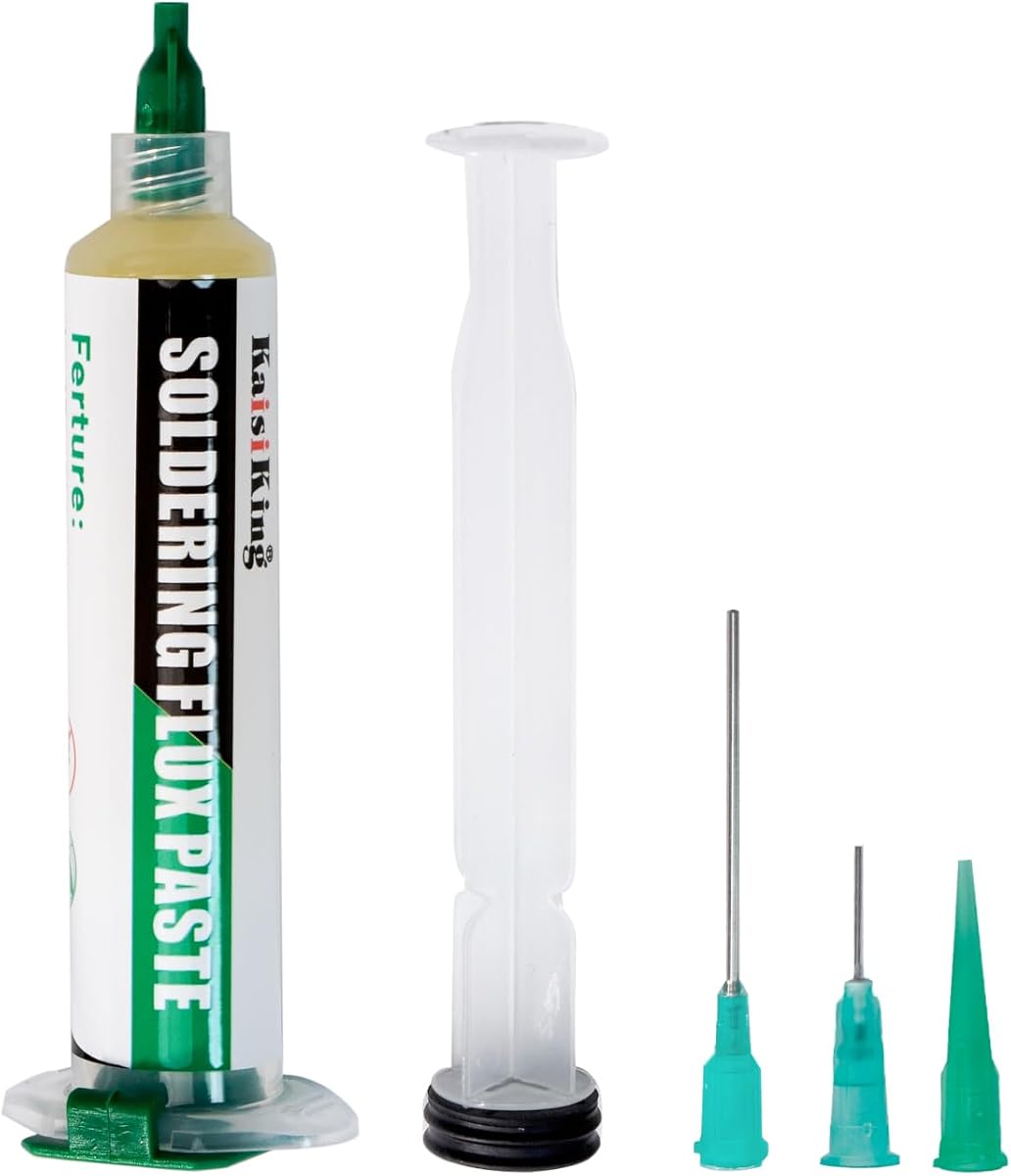
Kaisiking No Clean Soldering Flux Paste has a 4.5 rating and uses a push-type dispenser to control the flow of rosin flux. The design is more precise than applying material from an open jar, which can be useful on populated boards or when a technician wants to place a modest amount directly at a joint.
We may earn a commission when you buy through this link, at no additional cost to you.
Its listed properties include high-purity rosin materials, lead-free and halogen-free composition, low volatility, and non-corrosive behavior. The manufacturer says the paste removes stubborn oxide layers, improves wetting, and helps solder flow smoothly. It is also described as producing less smoke than some alternatives, although actual smoke levels depend on flux volume, temperature, and the solder being heated.
The product is stated to work with instruments and metals including gold, copper, tin, and iron. It supports both lead-free and lead-based solder, making it useful for older repairs as well as newer projects. Because rosin is described as nonconductive in dry conditions and as providing insulation, the paste is presented as suitable for circuit-board work where residue management matters.
This is a good pick for users who want simple, low-mess dispensing without paying for a full multi-syringe kit. The push rod releases flux gradually, and the cap can be replaced after use. The product listing does not state the included volume, so buyers who work in high volume should verify capacity before choosing it. For routine electronics soldering, however, the controlled delivery and broad material compatibility are meaningful advantages.
The push mechanism lets the user advance a small amount at a time. That control is helpful when working close to components or when a large puddle of flux would add unnecessary residue to the board.
The flux is described as usable with both lead-free and lead-based solder. That dual compatibility makes it practical for mixed collections of modern boards and older equipment, provided the soldering process follows appropriate safety practices.
We may earn a commission when you buy through this link, at no additional cost to you.
This package includes two piston-style solder flux dispensers, with each set containing a 10ml container, a plunger, and two dispensing heads. The product carries a 4.6 rating. Its main distinguishing feature is flexibility: users receive multiple head options and two complete dispensers rather than a single basic syringe.
We may earn a commission when you buy through this link, at no additional cost to you.
The flux is described as an environmental-friendly, halogen-free, non-corrosive liquid formula for electronic soldering. Good flow ability is one of its stated properties, and the product is intended for manual soldering, desoldering, PCB work, SMD and SMT components, phone repair, appliances, and instruments. The flowable formula may be useful for reaching narrow gaps or coating several surfaces before heat is applied.
The interchangeable heads can make it easier to match the dispensing style to the task. A narrower tip should suit detail work better than a broader opening, while the second dispenser provides redundancy or a separate station for a different soldering system. The included components support a straightforward apply-and-repair workflow and reduce the need to improvise tools around the container.
The primary consideration is that the material is described as liquid flux, even though the search term concerns paste. It can spread more readily than a viscous paste, so careful placement remains important. Each container is also only 10 milliliters. Nevertheless, the two-set arrangement, multiple heads, and broad repair focus make this an appealing option for users who want flexible dispensing and component replacement capability.
The included dispensing tips can be selected according to the size and location of the joint. This adds flexibility without requiring a separate set of syringes for broad and precision applications.
Each set includes a container, plunger, and two heads, so the package can support separate tasks or provide a backup. Labeling each container can also help prevent residue or contamination from being transferred between different projects.
We may earn a commission when you buy through this link, at no additional cost to you.
This Crivon-branded repair kit combines a no-clean rosin flux syringe with copper solder wick braid, earning a 4.6 rating. It is presented as a complete apply-remove-rework solution for PCB repair, SMD soldering, microelectronics, and everyday component replacement. The pairing gives a user both solder-preparation and solder-removal tools in one coordinated package.
We may earn a commission when you buy through this link, at no additional cost to you.
The flux is described as improving solder flow, reducing cold joints, supporting adhesion on pads and traces, and producing low residue. Its controlled viscosity is said to keep it stable on PCB traces while remaining easy to dispense. That balance is useful for SMD work, where liquid flux may spread and a stiff compound may not settle into the required area.
The copper braid serves the complementary removal function. When placed over an existing joint and heated, it is intended to absorb excess solder, which can help reduce solder bridges and make component extraction less difficult. The kit is therefore relevant not only for new soldering but also for correcting mistakes, removing old leads, and replacing components on assembled boards.
The product is described as compatible with most soldering tools and stations, which makes it suitable for a home bench or professional repair setup. A limitation is that no braid length is stated, and the supplied wick may not be appropriate for unusually large joints or extensive removal work. For typical electronics-scale repairs, however, the balanced combination, controlled paste, and 4.6 rating make this a versatile kit.
The paste is described as staying on traces during dispensing and then flowing under heat. That behavior supports neat application while still allowing the solder to wet the intended joint evenly.
The desoldering braid is especially relevant when removing a failed SMD component or reconnecting an old wire. It provides a practical counterpart to the flux, which is primarily used to prepare and improve the next joint.
We may earn a commission when you buy through this link, at no additional cost to you.
SOPAGRE Lead-Free Rosin Soldering Flux Paste is a compact 2oz jar option with a 4.4 rating. Its main selling points are a lead-free, non-corrosive rosin base, minimal residue, and a resealable container intended to protect the material from spills and drying. The formula is marketed for both lead-free and leaded solders.
We may earn a commission when you buy through this link, at no additional cost to you.
The paste is described as high-activity, meaning it is intended to remove oxides effectively and improve solder flow. The manufacturer lists copper, tin, and nickel among the compatible metals and says this helps produce bright, strong, reliable joints. The no-clean claim is also qualified by an emphasis on minimal, nonconductive residue rather than the suggestion that every board will look untouched.
Applications include smartphone, laptop, LED lighting, and other electronics repair. It is also suitable for soldering, desoldering, and rework, making it more than a simple new-construction product. The 57-gram container is large enough for regular projects while remaining compact enough to store in a small tool drawer or parts organizer.
This option makes the most sense for users who prefer a traditional jar and want a clearly stated lead-free formula with a resealable lid. Its listed rating is lower than the leading products in the guide, and the jar cannot match the placement precision of a needle syringe. Even so, the straightforward storage format, broad repair applications, and claimed low-residue performance make it a practical option for everyday electronics work.
The resealable jar is intended to reduce exposure to air and help prevent the paste from spilling or drying. Replacing the lid after each use is especially important because repeated opening can affect the consistency of any flux.
The stated compatibility with lead-free and leaded solders supports a mixed repair bench. Applications spanning smartphones, laptops, LED assemblies, soldering, desoldering, and rework make the jar relevant beyond a single category of project.
We may earn a commission when you buy through this link, at no additional cost to you.
The right flux depends on the joint, component scale, soldering method, and dispensing control you need. Review the following factors to narrow the field before choosing a jar, syringe, liquid dropper, or combined repair kit.
Rosin flux is the most common choice for conventional electronics work, while RA, RMA, and no-clean designations describe different activity levels and residue characteristics. The products in this guide are primarily rosin-based, with SRA 135 identified as Type RA and one dropper identified as an RMA formula. A more active flux may remove stubborn oxidation effectively, but it can also leave more residue or require additional attention after soldering.
A flux that works with one solder alloy may not be ideal with another. Many listed products support both lead-containing and lead-free solder, while some are specifically positioned for lead-free electronics. Lead-free solder generally needs a higher working temperature, so the user should also consider the solder, iron, and component restrictions rather than relying on the flux description alone.
A jar is convenient for wires, large pads, and frequent brush or tip application, but it offers less control over where the material lands. A syringe is better for small SMD pads and crowded boards because paste can be placed directly beside the joint. Liquid droppers offer fluid coverage and reach into narrow spaces, although the liquid may spread farther than expected.
No-clean flux is designed to leave a residue that is acceptable without immediate removal, but it is not literally residue-free. Most products here claim minimal residue, low residue, or non-corrosive behavior when used as directed. For sensitive analog circuits, high-voltage assemblies, RF work, or boards with manufacturer cleaning requirements, residue should still be evaluated and the appropriate cleaning process followed.
Copper, tin, gold, silver, nickel, iron, and various alloys appear among the stated compatible surfaces. That breadth is useful in a mixed repair environment, but no flux should automatically be applied to every material. Heatshrink, connectors, displays, batteries, and manufacturer-preserved components can react differently to flux, residue, heat, or cleaning chemicals.
Container size should reflect how often you solder and how precisely you need to dispense the material. Two-jar and multi-syringe packages provide redundancy, while compact 10ml dispensers work well for occasional repair. A large jar may sit unused for months, so its resealable lid and claimed storage life deserve attention. Smaller packages can also be easier to label and dedicate to specific tasks.
A complete rework station often needs more than flux. Solder wick removes existing solder, while flux improves wetting when the replacement component is installed. Several products in this guide combine the two, making them convenient for component removal, correcting mistakes, and reconnecting old wires. For very large joints, a manual solder sucker may still be more effective than braid.
Paste consistency affects both application and storage. Semi-solid material should remain in the intended area until heated, while a thin liquid may spread quickly. Syringes need tightly fitted caps, jars need clean resealable lids, and cold storage can alter viscosity. A labeled container is also useful because flux residue can contaminate later work if a tool or brush carries it to another project.
Begin with a clean, dry joint. Remove loose dirt and corrosion with an appropriate method, then apply a small amount of flux to the pad, lead, or wire. A thin, even coating is usually more useful than a thick deposit because excess flux increases residue and can create additional cleanup work.
Place the component in position, bring the soldering iron to the joint, and feed solder into the heated connection rather than directly onto the cold iron tip. Allow the flux to do its job by removing oxidation and improving wetting. When the solder flows across the intended surface and forms a cohesive joint, remove the heat and allow the connection to cool without disturbing it.
After use, reseal the container immediately and clean residue from tools according to the flux and assembly requirements. Store the paste away from heat, direct sunlight, and contamination. Keep syringe tips clear, close droppers securely, and avoid transferring flux between unrelated assemblies with the same brush or applicator.
Yes, but compatibility depends on the specific formulation. Several products in this guide explicitly support lead-free solder, including SRA 135, the two-jar rosin option, Kaisiking, and SOPAGRE. Lead-free alloys usually require a higher soldering temperature, so the iron, solder, component limits, and flux should all be suitable for the job.
No-clean flux is formulated to leave residue that can often remain on a board after soldering, whereas some other fluxes are intended to be washed away. No-clean does not mean no residue or zero corrosion risk. Critical, sensitive, or manufacturer-restricted assemblies may still require inspection and cleaning.
Paste is usually easier to place precisely and tends to stay near the intended joint, making it useful for SMD work and crowded boards. Liquid flux spreads more readily and can cover a larger area quickly, which can be helpful for larger joints. The best format depends on the size of the work and the level of control required.
In many routine electronics repairs, minimal-residue no-clean flux can remain after soldering. Cleaning may still be appropriate when residue could interfere with signal quality, coating, high voltage, conformal protection, or a manufacturer guideline. Check the board and component documentation before deciding, and avoid allowing residue to bridge conductive areas.
Use only enough to cover the area where solder needs to wet. A thin layer or small bead is generally more effective than a heavy puddle because it reaches the metal without creating unnecessary residue. For a fine SMD joint, a syringe provides better placement, while a wire or brush can work for larger pads and terminals.
Many of the products are suitable for desoldering, rework, or both, because flux helps new solder wet the prepared surface. Removing an existing joint may also require solder wick or another desoldering tool. The two combined kits are especially convenient for an apply, remove, and replace workflow.
Keep the container tightly closed, clean, and away from heat and direct sunlight. Syringes need their caps replaced, droppers need their tips secured, and jars should be resealed after each use. Some paste can thicken in cold conditions, so allow it to return to a normal consistency before judging its flow.
Flux can help remove oxidation and improve solder wetting, but a cold joint usually also needs the joint to be reheated and fresh solder added. If the connection remains dull, porous, or mechanically weak, inspect the pad, lead, and solder rather than relying on more flux alone. Excessive heating can also damage the component or board.
SRA Solder 135 stands out as the most balanced general-purpose pick because its semi-solid rosin paste supports both lead and lead-free work while remaining easy to apply to wires and circuit boards. The two-jar rosin option offers strong value for frequent users, and the four precision syringes provide the best control for SMD, SMT, and detailed rework tasks.
Prioritize the format that matches the work: use a jar for broad, convenient application, a syringe for small pads and dense boards, a dropper for fluid coverage, and a combined kit when component removal is frequent. Also check the stated solder compatibility, residue characteristics, container closure, and whether the formula suits the metals and sensitive components on the board.
Flux is a consumable, and current prices, packaging details, and availability may change. Before purchasing, verify the latest product information, confirm the included quantity, and compare the seller listing with the stated compatibility and storage instructions. That final check helps ensure the selected paste fits both the repair technique and the assembly's requirements.
