
1500W Sump Pump Battery Backup System
4.8Editor score
1500W clean sine output
Three AC outlets included
25A multi-stage charger
Wired LCD controller
This sump pump battery backup system guide compares 10 options for pumping power, battery support, monitoring, installation, and flood protection.
A sump pump battery backup system adds an important layer of protection when a primary pump loses power, a float switch fails, or severe weather overwhelms the usual drainage setup. The right system should move enough water for your sump basin, work with a suitable deep-cycle battery, and switch to backup operation without complicated controls or unsafe modifications.
The products in this guide cover complete pump-and-battery combinations, standalone DC backup pumps, and inverter-based systems that can power an existing AC pump during an outage. We compared their stated pumping output, battery compatibility, switching method, monitoring features, safeguards, installation requirements, and physical design to identify the strongest options for different households.
Each review explains the product's most useful benefits, along with any important limitations or compatibility considerations. Three standout choices are highlighted below, but the complete list also includes specialized systems for compact pits, smart monitoring, quiet operation, dual-pump coverage, and higher-capacity flood protection. Product availability and prices change, so check the current listing before purchasing.
4.8Editor score

4.8Editor score

4.6Editor score
The comparison below separates true sump-pump systems from general-purpose inverter backups and highlights the output, pump architecture, monitoring, battery support, and installation style of each product.



The Wayne Preassembled Primary & Battery Backup Sump Pump Combo System combines an AC primary with battery-ready backup capability in one indoor package. It carries a 4.5 rating and stands out for straightforward installation, strong 1/2 HP performance, and a stated maximum pumping rate of 5,100 gallons per hour.
We may earn a commission when you buy through this link, at no additional cost to you.
Its preassembled design is the central benefit for homeowners who want a complete system rather than separate components. The unit is designed for sump basins at least 16 inches in diameter and can be installed without drilling a weep hole. The listed 8-foot SJTW power cord also simplifies the connection between the pump and its protected power source.
The backup side can evacuate as much as 10,000 gallons on one charge when used with the recommended WSB1275 75 AH battery, although that battery is not included. Buyers should account for that separate requirement and verify basin clearance, discharge routing, and electrical access before ordering. Indoor use is another firm limitation.
This is an attractive choice for a household replacing both primary and backup pumps at once, especially when the installer wants a factory-assembled arrangement. Its output, installation simplicity, three-year warranty, and claim of testing to one million cycles make it a well-rounded option for properties with a conventional 1/2 HP sump-pump setup.
The preassembled format reduces the number of separate components that must be matched and installed. It is best suited to a standard basin where the stated dimensional requirements can be met without extensive modification.
The stated ability to move up to 10,000 gallons on one battery charge gives the system meaningful reserve capacity for prolonged outages. Actual results depend on the battery, starting water level, discharge lift, and cycling frequency.
We may earn a commission when you buy through this link, at no additional cost to you.
This 2500W Sump Pump Battery Backup System is one of the most versatile options in the guide. It combines automatic outage transfer, a 25A charger, pure sine wave output, and remote monitoring, earning a 4.8 rating among the strongest products reviewed.
We may earn a commission when you buy through this link, at no additional cost to you.
Because it supplies 2500 watts of clean AC power, the system can support a sump pump without requiring that pump to be a dedicated DC model. Three AC outlets, a USB port, and a Type-C port also make it useful for selected household electronics during a power interruption. The remote LCD displays battery voltage, load status, and operating mode.
Its charging architecture supports 12V LiFePO4, AGM, gel, and flooded deep-cycle batteries, with protection for overcharge, low voltage, overload, short circuit, and overheating. The battery is not included, so capacity, condition, and cable length remain the buyer's responsibility. The floating-neutral hardwire configuration also calls for careful installation by someone comfortable with electrical work.
This is the strongest all-around choice for a homeowner who already owns a dependable AC sump pump and wants one inverter to provide backup power and several emergency outlets. It offers more flexibility than a pump-specific backup unit, provided the battery, wiring, ventilation, and installation area are handled correctly.
Three AC outlets and two USB connections make the inverter more versatile than a pump-only backup product. Users should still confirm that each connected device has a compatible load and remains safe to operate on backup power.
Compatibility with four major 12V deep-cycle battery families allows owners to select a battery based on capacity, availability, and maintenance preferences. The 25A charger is designed to optimize charging while protecting the battery from common electrical faults.
We may earn a commission when you buy through this link, at no additional cost to you.
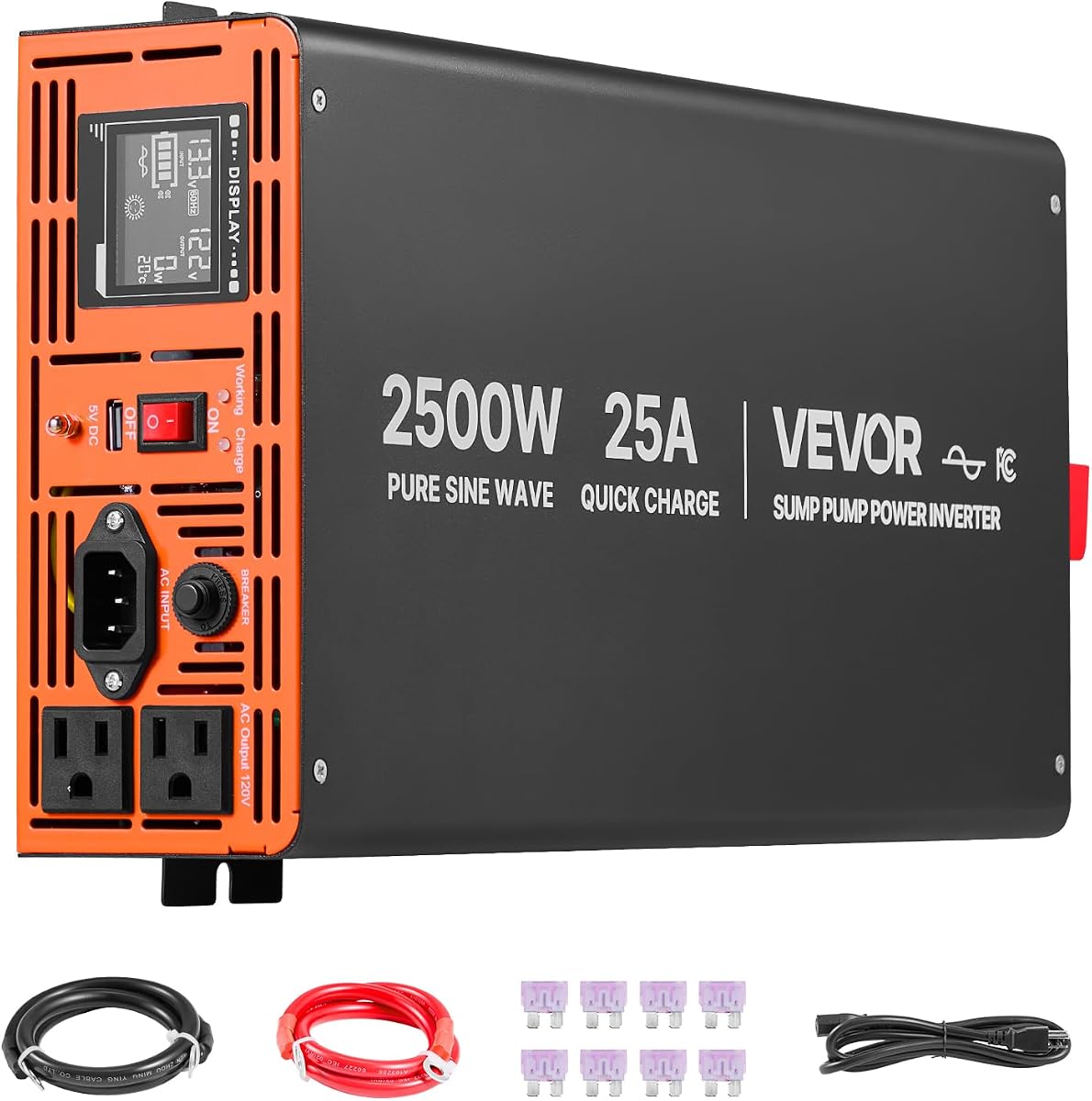
The VEVOR 2500W Sump Pump Battery Backup System is designed to power a 1 HP main pump and a 1/3 HP backup pump, giving it unusual flexibility for a high-capacity inverter. Its 4.3 rating reflects a capable design, although it sits slightly below the highest-rated products in this comparison.
We may earn a commission when you buy through this link, at no additional cost to you.
The 2500W pure sine wave output is suitable for sensitive AC equipment, and the stated dual-pump support makes the unit relevant to homes with greater-than-average drainage demand. A standard three-prong plug reduces installation complexity, while an LCD screen and LED indicators show voltage, battery level, and operating status.
The three-stage charging system supports 12V lead-acid, AGM, gel, and LiFePO4 batteries. Protection against overcurrent, overvoltage, short circuit, reverse polarity, and high temperature adds several layers of safety, and a circuit breaker provides additional protection. A deep-cycle battery is still required and is not included.
Choose this system if you want a portable-style inverter capable of serving two pumps or other moderate household loads during an outage. It is especially appealing to users who value plug-in setup and a broad battery selection, while those needing more detailed remote readouts may prefer a controller-equipped rival.
The stated support for a 1 HP main pump and a 1/3 HP backup pump is unusual among compact inverters. Verify startup demand, wiring, and the manufacturer's load guidance before operating both pumps simultaneously.
An LCD and LED indicators provide quick information about voltage, battery condition, and system status. The compact display is convenient for routine checks without requiring a phone or a separate network connection.
We may earn a commission when you buy through this link, at no additional cost to you.
The Viopumpo 2500W system provides automatic backup power for a sump pump with pure sine wave AC output and a wired LCD controller. Its 4.5 rating places it among the better-performing general-purpose backup inverters, particularly for users who want remote status information.
We may earn a commission when you buy through this link, at no additional cost to you.
The inverter's 2500W capacity is suitable for a range of typical sump pumps and inductive loads. A built-in 25A charger supports fast and trickle charging for deep-cycle lithium, AGM, and other compatible deep-cycle battery types, while excluding ordinary non-deep-cycle batteries from the intended application.
Protection against overload, overheating, short circuit, low voltage, and overcharge helps guard the inverter and connected battery. Installation is relatively approachable because the system uses supplied AC and DC cables and a plug connection for the pump, while side mounting holes permit wall-mounted or flat placement.
This model is a strong fit for basements where a remote display is more useful than a portable enclosure and where the sump pump is already known to work under AC power. The one-year warranty is shorter than the coverage stated for several alternatives, so buyers should consider the complete support package as part of the decision.
The wired controller displays voltage, power, and battery charge information, helping owners identify changes without opening the inverter enclosure. A permanent display is especially helpful for systems mounted out of easy sight.
Overload, cooling, overheat, short circuit, low voltage, and overcharge protection make the unit better suited to unattended basement duty. These safeguards do not eliminate the need for a sound battery and correct wiring.
We may earn a commission when you buy through this link, at no additional cost to you.
The Briidea Battery Backup Sump Pump System focuses on connected monitoring and an independently controlled DC pump. It has a 3.9 rating, the lowest among the ten products, but its WiFi alerts, dual sensors, and dry-run protection make it distinctive for connected-home users.
We may earn a commission when you buy through this link, at no additional cost to you.
The pump is rated to move up to 2,700 gallons per hour at zero feet of lift and 1,900 gallons per hour at a ten-foot lift. It connects in parallel with an existing primary pump and activates when the primary fails or the water rises beyond the normal level, allowing both systems to protect the basement.
Support for both 2.4G and 5G WiFi improves router compatibility, while the GeniLife app reports water levels, faults, and outage notifications. The control box has nine LED indicators, two water-level sensors, silence and reset functions, and a dry contact for alarms, security systems, or auto dialers.
This product is most compelling for owners who want to know what is happening in a finished basement while away from home. The recommended 12V 80 AH deep-cycle battery is not included, and reliable WiFi coverage is important. The lower rating may reflect a newer or less proven design, making feature fit more important than star level alone.
App-based outage notices and fault alerts can give travelers or landlords an early warning when water begins accumulating. Remote monitoring is especially valuable when the pump is installed in a finished basement or mechanical area.
Two sensors and an electronic level switch allow the control box to evaluate water conditions and pump status. The system also includes dry-run protection, which helps reduce the damage caused by continued operation without adequate water.
We may earn a commission when you buy through this link, at no additional cost to you.
The WAYNE ESP25n is a dedicated 12V backup pump for homeowners who want direct battery operation without an AC inverter. Its 4.5 rating reflects solid construction and useful anti-clog features, while the stated 10,000-gallon removal capability gives it a meaningful emergency reserve.
We may earn a commission when you buy through this link, at no additional cost to you.
The pump can deliver up to 2,700 gallons per hour at zero-foot lift and 1,680 gallons per hour at a ten-foot lift. It uses a premium reed float switch to start automatically, and the protective battery case includes an LED display and audible alarm so problems can be noticed.
Heavy-duty coated steel and cast iron are intended to withstand demanding sump-pit conditions. A top-suction design is intended to reduce debris buildup and air locks, avoiding the need for a traditional weep hole. The unit is for indoor use and works with the recommended WSB1275 battery, which is not supplied.
Choose the ESP25n when simplicity and direct 12V operation matter more than app-based monitoring. It is particularly useful as a second pump in a conventional basement where an AC primary pump is already installed and household power may fail during a storm.
Because the pump is designed for 12V DC power, it can continue working without an inverter or a continuously charged AC circuit. That simplicity is valuable in a sump pit with limited space or no suitable outlet.
The top-suction layout and rugged construction address two common sump-pump problems: debris collection and air locks. Routine basin cleaning remains necessary because no pump design can prevent every obstruction.
We may earn a commission when you buy through this link, at no additional cost to you.
The VEVOR 1500W Sump Pump Battery Backup System is a compact inverter option intended for pumps up to 3/4 HP. It has a 4.3 rating and provides pure sine wave output, automatic switching, three-stage charging, and a straightforward plug-based installation.
We may earn a commission when you buy through this link, at no additional cost to you.
Its 1500W capacity is adequate for many common residential sump pumps, and the clean sine wave is suitable for motor loads and sensitive electronics. An AC outlet and USB port allow the inverter to support a pump and a modest emergency device, although the available output should be monitored carefully.
The charging process uses bulk, absorption, and float stages, supporting 12V lead-acid, AGM, gel, and LiFePO4 batteries. An LCD and LED indicators report voltage, battery level, and operating status. A circuit breaker plus protection for overcurrent, overvoltage, short circuit, reverse polarity, and high temperature provide layered safeguards.
This is a practical choice for basements where a smaller pump and limited space make a 2500W inverter excessive. It offers a clean and convenient power source, but users should verify startup requirements and avoid continuously operating loads near the inverter's maximum rating. The deep-cycle battery is not included.
Supporting pumps up to 3/4 HP covers a common range of household sump pumps while keeping the inverter smaller than a 2500W model. Starting surge and simultaneous loads should still be checked against the stated limit.
Bulk, absorption, and float stages help manage charging across four common 12V battery types. This gives owners flexibility while reducing the need to rely on a separate basic charger.
We may earn a commission when you buy through this link, at no additional cost to you.
The 1500W Sump Pump Battery Backup System combines a high 4.8 rating with useful multi-outlet functionality. It automatically transfers an existing pump to battery power after an outage, then recharges the battery when utility power returns, making it a flexible value-oriented choice.
We may earn a commission when you buy through this link, at no additional cost to you.
Pure sine wave output provides stable AC for a standard residential sump pump, while three AC outlets, a USB port, and a Type-C port can serve selected essentials. A wired LCD remote provides battery voltage, load level, and operating-mode information, offering more visibility than a basic switch-only inverter.
The 25A multi-stage charger supports LiFePO4, AGM, gel, and flooded deep-cycle batteries. Overcharge, overload, short circuit, low-voltage, and overheat protection are included. The package contains the inverter, 31.5-inch battery cables, an AC power cord, remote controller, and manual, but no battery.
This model is a compelling selection for a typical home with a moderate sump pump and no need for dual-pump capacity. Its three AC outlets provide useful emergency utility, while 1500W keeps the system more manageable than a higher-output alternative. The floating-neutral hardwire terminals should only be handled by a qualified installer.
Three AC outlets and two USB connections make this a compact outage-power hub as well as a sump-pump inverter. Check surge requirements and avoid operating high-load appliances together with the pump.
The combination of remote monitoring, pure sine output, broad battery support, and a 25A charger delivers many benefits found in larger-capacity systems. It is a sensible middle ground for appropriately sized pumps.
We may earn a commission when you buy through this link, at no additional cost to you.
The Westinghouse WH50BBU is a complete primary-and-backup installation with a 1/2 HP AC pump, a high-flow DC backup pump, and an integrated vertical float switch. Its 4.6 rating and stated 5,200-gallon-per-hour output place it among the strongest dedicated pump combinations.
We may earn a commission when you buy through this link, at no additional cost to you.
The AC primary handles routine drainage while the battery-powered pump takes over automatically when power is lost. Both pumps use corrosion-resistant stainless steel housings, and the primary's PSC motor includes thermal overload protection, lubricated ball bearings, and a sealed shaft for dependable operation.
A top-suction intake helps reduce air locks and debris buildup, while the motor's dielectric-oil enclosure supports cooling and service life. Despite its power, the system is designed to fit relatively tight sump pits and is suitable for residential basements and light commercial applications.
This is the premier all-in-one option for someone who wants a capable primary pump and independent DC backup rather than an inverter that powers an existing pump. The battery is not included, and installation must accommodate both pumps and their discharge arrangements. Buyers should verify pit dimensions and required clearances before ordering.
Combining a primary AC pump and a separate DC backup removes the need to decide whether an inverter or backup pump architecture best fits the property. The automatic handoff protects against power loss without sacrificing everyday drainage.
Stainless steel housings, thermal overload protection, sealed shafts, lubricated bearings, and oil-assisted cooling reflect a focus on durability. Routine inspection, cleaning, and battery maintenance remain necessary to realize that potential.
We may earn a commission when you buy through this link, at no additional cost to you.
The Zoeller 508-0005 Aquanot 508 is a purpose-built 12V battery backup sump-pump system with a 4.4 rating. Its strengths are centered on straightforward pump construction rather than the digital monitoring and multi-outlet features found in inverter-based competitors.
We may earn a commission when you buy through this link, at no additional cost to you.
The listed design uses 12V highly efficient, noncorrosive pump construction and includes an integrated check valve. A quick-disconnect discharge simplifies removal and service, while an aluminum seal pocket and cooling plate support heat management in the confined sump environment.
The product is hand-built and tested in the USA according to its listed specifications. It is a direct battery pump, making it a logical second pump for homes with an existing AC primary. It does not provide a 1500W or 2500W inverter, multiple household outlets, or the app-based monitoring offered by smart systems.
Choose the Aquanot 508 when durable DC pumping, quick service access, and established sump-pump engineering matter most. The available information is concise, so buyers should review the current product page for exact flow, fit, battery, and included-component details before making a final selection.
The integrated check valve and quick-disconnect discharge reduce the number of separate connections and make maintenance more convenient. Routine cleaning remains important for any sump pump exposed to sediment and debris.
Rather than converting AC to DC or AC to AC, the system operates directly from a 12V source. That focused architecture can offer straightforward backup protection for an existing primary pump.
We may earn a commission when you buy through this link, at no additional cost to you.
The right backup system depends on your pump, basin, battery, discharge route, and monitoring needs. Compare architecture and capacity first, then examine installation constraints, safety features, and the ongoing maintenance required to keep emergency protection operational.
Choose direct DC for simplicity or an inverter for broader emergency-power use. Combo systems suit homes planning a full upgrade.
Match capacity to basin size, groundwater intrusion, and pump horsepower. Do not rely on maximum zero-foot flow alone.
Select a compatible deep-cycle battery and confirm charger support. Plan for periodic testing and eventual replacement.
Choose local displays for simplicity or smart alerts for remote awareness. Verify network compatibility before relying on app-based monitoring.
Measure before buying and follow all wiring restrictions. Never connect hardwired inverter terminals to utility or generator power.
Prefer systems with layered electrical protection. Keep the battery, connections, and float mechanism maintained as well.
Confirm basin dimensions, discharge direction, and float clearance. Leave enough room for cleaning and future repair.
Test the system regularly and keep the battery, basin, and connections maintained. Compare warranty and support with long-term replacement needs.
Begin by identifying the pump's horsepower, starting power, voltage, and required flow at the actual discharge lift. For an inverter, confirm that its continuous and surge ratings can handle the pump. For a DC backup, confirm battery voltage, cable polarity, and controller compatibility. Position the pump above the basin floor, secure the discharge, and ensure the float can move freely without obstruction.
Connect the system according to the supplied manual. Keep battery cables away from sharp edges and moving parts, tighten terminals as directed, and observe polarity. If a hardwired AC output is used, follow the inverter's terminal labels and grounding instructions exactly. Never connect a hardwire output terminal to utility or generator power, and do not use a wiring arrangement outside the manufacturer's instructions.
Test the installation before relying on it. Simulate an outage using the manufacturer's test method, confirm that the primary or backup pump starts, and verify that the battery receives a normal charge after utility power returns. Clean the basin regularly, inspect the float, remove sediment, test the battery under load, and replace aging batteries before they can no longer support the required runtime. Record the test date and respond promptly to alarms or fault indicators.
In most of the products reviewed, the deep-cycle battery is not included. The pump-specific systems generally require a 12V deep-cycle battery, while the inverter models also use 12V power but may accept several chemistries. Check the listing for the recommended capacity and verify charger compatibility before buying a battery.
Yes, if the backup product is an inverter with enough continuous and surge capacity. It stores energy in a 12V deep-cycle battery and converts that energy to AC for the pump. Check the pump's running and startup requirements, and avoid exceeding the inverter's output limits.
The correct size depends on pump power, basin size, outage duration, and expected cycling. A larger battery can provide longer runtime, but it must also match the system's charging and wiring requirements. Follow the product's recommended capacity and use a deep-cycle battery intended for repeated charging and discharge.
Test the system regularly throughout the year and after any maintenance, storm, or extended outage. Follow the manufacturer's test procedure, confirm that the backup pump starts, and verify battery charging afterward. Quarterly checks are a useful starting point, while more frequent testing may be appropriate in homes prone to flooding or used as seasonal properties.
WiFi is not necessary for the pump to remove water, but it can provide valuable remote alerts about outages, faults, and rising water. Local LED or LCD indicators remain valuable, and a smart system should not replace periodic physical testing. Make sure the router supports the stated 2.4G or 5G band before purchasing.
Some high-output models state that they can support a 1 HP main pump and a 1/3 HP backup pump, but that does not mean they can operate both indefinitely at full load. Startup surge, running power, battery capacity, and manufacturer limits must all be considered. Confirm compatibility with the installer and avoid exceeding published output.
The check valve prevents water from flowing backward into the pit, while the float switch tells the pump when the water has reached the activation level. Both components must function correctly. A stuck or failed float can stop pumping even when the pump and power supply are healthy.
Battery and plug-in DC systems can be approachable for a confident homeowner, but basin, float, discharge, and electrical work can introduce flooding or shock risks. Inverter hardwiring and floating-neutral configurations may warrant a qualified electrician. Follow local electrical rules, the product manual, and manufacturer warnings.
The 2500W Sump Pump Battery Backup System for Basement Flood Protection is the most versatile general-purpose option, combining automatic transfer, a 25A charger, clean sine wave output, and useful remote monitoring. The 1500W version is a strong value choice for typical residential pumps, while the Westinghouse WH50BBU stands out as the most complete dedicated primary-and-backup pump system.
Prioritize the architecture that matches your existing equipment, then verify output against pump startup demand, real lift, and expected inflow. Battery chemistry, capacity, monitoring, protection, and installation clearance are just as important as the headline wattage. A dedicated DC pump may be the simplest option, while an inverter can provide useful emergency power beyond the sump pit.
Before ordering, measure the basin, check the discharge route, review battery requirements, and read the installation instructions carefully. Product specifications, included accessories, availability, and prices can change, so verify the current Amazon listing and seller information before making a final purchase decision.