
KIWITATA 2X Classic SNES USB Controller
4.3Editor score
Driver-free USB connection
Broad computer compatibility
Frosted concave D-pad
Five-foot wired cable
Explore the best Snes Nes Emulator Controller options, comparing compatibility, connectivity, controls, battery life, features, and setup ease for retro gaming.
A SNES and NES emulator controller should make classic games feel natural while adding the responsiveness modern computer hardware demands. The right choice depends on platform support, wired or wireless operation, button mapping, D-pad construction, battery life, and whether you need compatibility with original Nintendo hardware. Retro styling alone does not guarantee a satisfying experience.
This guide compares ten controllers and one complete retro gaming system based on the supplied specifications, including supported systems, connection methods, control layouts, charging details, range, and setup requirements. It covers USB gamepads, 2.4GHz wireless controllers, Bluetooth models, a multi-mode original-SNES controller, and a preloaded console for readers considering an all-in-one alternative.
Each review explains who the product is best suited for, along with the compromises that may matter at purchase time. The top selections highlight a practical wired budget pick, a feature-rich wireless option, and a versatile controller for original-console and computer use. Product availability and prices can change, so verify the current listing and compatibility details before ordering.
4.3Editor score

4.7Editor score

The comparison below places every listed option by connection type, platform coverage, control features, and practical setup demands, making it easier to identify the right controller for a particular retro-gaming setup.




The KIWITATA 2X Classic SNES USB Controller earns a 4.3 rating and stands out as a straightforward, budget-conscious way to add familiar retro controls to a computer. Its classic SNES-inspired face features a frosted concave cross-shaped D-pad, face buttons, and a layout that is designed to follow the contour of the hands. The package includes two controllers, making it more useful for local multiplayer than a single-controller purchase.
We may earn a commission when you buy through this link, at no additional cost to you.
Its wired USB 2.0 connection eliminates charging, wireless interference, and pairing concerns. The controller works with Windows systems ranging from older releases through Windows 11, as well as macOS, Linux, and Raspberry Pi. A 1.5-meter, or five-foot, cable provides room to sit comfortably at a desk. The supplied information also says no driver installation is needed, although an emulator must already be installed and its controls configured manually.
The main limitation is that this is a third-party USB controller rather than a replacement for an original SNES pad. It will not connect to the Super Nintendo console, and the emulator must recognize the controller as a standard USB gamepad. Button assignments and directional axes are not assigned automatically. That setup requirement makes it slightly less convenient than a controller with broad preset support, but it remains reasonable for anyone comfortable adjusting emulator input options.
This is a strong recommendation for new emulator users who want two traditional-looking wired pads without dealing with batteries or wireless receivers. It suits Windows, Mac, Linux, and Raspberry Pi setups that can accommodate a five-foot cable. For original-console use or buyers who want automatic mapping, one of the wireless or multi-platform models will be a better fit.
Two included controllers immediately expand the options for couch multiplayer, provided the games and emulator support multiple pads. A physical connection also removes the need to charge batteries or troubleshoot a wireless link during a session.
The concave frosted D-pad is designed to resist slipping and improve directional control, while the traditional face-button arrangement makes it approachable for fans of 16-bit and 8-bit games.
We may earn a commission when you buy through this link, at no additional cost to you.
The ZAMPAM 2 Pack Wireless SNES Controllers carry a 4.0 rating and offer a useful combination of retro styling, wireless freedom, and broad platform coverage. Two controllers are included, so the set is well suited to multiplayer games when the selected software supports more than one player. Their familiar SNES-style layout should also appeal to players who prefer physical buttons and a traditional D-pad.
We may earn a commission when you buy through this link, at no additional cost to you.
Connection is handled through 2.4GHz technology and a USB receiver. The listed range reaches 10 meters, or 32 feet, providing enough freedom to move around a room without depending on a short cable. The controllers are compatible with Windows PC, Mac OS, Linux, Raspberry Pi, RetroPie, Recalbox, and Switch 1, making this one of the more versatile sets in the roundup. They also support common emulators and retro platforms such as RetroArch, BSNES, and OpenEmu.
The built-in 240mAh rechargeable battery provides up to three hours of continuous play and recharges in about one hour. A battery-level indicator is a welcome convenience, although three hours is shorter than the runtime claimed by several competing wireless controllers. As with other USB gamepads, the software must support a standard controller, and the precise behavior of the Start and Select buttons can depend on the emulator.
This set is a good fit for players who want wireless controllers for a computer but also value the option of using the pads with Switch 1. It is less suitable for long sessions without a charging opportunity or for anyone hoping to use the controllers with Switch 2. The two-controller bundle and receiver-based operation make it a practical choice for shared retro setups.
The included USB receiver uses 2.4GHz radio technology, so players can move away from the computer while retaining a familiar wired-style connection method. The stated range of up to 10 meters is suitable for living-room or desk-based play.
Support for PC, Mac, Linux, Raspberry Pi, RetroPie, Recalbox, and Switch 1 gives the pair a broader role than a basic computer-only gamepad. Check the specific console or emulator before assuming every function is identical.
We may earn a commission when you buy through this link, at no additional cost to you.
The miadore 2 Pack USB SNES Controller has a 4.4 rating, the highest among the dedicated third-party SNES-style controllers in this list. It offers a traditional gaming experience with an eight-way directional pad, six digital face buttons, concave X and Y buttons, convex A and B buttons, and separate Start and Select controls. The pair is designed for Windows, Mac, Linux, Raspberry Pi, RetroPie, and other systems that accept standard USB gamepads.
We may earn a commission when you buy through this link, at no additional cost to you.
The controllers connect through a five-foot USB cable and require no separate driver or software installation. That makes setup more predictable than options that depend on added mapping utilities. The supplied guidance does note that the controller should be connected before launching an emulator and that the input settings may still need to be mapped, which is normal when software does not automatically identify a new gamepad.
Its authentic-inspired button arrangement gives it a clear advantage for people recreating the feel of an older console. It is also practical for a variety of retro genres, including SNES, NES, PlayStation, Atari, and Genesis games when the relevant emulator is available. As a third-party product, however, it is not an original Nintendo controller and should not be expected to work with an original SNES or NES console.
The miadore set is a strong recommendation for families, shared computers, and Raspberry Pi collections that need two familiar controllers. Its 4.4 rating, broad retro-platform support, and cable-based simplicity make it especially appealing to users who prefer not to manage wireless pairing or charging. Buyers should remain prepared to complete an initial mapping step in the emulator.
The contrasting concave and convex button shapes provide tactile cues similar to classic 16-bit controllers. That makes the layout easier to master when playing action games or any title that benefits from accurate directional and face-button inputs.
With two pads in the package, this is a practical choice for local multiplayer. The attached five-foot cables allow comfortable separation on a desk or coffee table without requiring additional receivers or battery management.
We may earn a commission when you buy through this link, at no additional cost to you.
The Wireless USB SNES Controller Multi-Color has a 4.2 rating and emphasizes a longer wireless playing time than most of the 2.4GHz alternatives in this roundup. Two controllers, USB receivers, charging cables, and a user manual are included, providing most of the accessories needed to begin using the set with a compatible computer.
We may earn a commission when you buy through this link, at no additional cost to you.
The controllers use 2.4GHz wireless communication with a stated range of 10 meters, or 33 feet. They are intended for retro emulators on Windows PC, macOS, Linux, and Raspberry Pi. Compatible systems recognize the supplied USB receiver without requiring drivers, while sensitive buttons are intended to support precise control. A built-in rechargeable battery is claimed to deliver up to ten hours of runtime.
The compatibility boundaries are important. The supplied information explicitly excludes Android TV Box, Fire TV, Chromebook, SteamOS, Tesla, C64, and Switch. The reason given for Switch exclusion is a lack of the required button configuration, so this should not be purchased for Nintendo Switch use even if the appearance resembles a console pad.
This set is a good recommendation for anyone who wants wireless freedom and long sessions without frequently recharging. It works especially well for multi-session retro gaming on a Windows, macOS, Linux, or Raspberry Pi system. The two-controller arrangement and ten-hour runtime also make it attractive for couch multiplayer, provided the target platform is on the supported list.
The claimed ten-hour runtime is the defining advantage of this model. It is well suited to long retro-gaming evenings and sessions where pausing to recharge would interrupt play.
The USB receivers allow the controllers to connect without visible cables while still presenting a familiar computer-gamepad connection. Plugging the receiver into a compatible system should be the primary setup step.
We may earn a commission when you buy through this link, at no additional cost to you.
The ZAMPAM Wireless Turbo Controller carries a 4.2 rating and combines a 2.4GHz connection with programmable turbo functions. It is described as compatible with Windows, iOS, Linux, and Android devices that use an emulator, giving it a potentially useful mobile and desktop audience. A USB wireless receiver is included for systems requiring that form of connection.
We may earn a commission when you buy through this link, at no additional cost to you.
Wireless range reaches 24 feet, while the built-in rechargeable lithium-ion battery is claimed to last around 100 hours. The standout feature is a programmable turbo function: holding Select and one of the A, B, X, or Y buttons can enable or disable rapid input for that selected face button. This can be helpful in certain arcade-style or retro titles, although it is not a universal requirement for NES and SNES games.
The controller has a more involved setup process than the simplest USB gamepads. The supplied instructions recommend downloading software such as Joystick Mapper to configure the keys, particularly when using the wireless receiver. It also explicitly does not work with the Mini SNES or Super Nintendo, despite its retro-inspired appearance. These limitations should be understood before purchase.
This ZAMPAM model is best for users who want a wireless controller with configurable turbo behavior across several operating systems. It is less attractive for plug-and-play simplicity because the mapping utility may be required, and it is unsuitable for original Nintendo hardware. For those who value custom functions over immediate setup, however, it offers a flexible feature set.
Selectable turbo functions can save repeated presses in compatible games. The mapping method gives users control over which face button carries the function, although accidental activation should be considered when playing.
The stated support for Windows, iOS, Linux, and Android makes the controller relevant beyond a single desktop platform. Each target still needs compatible software and a working receiver or supported connection path.
We may earn a commission when you buy through this link, at no additional cost to you.
The 8Bitdo SN30 Pro earns a 4.7 rating, making it the highest-rated dedicated controller in the roundup. It combines a retro-inspired appearance with a surprisingly modern feature set: clickable Hall Effect joysticks, a proper D-pad, rumble vibration, motion controls, Bluetooth, a rechargeable battery, Home and screenshot buttons, and a USB-C connection. It is designed for players who want more than a basic emulator pad.
We may earn a commission when you buy through this link, at no additional cost to you.
Platform support is one of its strongest attributes. The controller is listed for Switch, Windows, Steam Deck, Android, Raspberry Pi, iPhone, iPad, macOS, and Apple TV, with those Apple platforms described as officially supported. Users can rely on Bluetooth for wireless play or connect by cable. The 480mAh rechargeable battery provides up to 18 hours of play and requires approximately one to two hours for a full charge.
The Hall Effect joysticks are intended to deliver higher precision and sensitivity, while the dual micro-vibration motor supplies different effects depending on the game scene. Six-axis motion controls and a programmable turbo function add further flexibility. The controller measures 144 by 63.5 by 32.5 millimeters, making it reasonably portable, and firmware updates are supported.
The SN30 Pro is the strongest overall recommendation for a versatile retro-gaming setup, especially for users who alternate among emulators, a Switch, a Steam Deck, and mobile devices. It is less compelling for someone seeking only the simplest original-SNES-style wired experience, and it should not be assumed to support proprietary original-console ports. Its platform breadth and feature depth make it especially well suited to experimentation.
Rumble, motion sensing, programmable turbo, clickable sticks, and dedicated function buttons expand what a conventional retro gamepad can do. These features are useful when moving between classic emulators and modern platforms.
Bluetooth and USB-C connectivity make the SN30 Pro easy to carry between supported computers, handhelds, tablets, and other devices. Broad platform support is its clearest advantage over simpler USB-only alternatives.
We may earn a commission when you buy through this link, at no additional cost to you.
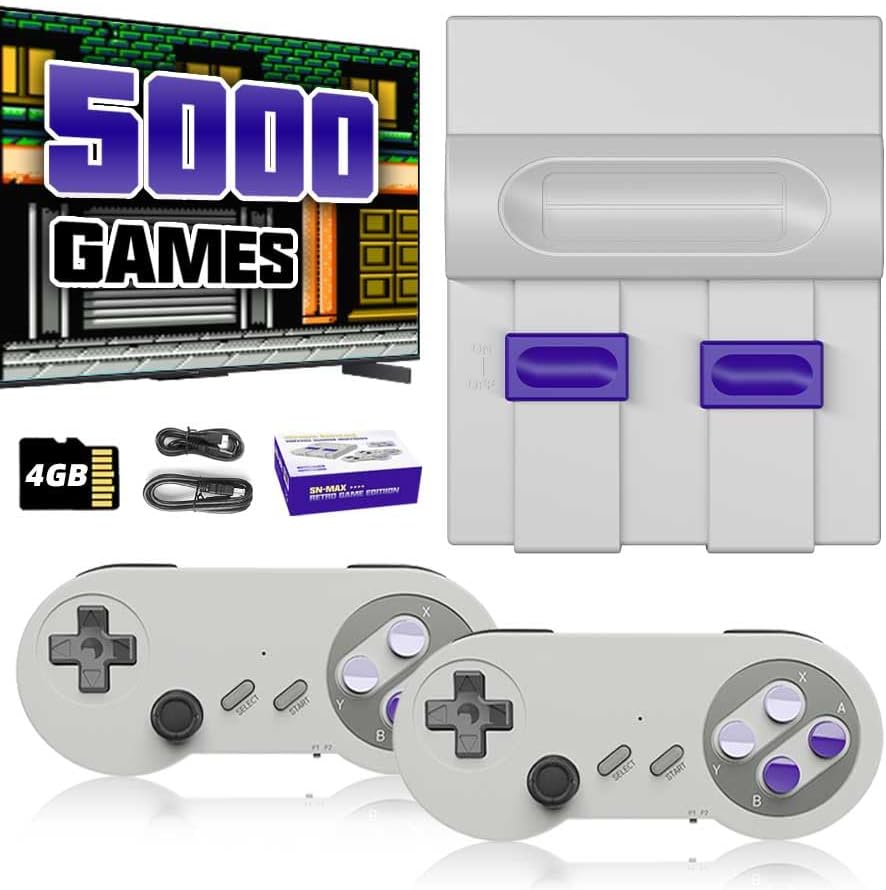
The Retro Game Console with 5000 Games has a 3.5 rating and is a different kind of solution from the individual controllers elsewhere in this guide. It is a standalone retro gaming system with a preloaded selection of 8-bit and 16-bit style games, an HDMI-compatible television connection, and two included controllers. It does not act as a USB gamepad for a computer.
We may earn a commission when you buy through this link, at no additional cost to you.
The appeal is immediacy. Because the games are preloaded, users can connect the system to a television and begin playing without downloading emulators, configuring ROM collections, or assigning computer inputs. The supplied information describes it as a plug-and-play console designed to reproduce the pixel-art visuals and sound associated with older gaming eras. Compatibility with 4K HDMI displays is also stated.
This setup is convenient for casual players, families, or anyone who wants a self-contained TV gaming experience. However, it does not provide the flexibility of a computer-based emulator library, and it is not the right purchase for a PC gamer seeking a peripheral. The lower 3.5 rating and more limited supplied feature detail also make it harder to evaluate in terms of controller precision and long-term software support.
The console is best for users who value immediate access to classic games more than customizable emulation or precise third-party controller support. It is less suitable for anyone who already has an emulator setup or wants a durable SNES-style pad for Windows, Mac, Linux, or Raspberry Pi. In this roundup, it works best as an alternative category rather than a direct substitute for an emulator controller.
The preloaded library removes the largest obstacle for newcomers: configuring emulators and game files. Connecting the console and using the included controllers is the central appeal.
This console focuses on immediate console-style entertainment rather than peripheral performance. Its inclusion of two controllers supports the idea of sharing a living-room session without assembling a PC controller setup.
We may earn a commission when you buy through this link, at no additional cost to you.
The Wireless USB SNES Controller Purple/Gray carries a 4.2 rating and provides the same core proposition as the related multi-color set: two 2.4GHz controllers, a receiver-based computer connection, and a claimed ten-hour rechargeable battery runtime. The purple-and-gray color combination gives it a distinctive retro appearance while retaining the familiar directional pad and face-button layout.
We may earn a commission when you buy through this link, at no additional cost to you.
The controllers are intended for emulators on Windows PC, macOS, Linux, and Raspberry Pi. Their wireless range is stated at 10 meters, or 33 feet, and the package includes the controllers, USB receivers, charging cables, and a user manual. Compatible devices do not require additional drivers, and the high-sensitivity buttons are intended to support accurate inputs.
Compatibility is narrower than the product's broad retro appearance might imply. The supplied details exclude Android TV Box, Fire TV, Chromebook, SteamOS, Tesla, C64, and Switch. The Switch limitation is specifically attributed to a missing required button configuration, so buyers interested in Nintendo hardware should choose a model expressly designed for it.
This set is a sensible choice for two-player computer retro gaming where wireless movement and long battery life are priorities. It works well for users on the listed desktop and Raspberry Pi systems and avoids the charging interruptions associated with shorter-runtime wireless pads. The main reason to choose it over the similar multi-color model would be its color scheme; its core specifications are closely aligned.
The two-controller package supports local multiplayer and makes it easier to keep a dedicated pad available for each player. Each controller connects wirelessly through the supplied receiver system.
With a stated runtime of up to ten hours, the built-in batteries should support multiple shorter sessions or a lengthy evening of play. Included charging cables help keep both controllers ready.
We may earn a commission when you buy through this link, at no additional cost to you.
The ZAMPAM 2 Pack 2.4GHz Wireless USB Controllers have a 3.9 rating and focus on two-player flexibility with programmable turbo functions. Two wireless gamepads are included, along with a USB receiver connection for compatible computers. The listed platforms are PC, Mac, Linux, and Raspberry Pi-style gadget use, depending on the software and receiver configuration.
We may earn a commission when you buy through this link, at no additional cost to you.
The 2.4GHz system has a stated range of up to 10 meters, and each controller uses a built-in rechargeable lithium-ion battery. The claimed battery endurance is around 100 hours of playing time. A turbo function can be assigned to selected rapid-fire inputs, with the included manual providing instructions for configuring and canceling it. This is useful for games that reward repeated action, though it is not essential for most standard NES and SNES library play.
The setup process may require a utility such as Joystick Mapper, especially when using the USB wireless adapter. The controllers also do not support the original Super Nintendo, Mini NES, or NES Classic Edition. These limitations place the set firmly in the computer-emulator category rather than the original-console accessory category.
This two-controller set is a practical option for shared PC, Mac, or Linux retro sessions where customizable turbo inputs are useful. Its lower rating and potentially more involved configuration make it less compelling than the simplest wired options for beginners. The strongest case for it is multiplayer use combined with wireless operation and user-selectable rapid button functions.
Users can decide which buttons act as turbo inputs and cancel the function if it is activated unintentionally. Reading the included manual is worthwhile because rapid input changes how a button behaves.
Two wireless controllers reduce cable clutter and support local two-player games. Their computer focus makes them suitable for emulators rather than proprietary Nintendo console connections.
We may earn a commission when you buy through this link, at no additional cost to you.
The KIWITATA Wireless Original SNES Controller is the only dedicated controller here explicitly designed to bridge original Super Nintendo hardware and computer use. It includes both a USB dongle for 2.4GHz wireless computer connection and a seven-pin SNES adapter for use with the Original SNES Entertainment System. The supplied information does not include a numerical customer rating, so its evaluation here relies on its stated features and compatibility.
We may earn a commission when you buy through this link, at no additional cost to you.
The controller uses a 2.4GHz wireless connection with a listed range of up to 30 feet. Its built-in 3.7-volt, 500mAh lithium-ion battery is said to operate for more than ten hours. Pairing is described as straightforward, followed by plugging the appropriate adapter into the relevant console or USB port and pressing Start. The included USB dongle supports Windows systems from Windows 98 through Windows 11 and macOS 10.0 or later.
Raspberry Pi support is also listed for several Pi models, including the Raspberry Pi 1 Model A+, Model B, Raspberry Pi 2 Model B, Raspberry Pi 3 Model B, Zero W, and Pi 4. The familiar concave frosted D-pad and hand-shaped body preserve a traditional feel, while wireless operation eliminates the need to remain directly beside an original console.
This is the premium recommendation for owners of original SNES hardware who also want a wireless controller for PC or Mac emulation. It is less appropriate for modern mini-console variants, which have different ports and button requirements. Because it bridges two distinct use cases, careful attention to the included adapters and the type of original hardware is essential before purchase.
The included seven-pin connector adapter allows the controller to work with an original SNES console while preserving wireless freedom. This makes it a specialized choice rather than a generic replacement pad.
The USB dongle transforms the same controller into a wireless computer gamepad for supported Windows and macOS systems. Raspberry Pi compatibility expands the potential role of the controller in a retro-gaming collection.
We may earn a commission when you buy through this link, at no additional cost to you.
The best emulator controller is the one that matches your hardware, preferred connection method, and tolerance for setup. Platform support, control precision, wireless range, battery life, and original-console compatibility should be considered together rather than as isolated specifications.
Choose only after checking the complete device list, not just the headline platform names.
Prioritize confirmed support for your exact setup.
Choose wired for reliability and zero charging.
Choose wireless for room-freedom and comfort.
Prefer a distinct, well-shaped D-pad.
Check analog placement for mixed libraries.
Bundle two controllers for local multiplayer.
Verify software supports simultaneous players.
Compare runtime against typical session length.
Check charger and cable inclusions.
Never infer console support from appearance.
Match the exact model and connector.
Match advanced features to supported software.
Check setup utilities before buying.
Use legally obtained game files.
Prioritize control quality over extras.
Begin by confirming that your computer or Raspberry Pi is running a supported operating system, then install a compatible emulator and legally obtained game file. For a wired controller, connect the USB plug before opening the emulator. For a 2.4GHz model, charge the controllers, insert the supplied receiver into the correct USB port, and perform the indicated pairing procedure. Bluetooth controllers may require the operating system to discover the controller before the emulator can use it.
After the controller is recognized, open the emulator's input or controller settings. Assign each directional input and face button to the appropriate command, including Start and Select where applicable. Some standard USB pads work automatically, while others require manual configuration. Test the full range of directions and every button in a simple title before beginning a longer game. If inputs do not register, reconnect the controller, restart the emulator, or revisit the mapping screen rather than assuming a defective pad.
For wireless models, recharge the controllers before long sessions and keep the receiver in a clear position with minimal obstruction. Avoid pressing turbo combinations unintentionally, and review the manual when a rapid-fire mode does not behave as expected. Keep wired cables untangled, clean the controllers with a soft dry cloth, and avoid moisture around ports and buttons. For original-console use, confirm that the adapter matches the console model and power the system only after the controller is connected and paired.
Usually, yes, provided the emulator recognizes a standard USB gamepad and the controller is mapped correctly. Most modern systems use standard directional and face-button commands rather than requiring a dedicated NES controller. Connect the pad before launching the emulator, then check its input settings if any direction or button does not respond.
The listed wired and 2.4GHz USB controllers generally do not require separate drivers on compatible devices. Their primary setup involves plugging in the controller or receiver and configuring the emulator. The ZAMPAM models may also require mapping software such as Joystick Mapper for some systems or connection modes.
Several models in the guide list Raspberry Pi support, including the wired KIWITATA, the ZAMPAM 2.4GHz sets, the original-SNES KIWITATA wireless controller, and the 8Bitdo SN30 Pro. Use a compatible receiver or Bluetooth connection and configure the input within RetroPie or another front end as required.
Most of the third-party USB pads in this guide are designed for emulators and are not compatible with original Nintendo hardware. The KIWITATA Wireless Original SNES Controller is specifically supplied with a seven-pin adapter for the Original SNES Entertainment System. Mini consoles, NES Classic models, and other modern variants have different connectors and requirements.
No. Bluetooth provides freedom from cables and supports convenient switching among compatible devices, but a wired controller is usually simpler and avoids charging and pairing concerns. The best choice depends on whether you value mobility or dependable plug-and-play use more, as well as the platforms you use.
Many emulators need the controller connected before the software starts, and new gamepads may not receive automatic assignments. Open the emulator's controller settings and map the directions, face buttons, Start, and Select commands. Restarting the emulator after connecting the controller can also help it detect the pad.
Stated runtime varies substantially across the products in this guide, ranging from about three hours to as much as 18 hours, with some ZAMPAM models claiming around 100 hours. Actual performance depends on battery condition and use. Check the specific listing and included charging accessories before planning long sessions.
The Retro Game Console with 5000 Games is described as coming with preloaded 8-bit and 16-bit classic games, so it is intended to work without separate downloads or installations. The dedicated controller products in this guide are peripherals and do not include emulator software or game files.
The best overall option is the 8Bitdo SN30 Pro because it combines the highest listed rating with Bluetooth, USB-C, Hall Effect sticks, a proper D-pad, rumble, motion controls, and support for a wide range of computers, handhelds, tablets, and consoles. For buyers who want the simplest affordable wired experience, the KIWITATA two-controller set is the strongest budget recommendation, while the miadore set offers a similarly approachable alternative with a 4.4 rating.
Wireless players should compare the long-running 2.4GHz sets, particularly the multi-color and purple/gray models with claimed ten-hour runtimes, against the ZAMPAM options with programmable turbo controls. Owners of original SNES hardware have a more specialized path: the KIWITATA wireless original-SNES controller includes both a console adapter and a USB dongle. In every case, confirm the exact operating system, emulator, connection method, and physical console before ordering.
Product prices, availability, and configurations can change, so review the current listing before making a purchase. Also read the included instructions, complete the required button mapping, and check all compatibility exclusions. Those small steps prevent most disappointments and make it easier to enjoy a comfortable, responsive controller experience across favorite retro games.
