
GiveBest Smart Wall Heater
4.3Editor score
1500W heating capacity
Wi-Fi app control
Space-saving wall mount
Tip-over and overheat protection
Discover the best 110v garage heater options for garages and workshops, comparing wattage, mounting, controls, safety features, and electrical compatibility.
A 110v garage heater can make a cold garage or workshop more comfortable without requiring a 240V dedicated circuit. The right unit depends on room size, insulation, mounting preferences, control features, and whether radiant or fan-forced heat better fits your routine.
We compared all ten products by examining voltage, heating capacity, listed coverage, installation method, airflow design, thermostat options, timers, safety protections, and control convenience. The list includes compact wall heaters, ceiling-mounted units, portable forced-air models, and several hard-wired 240V heaters that are not compatible with a standard 110V outlet.
Each review explains what makes the heater suitable for a garage or workshop, while also identifying limitations that matter before installation. Ratings and specifications can change over time, and current prices should always be checked on the retailer page before purchasing.
4.3Editor score

4.0Editor score

4.6Editor score
This side-by-side comparison highlights each heater's electrical requirements, heating method, installation style, control features, and intended coverage. Pay particular attention to voltage because most high-output models listed here require 240V service rather than a standard 110V circuit.



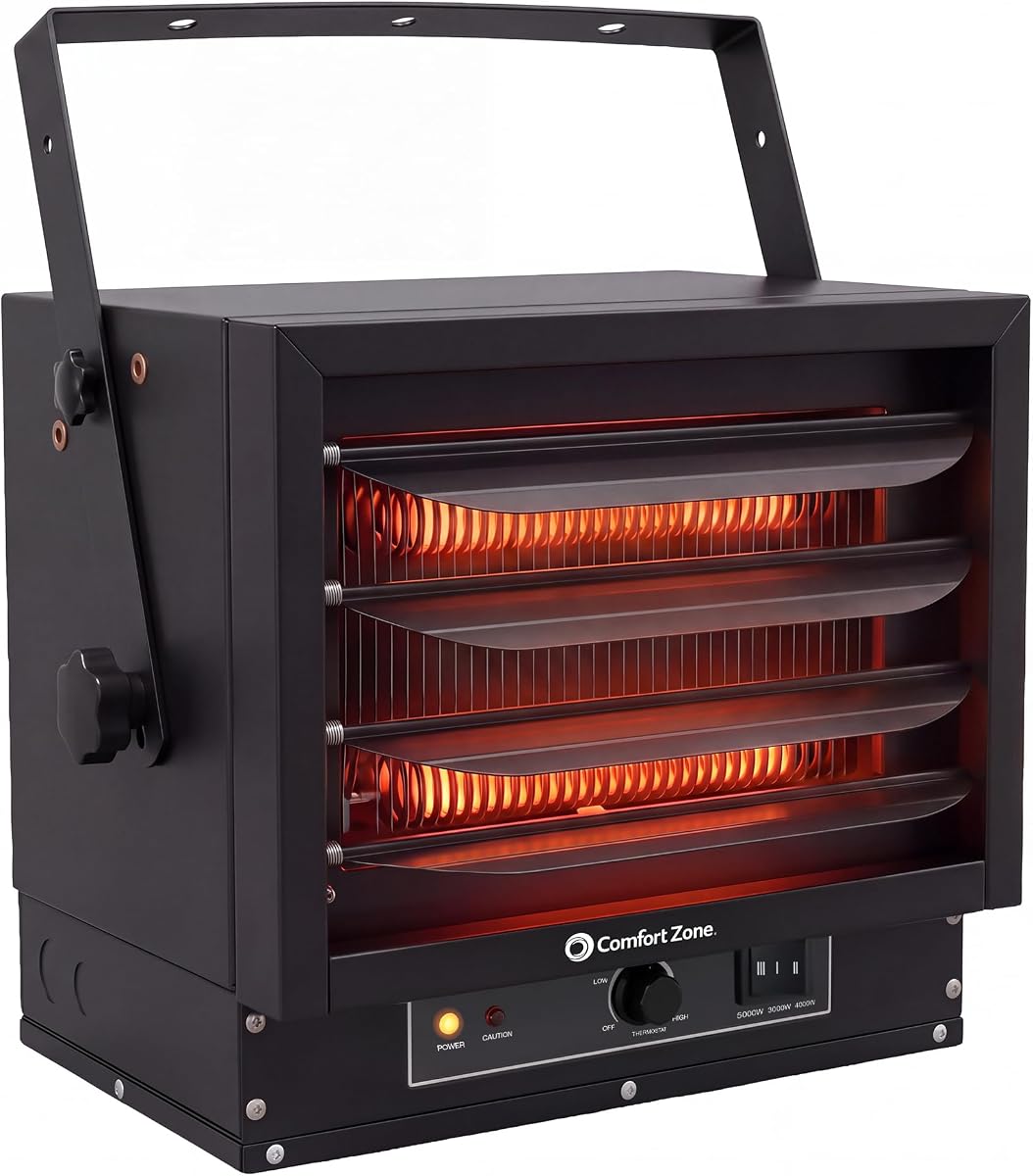

The Comfort Zone CZ230ERBK is a ceiling-mounted, fan-forced garage heater with a 4.4 rating. Its 7500W output, listed coverage of up to 1,250 square feet, adjustable louvers, remote control, digital thermostat, and 12-hour timer make it a capable workshop heater when the required electrical infrastructure is available.
We may earn a commission when you buy through this link, at no additional cost to you.
Its strongest advantage is overhead installation. Mounting the unit near the ceiling preserves valuable floor and wall space, while the variable mounting angle lets an installer aim the airflow toward a workbench, vehicle bay, or another frequently used part of the garage. The fan-forced design circulates air throughout the area, and the digital thermostat provides more precise control than a simple mechanical dial.
The major limitation is electrical. This model is a 240V hard-wired appliance, so it is not a true 110V solution and cannot be connected safely to a standard household-style garage receptacle. Hard-wiring also introduces installation requirements that can exceed the scope of a basic plug-in setup. It is better suited to a larger garage receiving heat regularly.
Buyers who already have a suitable 240V circuit and want to free floor space will find this model well equipped. It is not the right pick for someone searching specifically for a simple 110V plug-in heater, but for a properly wired workshop, it offers an effective balance of output, directed airflow, remote operation, and flexible scheduling.
Ceiling placement keeps vehicles, storage bins, and worktables clear. The adjustable mounting angle and louvers also make it possible to concentrate warmth where it is used most rather than directing it into unused corners.
The included remote, digital thermostat, and 12-hour timer simplify daily control. This is particularly useful in workshops where the heater can start according to a schedule without requiring someone to approach the wall-mounted controls.
We may earn a commission when you buy through this link, at no additional cost to you.
The GiveBest Smart Wall Heater has a 4.3 rating and brings 1500W of heating to spaces up to 200 square feet. Its wall-mounted form factor, thermostat, ECO mode, LED touch panel, remote, and Wi-Fi app support make it a convenient choice for smaller garage work areas, finished rooms, offices, or basements.
We may earn a commission when you buy through this link, at no additional cost to you.
The controls are unusually versatile for a compact heater. Buyers can preheat a space through the app, change settings from across the room with the remote, or make adjustments directly on the illuminated panel. Real-time room-temperature feedback helps prevent unnecessary adjustments, while ECO mode automatically changes output to maintain the selected temperature.
This is not a high-output commercial garage heater. Its own guidance limits the recommended area to 200 square feet and warns against long-distance heating in larger rooms or unobstructed spaces. The voltage is also not explicitly identified in the supplied product information, so buyers should verify the manufacturer specifications and nameplate before connecting it to any circuit.
The GiveBest model makes the most sense for a small, reasonably insulated corner of a garage or another indoor room where convenient controls matter more than powerful heat distribution. It is an appealing budget-oriented option for a home office, bedroom, bathroom, or basement, provided the area is within its stated capacity and the electrical requirement is confirmed first.
Wall mounting reduces clutter and keeps the heating unit away from tools, storage bins, and traffic areas. The drilling guide and straightforward mounting format also make it more approachable than a hard-wired installation.
The precision thermostat and ECO mode help the heater maintain the selected temperature without continuously applying maximum output. That makes the 1500W capacity more practical in compact, well-insulated areas.
We may earn a commission when you buy through this link, at no additional cost to you.
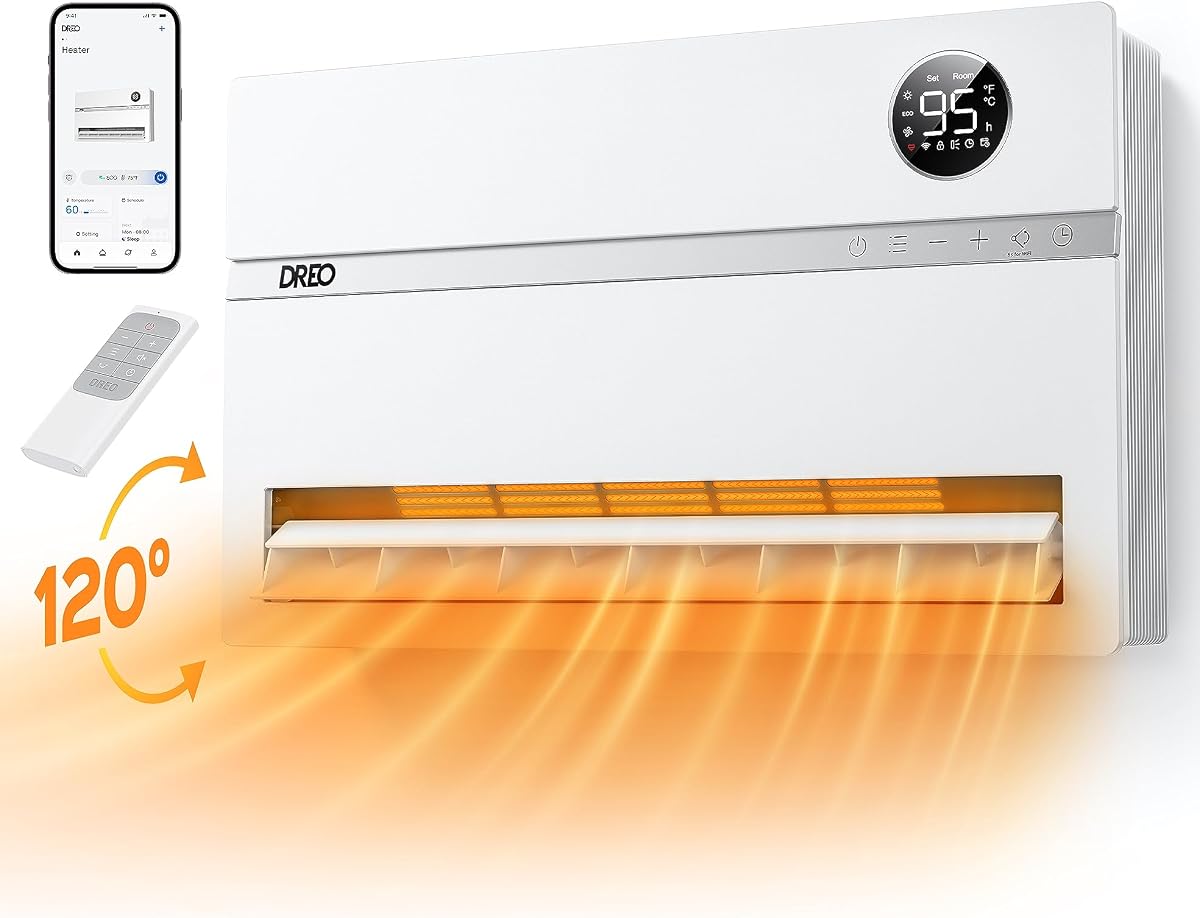
The DREO Smart Wall Heater carries a 4.4 rating and uses 1500W PTC ceramic heating with a wide 120-degree oscillation. Its temperature range of 41 to 95°F, one-degree adjustment accuracy, app scheduling, and voice-platform compatibility make it polished and convenient for bedrooms and other compact indoor spaces.
We may earn a commission when you buy through this link, at no additional cost to you.
Wide oscillation is the feature that most distinguishes it from a basic wall heater. Instead of directing a narrow stream toward one area, the DREO model moves heat from top to bottom to distribute warmth more evenly through the room. Users can schedule heating around their daily routine, adjust it from the app, or connect it to Alexa or Google Home for voice control.
This heater was designed with bedrooms in mind rather than demanding garage environments. The quiet operation and automatic reduction of LED-panel brightness are useful for sleeping areas, while the included drilling guide simplifies wall installation. However, its supplied information does not explicitly state the operating voltage, and its indoor-room positioning makes it less suitable for exposed or poorly insulated garages.
Consider the DREO unit for a finished garage office, bedroom, home office, or another room no larger than its intended application. It is particularly attractive to users who value app scheduling, voice control, and quiet nighttime operation. Confirm the voltage, circuit requirements, and garage-suitability details before installation.
The 120-degree oscillation spreads air vertically, reducing the need to manually redirect the heater throughout the day. This focused distribution can be especially effective in smaller rooms where occupants move between different areas.
App-based schedules can align heating with work or sleep routines, while compatibility with Alexa and Google Home adds another control option. The dimmable panel reduces nighttime distraction without removing the temperature display entirely.
We may earn a commission when you buy through this link, at no additional cost to you.
The VEVOR 10000W Garage Heater has a 4.5 rating and is the highest-output unit in this guide. Its 10000W fan-forced design, stated coverage of 90 square meters, two power levels, remote control, and 9-hour timer target substantial garages, warehouses, and commercial workspaces.
We may earn a commission when you buy through this link, at no additional cost to you.
High circulation is central to the design. The fan moves heated air through the space while adjustable louvers and a selectable mounting angle help direct warmth toward work areas. Digital temperature control is described as maintaining a difference of only 2°F, supporting more consistent conditions than a basic mechanical thermostat. A power indicator and automatic overheat cutoff add visible and automatic operating safeguards.
Electrical demands are the decisive trade-off. The product information calls for a breaker rating of at least 42A, and the unit must be hard-wired. It is therefore unsuitable for a standard 110V outlet and is not appropriate for many single-garage electrical setups. SPCC cold-rolled steel provides a rigid enclosure, but the appliance still demands proper professional installation.
This VEVOR is a compelling choice for a large, frequently used garage with suitable 240V service, especially when the priority is rapid, broadly distributed heat. Choose it over smaller heaters when adequate electrical capacity is already available. For a plug-in 110V setup, this model should be ruled out immediately rather than treated as a universal garage option.
The 10000W rating and 90-square-meter coverage claim separate this model from compact heaters. It is intended for spaces where opening the garage door frequently would overwhelm a 1500W unit.
Two power levels allow a balance between aggressive heating and reduced output. Remote operation, a 9-hour timer, louvers, and installation-angle adjustment make it easier to manage different work periods and direct heat toward priority zones.
We may earn a commission when you buy through this link, at no additional cost to you.
The Dura Heat EUH1465 has a 4.3 rating and combines 1500W PTC ceramic heating with 5,120 BTU of output. Its portable form, pivoting base, 6-foot cord, and stated coverage of up to 250 square feet make it useful for localized heating in compact garage or workshop areas.
We may earn a commission when you buy through this link, at no additional cost to you.
Unlike a fixed wall or ceiling model, this heater can be repositioned as needed. The pivoting base directs airflow toward the person working or the area needing warmth, while the high-velocity fan circulates hot air through the surrounding space. A heat setting and fan-only setting allow the appliance to provide airflow without full heat when appropriate.
The steel body, overheat shutoff, adjustable thermostat, and easy-grip handle support regular use in a workshop. Nevertheless, portable heaters are best suited to contained rooms or supplemental zones. They cannot match the output and circulation of a permanently mounted 5000W to 10000W fan-forced system, and a drafty or open garage will lose heat quickly.
Buy the EUH1465 if you need an inexpensive, movable heater for a small work corner, greenhouse, storage room, or compact garage bay. Its advantages are portability, straightforward controls, and flexible placement rather than whole-garage heating. Confirm that the outlet and circuit meet the manufacturer's instructions before use.
The handle and pivoting base allow the heater to follow changing work areas. It is especially useful when one bench needs warmth during the day but another section of the garage becomes the focus later.
An adjustable thermostat helps limit unnecessary heating, while fan-only operation can circulate air independently. Overheat protection provides an additional safeguard when the unit is used in a confined area.
We may earn a commission when you buy through this link, at no additional cost to you.
The Comfort Zone 5000W has a 4.4 rating and provides a middle ground between compact portable heaters and high-output hard-wired systems. Its ceiling-mounted, fan-forced design is intended for garages, warehouses, and storage areas where floor space is valuable.
We may earn a commission when you buy through this link, at no additional cost to you.
Three heat settings give the user more adjustment than a basic single-level heater. The dual-knob thermostat provides direct temperature and power control, while adjustable louvers and mounting angle help direct the airflow. The heavy-gauge steel body is designed to tolerate temperature fluctuations in poorly insulated environments, and an overheat sensor automatically shuts the appliance down when necessary.
As with other 5000W shop heaters in this list, 240V hard-wiring is the primary limitation. It cannot be treated as a 110V appliance, and its power requirements may require circuit work that a plug-in heater avoids. Its 5000W output also offers less reserve than the 7500W and 10000W models when a garage door is opened during cold weather.
This Comfort Zone is a sensible choice for a medium-sized garage or workshop with an existing suitable 240V circuit. It suits buyers who value physical controls, clear power settings, and overhead placement more than smartphone features. For a standard residential-style outlet, choose a confirmed 110V model instead.
Heavy-gauge steel and fan-forced airflow suit garages and shop environments where durability and broad circulation are priorities. Mounting overhead also reduces interference with parked vehicles and stored equipment.
The dual knobs are easy to understand and adjust without an app or remote. Three heat settings let users respond to changing conditions while a temperature sensor handles overheat protection.
We may earn a commission when you buy through this link, at no additional cost to you.
The Comfort Zone CZ220BK carries a 4.4 rating and delivers 5000W of fan-forced heat from a ceiling-mounted position. Designed for workshops and garages, it combines a durable steel body, adjustable airflow, manual temperature controls, and thermal safety features.
We may earn a commission when you buy through this link, at no additional cost to you.
The main benefit is efficient use of space. Keeping the heater overhead leaves the floor available for vehicles, shelving, tools, and workbenches. Louvers and a variable mounting angle provide directional control, while the fan helps spread warmth across the room rather than concentrating it in a narrow line.
Its controls are intentionally straightforward. A dual-knob thermostat handles temperature settings and quick on-off operation without requiring a phone, remote, or complex programming. That simplicity is useful in a workshop where the heater may be used by several people. The tradeoff is that it offers none of the scheduling or connected controls found in smart wall heaters.
The 240V hard-wired requirement again places this product outside the true 110V category. Choose the CZ220BK for a permanent installation in a garage or workshop with adequate electrical service and a preference for simple mechanical controls. It is a practical option for users who want dependable fan-forced heat and floor clearance more than smart features.
A ceiling heater can be positioned above a work area without taking up wall or floor space. That is especially helpful in one-car garages where a portable unit would occupy valuable storage room.
The heavy-gauge steel enclosure is made for poorly insulated spaces and temperature fluctuations. A thermal cutout and overheat sensor add layered protection around a high-output fan-forced appliance.
We may earn a commission when you buy through this link, at no additional cost to you.
The InoKraft 7500W Electric Garage Heater has a 4.6 rating and offers one of the most refined feature sets in the guide. Its fan-forced 7500W output, listed coverage of up to 750 square feet, digital thermostat, 24-hour timer, and flexible mounting system make it a premium option for a properly equipped garage.
We may earn a commission when you buy through this link, at no additional cost to you.
Control is more detailed than on basic shop heaters. The thermostat adjusts from 40°F to 99°F, a 1-24-hour timer supports scheduled operation, and intelligent ECO mode adjusts output according to ambient temperature. High and low manual modes, automatic fan delay, five installation-angle choices, and adjustable louvers give the user considerable control over comfort and air distribution.
Despite the included NEMA 14-50P plug, this model still requires 240V power. The supplied information specifically recommends professional electrical installation. A large dedicated appliance plug can also be inconvenient near the garage door, where extension cords and vehicle traffic create hazards. The product is therefore not a conventional 110V option despite being easier to connect than a fully hard-wired unit.
For a garage receiving frequent use, the InoKraft is a strong all-around choice when 240V service is available. Its automatic controls and flexible mounting reduce the need for constant manual adjustment. Buyers seeking a true 110V heater should not use its rating or feature set as a substitute for matching the electrical supply.
A 24-hour timer and automatic ECO mode are especially useful in garages that need warmth only during work sessions. The digital thermostat provides a clear 40-99°F adjustment range rather than a single mechanical target.
Wall and ceiling mounting options preserve floor space, while five angle settings and adjustable louvers support targeted airflow. Automatic fan delay can improve heat transfer while avoiding unnecessary fan operation.
We may earn a commission when you buy through this link, at no additional cost to you.
The Shinic 2-Pack 120V Electric Garage Heater has a 4.0 rating and is the clearest electrical match for this guide's 110V focus. Each ceiling-mounted unit uses a grounded three-prong plug, operates at 1500W or 750W, and includes a halogen work light.
We may earn a commission when you buy through this link, at no additional cost to you.
Radiant quartz tubes provide immediate heat in front of the heater, which can be useful when working at a bench or standing in one area. The ceiling bracket rotates up to 90 degrees, allowing the direction of radiant heat to be adjusted while keeping floor space open. The built-in light adds visibility around workbenches, tools, and surrounding surfaces during nighttime work.
A five-setting pull-string control offers low heat, high heat, two radiant-heat-plus-light combinations, and off. Overheat auto-off, a metal housing, grounded plug, and ETL listing support safe operation when the installation follows the instructions. The package includes two heaters, brackets, accessories, and a user manual.
This is the most practical pick for buyers who explicitly need a standard-voltage garage heater. Its limitations are the nature of radiant heating and its lower 4.0 rating. It is better for direct personal warmth at a workstation than for warming an entire detached garage, but the two-pack configuration allows one heater to serve each of two work zones.
The 120V grounded plug makes this model substantially more relevant to the keyword than the 240V hard-wired heaters. It can be used where a suitable standard-voltage receptacle is already available, subject to normal circuit and placement rules.
The integrated halogen lamp eliminates the need for a separate work light in some situations. A 90-degree rotating ceiling bracket further improves the ability to aim radiant heat toward a bench or technician.
We may earn a commission when you buy through this link, at no additional cost to you.
The VEVOR 5000W Garage Heater has a 4.6 rating and combines 5000W fan-forced heating with digital controls in a wall- or ceiling-mountable housing. Its stated coverage is 50 square meters, and features include two power levels, remote operation, a 9-hour timer, and automatic overheat protection.
We may earn a commission when you buy through this link, at no additional cost to you.
The fan circulates air throughout the space, while adjustable louvers and installation-angle control determine where the heated airflow is directed. The remote is useful when the heater is mounted overhead, and the timer offers a straightforward way to limit operation to defined periods. Digital temperature control is described as maintaining a difference of only 2°F, which supports steadier workshop conditions.
Its primary constraint is electrical. This is a 240V hard-wired model, so it cannot be connected to a standard 110V receptacle. It also requires sufficient circuit capacity and careful placement away from traffic, moisture, and combustible materials. Buyers who only need occasional spot heat may find the output excessive, while those with large, open garages may prefer the 10000W version.
The VEVOR 5000W is a strong feature-balanced heater for a garage or shop with proper 240V service. It offers easier daily operation than manual-knob models and lower power demand than the 10000W alternative. It remains a poor match for a 110V search, but it is a capable permanent installation where the electrical requirement is already met.
Remote operation makes an overhead or distant wall installation easier to manage. The 9-hour timer adds a useful boundary for workshops where heating should not continue indefinitely.
Two power levels accommodate different conditions, while fan-driven convection distributes warmth beyond the immediate area. Adjustable louvers and mounting angle help focus heat toward the section of the garage that matters most.
We may earn a commission when you buy through this link, at no additional cost to you.
Choosing a garage heater begins with electrical compatibility, followed by room size, heat-delivery method, mounting needs, and control preferences. A unit that looks powerful but cannot be installed safely on the intended circuit is not a useful option.
Voltage is the most important distinction in this roundup. The Shinic unit explicitly uses 120V, which is the standard-voltage format normally searched for with a 110v garage heater query. By contrast, the Comfort Zone, VEVOR, and InoKraft models listed here use 240V, whether hard-wired or fitted with a large NEMA plug. Those higher-output heaters cannot be connected to an ordinary 110V wall receptacle or safely treated as equivalent appliances.
The voltage information for the GiveBest and DREO wall heaters is not explicitly stated in the supplied listings, so buyers should check the nameplate, manual, and official product specifications. If a heater is listed as 120V, it must still be placed on a properly grounded circuit with suitable capacity and connected without an extension arrangement that violates the instructions.
Match the heater first. Verify voltage, amperage, plug type, circuit rating, and grounding requirements before considering square footage or features. A compact 1500W heater may be perfectly suitable if it meets the space's needs and can operate safely on the available electrical supply.
Listed coverage provides a useful starting point, but it should not be treated as a guarantee for every building. Insulation, door insulation, ceiling height, drafts, and how often the garage door opens can all affect the heat required. The Shinic radiant heaters warm people directly, while fan-forced models are designed to mix air throughout a larger enclosed space.
The compact wall heaters list suitable areas around 200 square feet, while the portable Dura Heat model lists up to 250 square feet. The VEVOR 5000W and InoKraft 7500W models cover larger spaces, and the Comfort Zone CZ230ERBK lists coverage of up to 1,250 square feet. These figures describe different heating methods, so direct comparison requires caution.
For a drafty garage, choose output conservatively and avoid leaving the largest opening uncovered. For a well-insulated workshop with a modest work area, a compact heater may be adequate. The listed coverage should be compared with room dimensions, while realistic expectations and local conditions determine whether the capacity is sufficient.
Radiant heaters use hot elements to send infrared-style heat toward people and objects in front of the unit. The Shinic heaters fit this category and can feel effective at a bench because heat is directed toward the occupied zone. They do not mix the entire room air as effectively as a circulating fan-forced model.
Fan-forced heaters pull air through the unit, heat it, and distribute it across a wider area. This makes them better suited to workshops that need relatively uniform air temperature. They also benefit from adjustable louvers, installation angles, and sometimes automatic fan delay, all of which appear among the higher-output products.
Think about how the space is used. Choose radiant heat for a focused repair position or immediate personal comfort. Choose fan-forced heat for an enclosed workshop, vehicle maintenance area, or room that should reach a broadly maintained temperature. A combination of radiant and fan-forced heaters may also be useful if one worker needs direct warmth while the room needs ambient heating.
Installation convenience varies dramatically across the list. The Shinic heaters use ceiling brackets and grounded plugs, while the GiveBest and DREO models use wall-mounting guides. The Dura Heat EUH1465 is portable and needs no permanent mounting. These characteristics can make lower-output heaters much easier to add to an existing garage.
The Comfort Zone ceiling units and VEVOR models require hard-wiring, while the InoKraft uses a 240V NEMA 14-50P plug but still recommends professional electrical installation. A large dedicated heater connection should be planned around the garage door, parked vehicles, extension cords, storage, and the required clearance around the unit.
Choose the simplest installation that safely meets your heating needs. If the electrical work is substantial, the total project cost and effort may outweigh the benefit of additional wattage. Conversely, a permanently mounted fan-forced unit can be worthwhile in a frequently used workshop when suitable service is already available.
Controls range from pull strings and dual mechanical knobs to remotes, digital thermostats, timers, applications, and voice assistants. Manual controls are straightforward and dependable, but the user must approach the heater to change settings. Remote and connected controls are more convenient for wall or ceiling installations.
The GiveBest heater offers Wi-Fi, remote, and touch-panel control, while the DREO unit adds app scheduling, wide oscillation, and compatibility with Alexa and Google Home. The VEVOR models include remote controls and 9-hour timers. The InoKraft adds a digital 40-99°F thermostat, 24-hour timer, and ECO mode, while the Comfort Zone CZ230ERBK combines a digital thermostat with a 12-hour timer.
Choose based on how often settings will change and who will use the heater. Connected controls are valuable in home offices and bedrooms, where quiet operation and scheduling matter. In an active shop, a clearly reachable thermostat and visible power status may be more useful than smartphone features. Always confirm that the app and voice-platform functions work as expected in the intended setup.
Every product in the list includes some form of overheat protection, which is essential for unattended use. Many also use a temperature sensor or thermal cutout to stop power when temperatures become unsafe. The Shinic pair adds a grounded three-prong plug and metal housing, while the GiveBest model includes tip-over protection, overheat protection, and V-0 flame-retardant materials.
ETL listing or compliance is listed for several models and can provide useful independent verification of tested safety standards. Certification does not replace correct installation, however. Clearances, electrical load, grounding, ventilation, and manufacturer instructions remain the buyer's responsibility.
Position the heater away from moving vehicles, moisture, combustible materials, extension cords, and foot traffic. Ceiling mounting generally helps with floor clearance, while portable models need stable ground and an unobstructed airflow path. Built-in protection should be treated as a backup layer rather than a reason to ignore placement and maintenance.
Garage heaters often use a high-velocity fan to move air, which can produce noticeable sound in a quiet room. The InoKraft lists operation at 65 dB, while the DREO emphasizes lower noise and automatic LED-panel dimming for bedroom use. For a garage workshop, fan noise may be less important than uniform heat delivery.
If the heater will share a room with conversations, recordings, or sleep, consider controls that support quieter use and examine published noise information where available. The Dura Heat includes a fan-only setting, allowing air circulation without maximum heat. A thermostat or timer can also prevent the unit from running unnecessarily.
Comfort depends on more than decibel level. Even airflow, adjustable louvers, consistent temperature control, and a suitable mounting position can make a louder fan feel more effective. Conversely, a quiet unit may underperform if its output is insufficient for the room. Balance noise expectations with realistic heating capacity.
Steel construction, replaceable installation positioning, accessible controls, and straightforward cleaning can lower long-term inconvenience. The Comfort Zone units emphasize heavy-gauge steel for poorly insulated environments, while the VEVOR heaters use SPCC cold-rolled steel. Portable models offer the advantage of moving the heater when the layout changes.
Consider how often the heater will run and who will maintain it. Ceiling and wall-mounted units reduce the chance of being bumped, but they may require careful ladder access for cleaning. Portable heaters are easy to reposition but occupy usable space and require attention to cord placement. Digital and app-based controls can make scheduling easier but introduce an electronic dependency.
Follow the manufacturer's maintenance instructions, keep intake and output openings clear, and inspect electrical connections periodically. If the garage is damp, dusty, or subject to large temperature swings, choose equipment with an appropriate construction and safe placement. Long-term reliability comes from compatibility, installation, and maintenance working together.
Before installation, identify the heater's voltage and required circuit, then compare those requirements with the outlet or wiring available in the garage. Place the unit on a level, stable surface or mount it using the supplied bracket according to the manual. Keep the required clearance around intake and output openings and remove combustible objects from the mounting area.
For a portable heater, position the pivoting base or louvers toward the occupied area and connect it directly to a suitable outlet. For wall or ceiling models, follow the drilling guide or installation instructions carefully. Hard-wired 240V appliances should be installed by a qualified electrician, and the circuit must meet the heater's load requirements without extension cords or other modifications not approved by the manufacturer.
Start with a moderate setting, allow the fan to circulate air, and adjust the thermostat or power level according to comfort. Use the timer or app schedule when appropriate, avoid leaving the heater unattended in hazardous conditions, and never block its vents. Periodically remove dust from accessible openings, inspect the cord or wiring for damage, and discontinue use if the overheat system activates repeatedly.
No. A 240V appliance must be connected to a correctly configured 240V circuit with appropriate capacity and grounding. Plugging it into a 110V outlet could damage the heater, create a serious electrical hazard, or cause a fire. Most 240V units also require professional installation.
In standard North American terminology, 120V appliances are designed for the common 120V household supply often called 110V. You must still verify the nameplate, plug type, grounding, and circuit capacity. Never use an adapter or extension arrangement that conflicts with the manufacturer's installation instructions.
The Shinic 2-Pack is the clearest match because its supplied information explicitly identifies 120V power and a grounded three-prong plug. It uses radiant quartz heat with 1500W and 750W settings. The voltage of the GiveBest and DREO wall heaters is not explicitly stated in the supplied data, so those models require further verification.
That depends on the garage's size, insulation, ceiling height, and heat loss. The GiveBest and DREO wall heaters are intended for compact areas, and the Dura Heat lists coverage up to 250 square feet. A detached or drafty garage generally needs a higher-output fan-forced system and appropriate electrical service.
Neither is universally better. Radiant heaters are effective at directly warming a person or work surface in front of the unit. Fan-forced heaters are generally better for circulating heated air throughout an enclosed garage or workshop. The best choice depends on whether localized comfort or broader room heating is the priority.
Portable and standard-voltage plug-in models can often be set up according to their instructions, provided the outlet and circuit meet all requirements. Hard-wired 240V units should be installed by a qualified electrician. Even a unit with a large NEMA plug may need an appropriate dedicated receptacle that is not commonly available.
Automatic overheat shutdown is essential, and a temperature sensor or thermal cutout adds useful protection. Look for a grounded plug or proper grounding, suitable materials, and relevant safety certification. Features such as tip-over protection, timers, and automatic shutoff improve convenience, but correct placement and electrical installation remain essential.
Ceiling mounting can preserve floor and wall space, while wall mounting may be easier to access for adjustments. Keep the unit away from moving vehicles, moisture, combustible materials, and foot traffic, and follow all clearance instructions. Portable models need a stable surface and unobstructed airflow in every direction.
The Shinic 2-Pack stands out as the most relevant standard-voltage choice because it explicitly uses a 120V grounded plug, ceiling mounting, radiant heat, and an integrated work light. The GiveBest and DREO wall heaters offer convenient connected controls for smaller indoor spaces, although their operating voltage should be verified before use.
For a larger garage, the InoKraft and VEVOR models offer stronger fan-forced heating, digital controls, timers, and flexible mounting. Every one of those prominent high-output units requires 240V power, so prioritize electrical compatibility before output or features. A dedicated circuit may be worthwhile for frequent workshop heating, but it adds installation complexity and cost.
Check the current product listing, manufacturer instructions, voltage label, circuit requirements, and latest specifications before ordering. Ratings, features, availability, and prices can change, so use this guide as a structured comparison rather than a substitute for checking the latest retailer and manufacturer information.