
Athlon Optics Argos HD
4.3Editor score
20-60x magnification range
85mm objective lens
Fully multi-coated HD optics
Waterproof argon-purged body
Rotating tripod collar
This guide compares the best long range spotting scope for 1000 yards, evaluating magnification, objective lenses, clarity, portability, and field features.
Reaching a target, animal, or landscape feature 1,000 yards away requires more than ordinary magnification. A capable spotting scope combines a usable magnification range, a bright objective lens, sharp optics, precise focusing, and a stable tripod interface. The best models also remain comfortable during extended observation.
This guide compares ten spotting scopes suited to long-range viewing using their documented magnification ranges, objective diameters, optical designs, focusing systems, mounting options, weather protection, and included accessories. It covers general-purpose scopes, premium glassing tools, and a tactical model intended for competitive shooting.
Each review highlights the features that matter most at distance while noting any limitations visible from the available specifications. Ratings and availability can change over time, and prices fluctuate frequently, so readers should confirm current product details before making a purchase.
4.3Editor score

4.6Editor score

4.6Editor score
The comparison below places all ten scopes side by side, emphasizing magnification, objective diameter, optical construction, focusing, mounting, and weather resistance for long-distance observation.
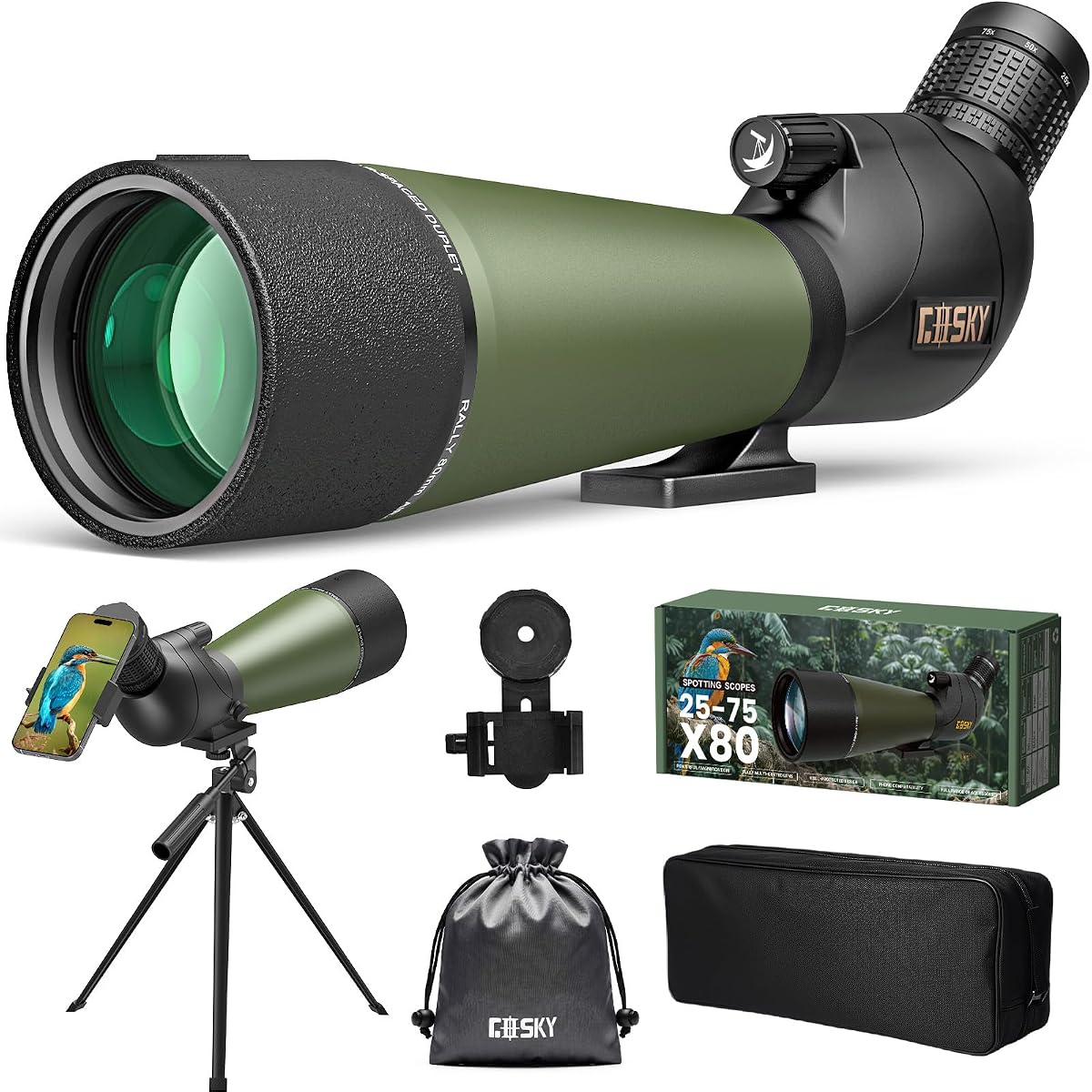



The DiamondEdge 25-75×80 combines a broad 25-75x magnification range with an 80mm objective lens, making it a versatile choice for target shooting, wildlife observation, and long-range landscape viewing. Its 4.4 rating reflects a strong balance of capability and practicality. The included BAK4 prism, FMC optics, 23mm eyepiece, and weather-sealed construction support clear outdoor use.
We may earn a commission when you buy through this link, at no additional cost to you.
The most useful feature is the upper magnification ceiling. At the low end, the scope can scan broad areas and locate distant subjects, while the high end provides the detail needed to inspect small targets at 1,000 yards. The 80mm objective gathers substantial light, which is valuable when a target is partly shaded or the surrounding landscape is dark. A rotatable body and included tabletop tripod make initial setup straightforward.
There are some practical compromises. The bundled tabletop tripod offers a convenient starting point, but a full-height tripod would usually be more useful for extended sessions or shooting-position stability. The scope is also more general-purpose than models built around specialized glassing needs, so buyers who require a premium optical system may find greater refinement elsewhere in this list.
This is an appealing option for a new user who wants one scope to cover hunting, birdwatching, target shooting, and wildlife viewing. The combination of a 25x lower zoom limit, 75x upper limit, bright objective, and complete accessory package makes it especially approachable. For most long-distance needs, it offers useful magnification without requiring a separate spotting scope for each activity.
The 25-75x range supports both broad environmental scanning and close inspection of distant subjects. That flexibility makes the DiamondEdge useful for target shooters, hunters, hikers, and birdwatchers who want to carry only one optical instrument.
Nitrogen filling and O-ring sealing help protect the internals from moisture and fog, while the retractable sunshade reduces glare. The rubber-armored body also provides a secure grip during outdoor use.
We may earn a commission when you buy through this link, at no additional cost to you.
The Vortex Diamondback HD 20-60×85 is an all-around long-range scope with a 4.6 rating and a design that suits both field observation and precision target work. Its HD optical system, 85mm objective, and anti-reflective coatings are intended to deliver resolution, color fidelity, edge-to-edge sharpness, and useful light transmission. The result is a specification set well suited to 1,000-yard glassing.
We may earn a commission when you buy through this link, at no additional cost to you.
A 20x lower magnification helps users find and track distant subjects without moving the scope excessively, while 60x provides enough reach for detailed observation. The built-in helical focus wheel supports rapid acquisition followed by finer adjustment. Its mounting design accepts Arca-Swiss heads directly and also supports standard 1/4-20 equipment, making it easier to use with tripods, window mounts, and other familiar platforms.
The main limitation is its 60x maximum magnification. Scopes with larger objective lenses can collect more light, and models with apochromatic or fluorite elements may resolve finer detail under favorable conditions. The angled design can also place the eyepiece higher than a straight scope, though this can improve comfort when standing or sitting at different heights. These are contextual trade-offs rather than serious quality concerns.
The Diamondback HD is a strong recommendation for hunters and target shooters who want dependable 1,000-yard capability without moving into specialty premium equipment. It combines a generous objective, rapid focus, weather protection, and broad mounting compatibility in a recognizable, practical package. For many readers, its balance of optical performance and versatility makes it the most straightforward high-end choice.
The 20x starting point offers a broad view for locating subjects, while the helical focus wheel allows quick correction before settling into a precise focus. This combination is particularly helpful when a distant animal or target moves.
Arca-Swiss compatibility and standard 1/4-20 support reduce the need for extra mounting hardware. A tripod, car window mount, or other supported platform can be chosen according to the activity.
We may earn a commission when you buy through this link, at no additional cost to you.
The Celestron Ultima 22-66×100 is built around an exceptionally large 100mm objective, giving it abundant light-gathering potential for long-distance observation. Its 4.2 rating and 22-66x zoom range position it as a capable all-purpose optic. The angled body supports comfortable viewing, while multi-coated surfaces work to improve brightness, color, and contrast.
We may earn a commission when you buy through this link, at no additional cost to you.
At 1,000 yards, objective size becomes particularly meaningful. The 100mm lens can gather more light than smaller objectives, helping maintain a visible image when conditions are dim or the subject is partly obscured. The zoom eyepiece allows users to start broad and narrow down, and the large focus dial makes rapid focusing possible as the subject moves. An integrated T-adapter also opens the scope to digiscoping setups.
The trade-off is size. A 100mm objective naturally creates a bulkier instrument that may require more effort to carry, position, and balance on a tripod. The scope also reaches 66x rather than the 70x offered by a few premium alternatives, so its maximum magnification is not the highest available. Buyers should weigh whether maximum light gathering or a slightly more compact design matters more.
This Celestron is a strong match for observers who spend long periods watching distant wildlife, scanning dark terrain, or photographing scenes through a compatible camera. Its accessory package includes a carrying case, mounting plate, eyepiece pouch, lens cloth, and other useful items, making it a comprehensive choice for serious outdoor viewing.
The 100mm objective offers substantial light-gathering capacity, which can help preserve detail in shaded or low-light conditions. That makes it attractive for dawn and dusk observation.
The integrated T-adapter provides a straightforward path to attaching compatible imaging equipment. This adds flexibility for wildlife observation and recording distant subjects.
We may earn a commission when you buy through this link, at no additional cost to you.
The Vortex Crossfire HD 20-60×80 earns a 4.6 rating while offering a practical combination of HD optics, rapid focusing, and tripod-friendly mounting. Its wide field of view is especially useful when scanning open ground, while the 80mm objective provides a meaningful balance of brightness and portability for hunting, wildlife viewing, and target observation.
We may earn a commission when you buy through this link, at no additional cost to you.
Its 20-60x range covers the transition from environmental scanning to detailed distance viewing. The helical focus mechanism provides both fast and fine adjustments, and adjustable eyecups support users with and without eyeglasses. An Arca-Swiss-compatible foot allows it to mount directly to many tripods, while nitrogen purging and sealing help it cope with changing weather.
Compared with larger-objective alternatives, the 80mm front lens will not gather as much light in poor light. The 60x upper limit also means it cannot offer the reach of a 70x scope. These limitations matter most for dedicated low-light wildlife observation or when the smallest details must be resolved at maximum magnification.
For users who value ease of use, mounting flexibility, and a wide scanning field, the Crossfire HD remains an attractive option. It is especially compelling for target shooters who need to locate a distant target quickly and then refine the image without changing optical settings extensively.
The wide field of view helps users scan more terrain at lower magnification. This reduces the need to pan rapidly and can make a 1,000-yard target easier to acquire.
Twist-up adjustable eyecups allow the eyepiece to be positioned for different eye relief needs. That flexibility is useful for long observation sessions and shooters wearing corrective eyewear.
We may earn a commission when you buy through this link, at no additional cost to you.
The Vortex Razor HD 22-48×65 is a premium straight-bodied spotting scope with a 4.8 rating, the highest numerical rating among the listed products. Its defining feature is a triplet apochromatic lens using high-density, extra-low-dispersion glass. The design is aimed at exceptional resolution, color fidelity, and brightness, with XR Plus anti-reflective coatings supporting critical low-light viewing.
We may earn a commission when you buy through this link, at no additional cost to you.
The scope’s 22-48x range offers enough magnification for detailed observation without requiring the extreme high magnification available from some larger models. A smooth helical focus helps bring subjects into sharp resolution, while a built-in sunshade reduces glare. The multi-position eyecup and rotatable body make it easier to find a comfortable viewing angle.
The 65mm objective and 48x maximum make this the least specialized option for extremely distant precision tasks. Compared with 85mm or 100mm scopes, it gathers less light and reaches lower magnification. Buyers prioritizing raw reach or maximum brightness may find those characteristics more important than the Razor HD’s apochromatic refinement.
The Razor HD is best suited to serious observers who value color, contrast, and edge-to-edge clarity over maximum magnification. It is a compelling choice for birding, scenic observation, and target glassing where a premium optical system and relatively compact straight body matter most.
The triplet apochromatic design uses extra-low-dispersion glass to improve color fidelity and reduce chromatic aberration. This is especially noticeable when inspecting fine details or comparing natural colors across a wide scene.
The straight body and 65mm objective are more restrained than the large angled models in this list. That makes the Razor HD potentially easier to position and carry for premium glassing sessions.
We may earn a commission when you buy through this link, at no additional cost to you.
The Celestron TrailSeeker 22-67×100 is designed around a 100mm objective and a 3.9 rating. Its large aperture, XLT multi-coated lenses, and phase-coated BAK4 prism favor brightness and contrast, while the 22-67x zoom gives users a flexible way to scan and then inspect distant subjects.
We may earn a commission when you buy through this link, at no additional cost to you.
This configuration makes the scope attractive for long-range observation and digiscoping. The objective provides substantial light-gathering capacity, the rotating tripod collar permits an appropriate viewing angle, and the twist-up eyecup supports comfortable use with or without glasses. Compatibility with standard 1.25-inch astronomical eyepieces adds another layer of customization.
Its size is the clearest drawback. A 100mm objective requires a substantial chassis, which can become tiring when carrying over rough ground. The 3.9 rating is also lower than those of most products in this guide, although the available specifications do not identify a specific defect. Buyers should assess the complete package and how the large objective aligns with their priorities.
The TrailSeeker 100 is a sensible option for users who regularly observe in dim conditions or want the ability to change eyepieces. Those who regularly hike long distances may prefer a smaller 65mm, 80mm, or 85mm scope, while stationary glassing and digiscoping users may find the large objective especially attractive.
The large objective gathers more light than smaller lenses, helping maintain a brighter view at dawn, dusk, or under overcast skies. Multi-coatings and a phase-coated prism further support the optical system.
Support for standard 1.25-inch astronomical eyepieces allows users to explore wider fields or different magnification characteristics. This makes the scope more adaptable than a fixed-eyepiece design.
We may earn a commission when you buy through this link, at no additional cost to you.
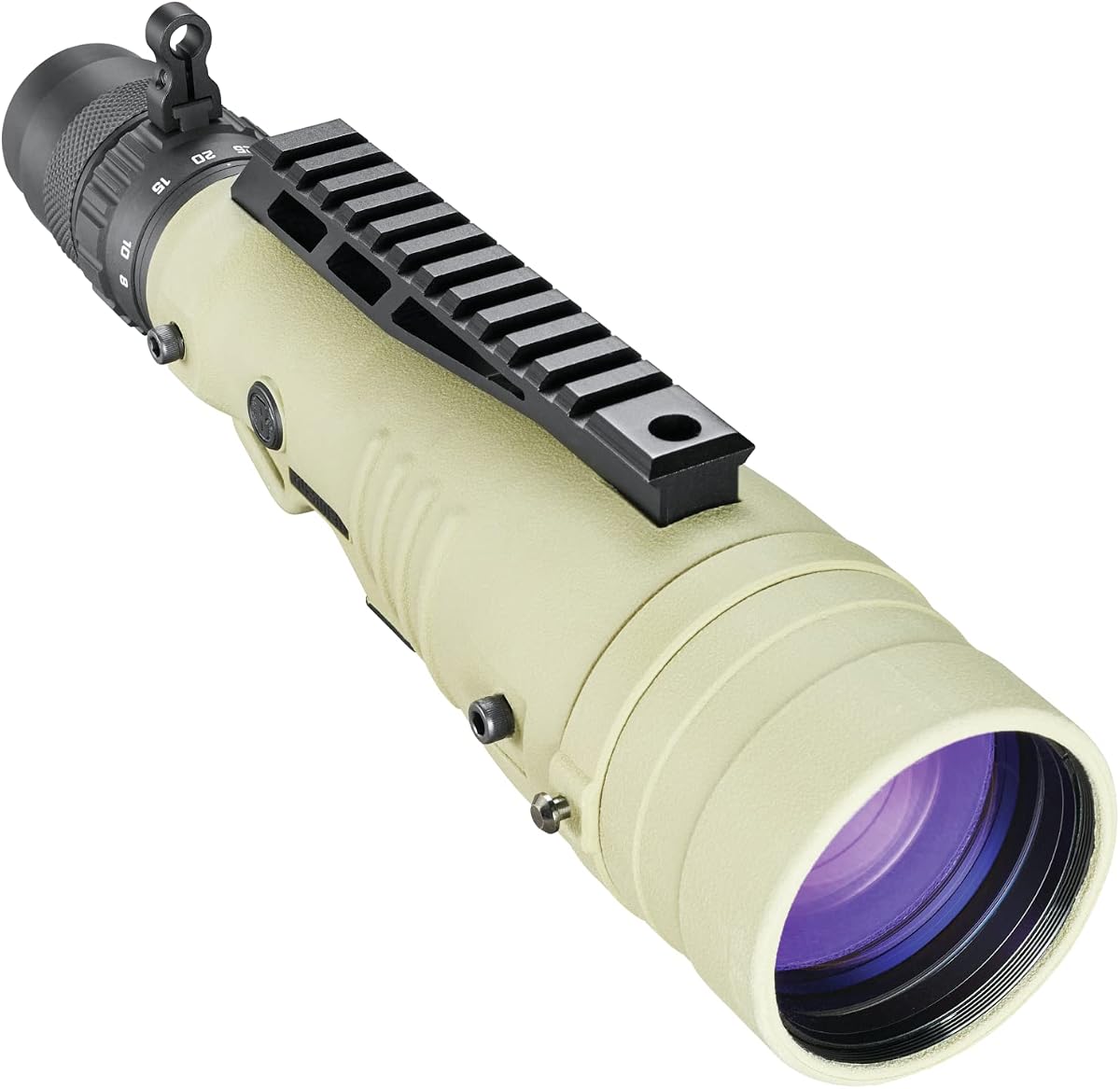
The Bushnell Elite Tactical LMSS2 is the most specialized scope in this group. Its product identity centers on competitive long-range shooting, and the included Tremor 4 reticle is designed to support distance estimation. Unlike general-purpose scopes, its value comes from combining optical observation with tactical ranging functions.
We may earn a commission when you buy through this link, at no additional cost to you.
At 1,000 yards, a calibrated or clearly graduated reticle can help shooters compare the size of a distant target with known reference marks and estimate range. The Elite Tactical designation indicates a feature set aimed at that task, while the spotting scope format allows the shooter to glass a target before taking a position or preparing for a shot.
The available product information is limited, so buyers should confirm magnification, objective diameter, focus controls, mounting compatibility, weather sealing, and included accessories on the current listing. The absence of a numerical rating also makes it difficult to compare user satisfaction directly with the other scopes. Its specialized reticle may not suit wildlife observation or casual scenic viewing.
This scope makes the most sense for competitive and long-range target shooters who specifically want a tactical ranging reticle. Rather than competing directly with wide-field birding scopes, it addresses a narrower need. Buyers should verify the reticle’s markings and the scope’s specifications against their preferred shooting discipline before purchasing.
The Tremor 4 reticle provides visual references intended for range estimation. This can reduce repeated transitions between a scope and separate ranging tool while observing a target.
The LMSS2 is aimed explicitly at competitive and long-range shooting. That focus may be advantageous for a target shooter, even though it is less directly relevant to general wildlife viewing.
We may earn a commission when you buy through this link, at no additional cost to you.
The KOWA TSN-99A PROMINAR is the premium choice in this guide, combining a 4.6 rating with a 30-70x range and 99mm pure fluorite objective. The large objective, Kowa XD concave lens, and enhanced coatings are designed for high resolution, contrast, color fidelity, and light transmission. This is one of the most advanced optical configurations listed.
We may earn a commission when you buy through this link, at no additional cost to you.
Its magnification range supports both environmental scanning and serious distance work. The dual focus system separates rapid subject acquisition from fine focusing, making it practical for moving wildlife or responsive target observation. The angled body supports a relaxed viewing position, and the waterproof, nitrogen-filled magnesium alloy chassis is protected by KR coating against moisture, dirt, and dust.
As a premium instrument, the main drawback is its size. A 99mm objective and substantial chassis require a stable tripod and may be less convenient for long hikes. The KOWA SYSTEM collar also adds complexity, although it provides valuable flexibility with interchangeable eyepieces, phone adapters, and camera accessories. Buyers should consider the entire system rather than only the magnification range.
The TSN-99A PROMINAR is ideal for serious birders, hunters, target shooters, and observers who place image quality and light gathering above portability. At 1,000 yards, its fluorite objective, advanced coatings, and precision focus controls make it one of the strongest choices for extracting fine detail under demanding conditions.
The pure fluorite objective and XD concave lens are intended to deliver high resolution and color fidelity. These attributes are particularly valuable when examining small, distant subjects at high magnification.
Quick Focus acquires a subject quickly, while Fine Focus makes precise corrections. The separation helps maintain control when an animal moves or a target changes distance.
We may earn a commission when you buy through this link, at no additional cost to you.
The Celestron Regal M2 100ED is a high-resolution long-range scope with a 4.3 rating and a 100mm ED objective. Extra-low-dispersion glass is intended to reduce chromatic aberration and color fringing, while the large objective supports brightness. Its 22-67x zoom eyepiece covers a versatile range for scanning and detailed observation.
We may earn a commission when you buy through this link, at no additional cost to you.
XLT coatings are applied across the air-to-glass surfaces to maximize light transmission, which is especially relevant in a scope designed around a large objective. The rotating tripod mount allows the eyepiece to be placed at a comfortable angle, and the included 1.25-inch eyepiece compatibility creates additional options for specialized viewing.
Like other 100mm scopes, it is physically substantial. That size can make the Regal M2 less appealing for mobile observation, and the 67x maximum does not lead the magnification category. Buyers may also need a full-size tripod to balance it properly. The included T-mount adapter adds useful digiscoping capability, but a compatible camera body and additional equipment may be required.
The Regal M2 100ED is a strong choice for users who want generous light gathering together with improved color control. It is particularly suitable for serious wildlife observation, scenic long-distance viewing, and compatible digiscoping, while target shooters should verify their tripod can support the scope securely.
Extra-low-dispersion objective glass is intended to reduce color fringing around high-contrast edges. This supports more natural-looking color and clearer fine detail at distance.
The bundled T-mount adapter supports digiscoping with compatible camera equipment. The view-through case, lens covers, and eyepiece cover support transport and protection in the field.
We may earn a commission when you buy through this link, at no additional cost to you.
The Athlon Optics Argos HD 20-60×85 offers an 85mm objective, HD glass, and fully multi-coated lenses at a budget-oriented tier. Its 4.3 rating indicates a generally positive reception, while the 20-60x range and 45-degree angled body make it well suited to hunting, birding, and target shooting.
We may earn a commission when you buy through this link, at no additional cost to you.
The 85mm objective provides a useful amount of light for a scope intended for outdoor observation, and the multi-coated HD optics are designed to deliver bright, sharp images with accurate color. The 20x lower limit creates a broad starting view that helps locate subjects, while the angled eyepiece and rotating tripod ring permit comfortable positioning during longer sessions.
Its main limitation is the 60x maximum magnification. Users needing 65x or 70x for extremely fine detail may find more reach in other scopes. The package does not list a tripod, so buyers should budget for a stable mount if they do not already own one. At 85mm, the scope also has more bulk than compact 65mm models.
The Argos HD is a strong choice for buyers who want a capable, weather-resistant spotting scope without moving to a premium fluorite system. It gives users a bright objective, practical zoom range, and angled viewing design at a sensible entry point. A suitable tripod and careful lens care will help it deliver dependable service.
The 85mm objective provides generous light-gathering performance while remaining smaller than many 99mm and 100mm scopes. This offers a practical compromise between brightness, detail, and portability.
The sealed body and argon purge help resist moisture and internal fogging. Rubber armor adds protection and grip, while the included soft case supports convenient transport.
We may earn a commission when you buy through this link, at no additional cost to you.
Choosing a scope for 1,000-yard observation requires balancing magnification, light gathering, optical quality, focusing precision, portability, and mounting compatibility. The following factors explain how each specification affects real-world use.
Magnification determines how large a distant subject appears, but more power is not automatically better. A lower setting such as 20x or 22x makes target acquisition easier by providing a wider view, while the upper setting reveals finer detail. The scopes in this guide range from 20-60x to 30-70x, with most clustering around a 60x maximum. Shooters often benefit from moving to intermediate magnification when a subject is moving, then increasing power after it is steady.
The objective lens determines how much light enters the optical system. A 100mm objective, such as those used by the Celestron Ultima, TrailSeeker, and Regal M2, offers exceptional light-gathering potential. An 85mm lens, found in the Diamondback HD and Argos HD, offers a more moderate balance between brightness and size, while the 65mm Razor HD is designed around portability and premium correction. Larger objectives can make a scope easier to use in low light, but they also require steadier mounting and add weight.
HD and ED glass systems aim to improve resolution and reduce chromatic aberration, while fluorite and apochromatic designs represent higher tiers of optical refinement. Multi-coatings on all air-to-glass surfaces improve light transmission and contrast, while phase coatings on a prism can support edge-to-edge clarity. The Kowa TSN-99A PROMINAR uses a 99mm pure fluorite objective, the Vortex Razor HD uses a triplet apochromatic lens, and several other models use HD or ED elements.
A useful focusing system must be quick enough to acquire a moving subject and precise enough to settle on a distant target. Helical focus rings provide a familiar continuous adjustment. The Kowa adds a dual-focus arrangement, separating rapid acquisition from fine adjustment. Large focus dials can also be easier to manipulate while wearing gloves or working quickly in the field. The control should feel deliberate rather than excessively loose or difficult to turn.
A spotting scope magnifies small vibrations, so stable support is essential. The DiamondEdge includes a desktop tripod for convenient starting use, although a full-height model is preferable for extended sessions. Vortex scopes offer Arca-Swiss compatibility, while standard 1/4-20 threads remain widely useful. Kowa’s interchangeable collar supports eyepieces and camera adapters. Before purchasing, confirm that the intended tripod head can carry the scope securely and maintain a level viewing position.
Long-range observation often takes place in wet grass, changing weather, or cold conditions where internal fog would be damaging. Nitrogen purging, argon purging, and O-ring sealing are used among the listed scopes to resist moisture. Rubber armor improves grip and protects the body from knocks. A retractable sunshade helps with glare and may also shield the objective from rain or snow. Buyers should keep protective lens caps on during transport.
An angled eyepiece can make a standing or seated viewing position more comfortable, especially during extended wildlife observation. A straight body may pack more compactly and suit certain shooting positions. Rotating tripod collars make it easier to change the eyepiece angle without moving the scope far from the target. Objective size remains the largest influence on portability: 100mm scopes are substantial, 85mm models are moderately sized, and the 65mm Razor HD is the most compact option listed.
Eyepiece compatibility can extend the usefulness of a scope beyond its bundled configuration. The Celestron TrailSeeker and Regal M2 accept standard 1.25-inch astronomical eyepieces, while the Kowa collar supports interchangeable eyepieces, phone adapters, and camera equipment. The Celestron Ultima includes an integrated T-adapter, and the Regal M2 includes a T-mount adapter. These options are valuable for wildlife photography, astronomy, or specialized magnification requirements.
Set up on a stable tripod before searching for a distant target. Balance the scope, tighten the controls, and adjust the eyecup for proper eye relief. Begin at the lowest magnification to locate the subject, then center it before increasing power. For shooting, confirm that the rifle is pointed in a safe direction and follow all applicable range safety procedures before moving between positions.
Focus in deliberate stages. Use the rapid focus control to acquire the subject, then apply smaller adjustments until the image is crisp. Avoid repeatedly changing magnification and focus at the same time. Let the scope settle after each adjustment, and use sunshades or lens hoods to reduce glare. At very high magnification, even small tripod movements become more visible, so keep elbows or arms supported and avoid touching the eyepiece.
Protect the optics by using the objective and eyepiece covers during transport. Clean lenses only with an appropriate optical cloth and a small amount of suitable lens solution, avoiding vigorous rubbing. Keep the scope dry when possible, and do not leave it in a hot vehicle. Periodically check the mount, focusing tension, seals, and tripod attachment for looseness, while allowing the unit to acclimate to temperature changes before use.
A range beginning around 20x or 22x is useful because it makes distant subjects easier to locate. Increasing to 50x or 60x then provides finer detail, while 65x to 70x can benefit the most specialized observation. The best magnification also depends on the target, atmospheric conditions, tripod stability, and how much light remains available.
A larger objective usually gathers more light, which can improve visibility at dawn, dusk, or in shaded terrain. It does not automatically produce a sharper image because glass quality, coatings, focus precision, and atmospheric conditions also matter. Large objectives also increase weight and bulk, so a slightly smaller model may be more practical for hiking.
A 60x scope can provide meaningful detail at 1,000 yards and is sufficient for many observation and target-checking tasks. Higher magnification can help distinguish smaller features, but image brightness, tripod stability, and the shooter’s own optic become important. Many shooters use moderate magnification for scanning and reserve the upper limit for a stationary target.
An angled scope places the eyepiece above the body, which is comfortable for standing birdwatchers and many target shooters. A straight body is compact and can be easier to align with some shooting positions. The rotating collars on several models help reduce the importance of this distinction by allowing the eyepiece angle to be adjusted.
Yes, especially at higher magnification, because tiny movements become increasingly visible as power increases. A stable tripod also makes precise focusing and range estimation easier. The DiamondEdge includes a desktop tripod, but most users will benefit from a full-height model with a suitable Arca-Swiss or 1/4-20 connection.
Resolution, contrast, color accuracy, and light transmission all affect the visibility of a distant target. HD or ED glass, phase coatings, and apochromatic or fluorite elements can improve these qualities. A fast focus system and stable mount are equally important because excellent glass cannot compensate for a poorly focused or vibrating scope.
Several models support digiscoping through integrated or included adapters. The Celestron Ultima has an integrated T-adapter, the Regal M2 includes a T-mount adapter, and the Kowa collar supports phone, DSLR, and other accessories. Compatibility, camera weight, and steady tripod support should all be confirmed before attaching imaging equipment.
Store it in its protective case with lens caps installed and the eyepiece retracted if the model allows it. Keep it away from moisture, excessive heat, and direct contact with dust or sand. Allow a temperature-shocked scope to return gradually to room temperature before opening the case, which helps limit condensation.
The Vortex Diamondback HD stands out as the most balanced all-around choice, pairing a 4.6 rating with an 85mm objective, 20-60x magnification, rapid focus, and broad mounting compatibility. The Athlon Argos HD delivers a similar 85mm-and-20x-to-60x configuration for budget-conscious buyers, while the KOWA TSN-99A PROMINAR represents the premium choice for users who prioritize a 99mm fluorite objective, 30-70x range, and refined optical performance.
Prioritize objective diameter when low-light viewing matters, magnification when resolving fine detail is the main objective, and optical glass when color and contrast are especially important. Weight, tripod support, eyepiece compatibility, and the intended activity should also influence the decision. A general-purpose scope with a wide field of view may be more useful than a specialized model if you hunt, bird, hike, and shoot with the same instrument.
Ratings, configurations, and product availability can change, and prices fluctuate over time. Before ordering, confirm the current magnification, objective diameter, included accessories, warranty terms, mounting hardware, and compatibility with your tripod or camera setup. Those final checks will help ensure that the chosen scope fits both the distance and the way you plan to use it.