
DARKROCK EC2 ATX
4.4Editor score
Type-C-ready front connectivity
Supports eight 120mm fans
Fits 340mm graphics cards
Our PC Case with Front USB C guide compares ten cases for USB-C connectivity, airflow, compatibility, styling, and build quality.
A PC case with front USB C is more than a cosmetic upgrade: it places a modern, symmetrical connector where you can reach it without reaching behind the chassis. The right enclosure also needs airflow, motherboard support, room for your graphics card, practical cable routing, and enough flexibility for the cooling hardware you plan to use.
We compared all ten cases using their supplied specifications, including USB-C details, included fans, radiator support, motherboard formats, GPU clearance, drive options, materials, and accessibility features. The list covers everything from compact ATX mid-towers to an E-ATX full-tower, with some models explicitly documenting USB-C and others requiring a closer look at their I/O listings.
Each pick reveals a different approach to a front-equipped build. The DARKROCK EC2 ATX emphasizes airflow and affordability, the Lian Li models focus on spacious layouts and polished presentation, the Okinos Cypress 7 blends walnut with USB-C, and the ASUS ProArt targets expansive workstation-class builds. Product availability and prices change, so confirm current details before purchasing.
4.4Editor score

4.7Editor score

4.7Editor score
The comparison below highlights front connectivity, cooling capacity, hardware clearance, and practical features across ten distinctive enclosures, while noting where the supplied specifications do not explicitly confirm USB-C.




The DARKROCK EC2 ATX is a mid-tower that combines a meshed front panel, tempered glass sides, Type-C readiness, and flexible cooling support. Its 4.4 rating reflects a broadly capable design without the dimensions of a full-tower. It is a practical option for builders who prioritize front access, airflow, and component compatibility.
We may earn a commission when you buy through this link, at no additional cost to you.
Its major strength is the cooling layout. The case supports as many as eight 120mm fans and a 360mm front radiator, giving users considerable freedom in arranging intake and exhaust positions. Magnetic filters mounted separately at the top and bottom help limit dust without requiring the entire chassis to be opened. Tempered glass also provides a clear view of the internal layout.
The trade-offs are mostly dimensional. GPU support reaches 340mm, which covers many mainstream cards but is less generous than the 400mm-plus clearances offered by several competitors. The supplied information identifies the front connection as Type-C ready but does not state its USB standard or maximum data rate. Buyers using high-speed external storage should verify that detail with the seller.
This case makes the most sense for an ATX gaming build where a roomy airflow platform, dust management, and modern front access matter more than workstation-scale expansion. It is our top budget pick and an Editor's Choice because the core feature combination is unusually useful, provided your graphics card and USB-C device meet the documented limits.
Support for eight 120mm fans and a front 360mm radiator allows builders to create a dedicated intake position without sacrificing all top-panel cooling. That makes the EC2 ATX suitable for air-cooled configurations, compact liquid-cooling loops, or a more elaborate mixed-fan arrangement.
The Type-C-ready top or front I/O area keeps frequently used devices within reach, while separately mounted magnetic filters make routine cleaning more convenient than a single combined filter would.
We may earn a commission when you buy through this link, at no additional cost to you.
The Lian Li Vector V100 is an open-layout ATX mid-tower built around showpiece presentation and room for substantial hardware. It has a 4.7 rating, explicit front USB-C connectivity, support for GPUs up to 420mm, and room for a 360mm top radiator. It suits builders who want both visual impact and room to upgrade.
We may earn a commission when you buy through this link, at no additional cost to you.
Four-millimeter tempered glass panels provide broad viewing angles, while a dedicated display platform allows a compact component or collectible to occupy the upper area. The chassis supports ATX, Micro-ATX, Mini-ITX, and qualifying back-connect motherboards. Front-side cable management and an included GPU support bracket improve the otherwise deliberately open presentation.
Its open chassis is not automatically superior in every situation. It may offer less visual concealment for cable clutter than a traditional enclosed case, and users with especially tall air coolers, long graphics cards, or large radiators still need to account for the stated 178mm CPU-cooler and 360mm radiator limits. Back-connect motherboard support also depends on the board fitting the under-246mm condition stated for supported models.
The Vector V100 is an excellent choice for a high-visibility gaming or creator system using current-generation components. It earns an Editor's Choice because its combination of explicit USB-C, unusually strong GPU clearance, flexible motherboard support, and a 360mm radiator option is particularly well balanced.
The open chassis, dual tempered glass surfaces, and display platform are aimed at builds where the graphics card, cooler, memory, and lighting are intended to remain visible. That makes the case particularly appealing for photography, streaming, or a desk-side showcase system.
A 420mm GPU limit, 178mm CPU-cooler allowance, nine possible fan positions, and a 360mm top radiator provide generous room for powerful components while retaining a conventional ATX mid-tower format.
We may earn a commission when you buy through this link, at no additional cost to you.
The Okinos Cypress 7 is among the most distinctive cases in the group, combining genuine walnut with a black chassis, magnetic tempered glass, and an explicit USB-C 3.2 Gen 2 port. Its 4.8 rating is the highest listed here. It targets builders who want a warm, furniture-like finish without giving up modern front connectivity.
We may earn a commission when you buy through this link, at no additional cost to you.
Four preinstalled 120mm PWM fans provide a useful foundation, and the stated airflow intake reaches 200 CFM. The case supports a 360mm top radiator, direct water cooling at the front, and a rear air-cooling arrangement with a stated 37mm negative-pressure space. Its I/O panel also includes two USB 3.0 ports, audio jacks, power, and reset controls.
There are two notable limitations. First, vertical GPU mounting is unsupported, so the graphics card must remain horizontal. Second, placing two SSDs on the side limits additional fan installation in that area, creating a choice between storage capacity and cooling flexibility. The front configuration allows GPUs up to 415mm, the rear allows up to 390mm, and a side-mounted AIO supports 280mm.
The Cypress 7 is a strong recommendation for a refined workstation or gaming system where natural materials, visible components, and a confirmed 10Gbps USB-C port matter. Check the GPU orientation and intended storage plan early, because those are the two decisions most likely to affect whether the design fits your build.
Genuine walnut gives the Cypress 7 a warmer and more decorative character than the usual black or white enclosure. The confirmed 10Gbps USB-C interface keeps that aesthetic build fully connected to modern accessories and storage devices.
Up to five SSDs can be accommodated, but using the two side storage positions restricts extra fan mounting there. Treat this as a deliberate layout decision rather than a reason to avoid the case, since the four included fans already provide a strong starting point.
We may earn a commission when you buy through this link, at no additional cost to you.
The CORSAIR 4000D RS ARGB FRAME is built around modularity, strong airflow, and extensive fan-placement options. Its 4.7 rating makes it one of the strongest general-purpose mid-towers here. However, the supplied specifications do not explicitly list a front USB-C connector, so buyers searching specifically for that feature should verify the exact configuration.
We may earn a commission when you buy through this link, at no additional cost to you.
Three CORSAIR RS ARGB PWM fans come preinstalled at the front, each using daisy-chainable four-pin PWM connections and eight LEDs controllable through a motherboard's 5V ARGB header. The InfiniRail mounting system allows fans up to 200mm along the front and 140mm in the roof, offering unusual flexibility for directing airflow toward particular components.
The FRAME concept also extends to possible upgrades, including alternative motherboard trays and front I/O panels, although the supplied information does not specify which optional modules are currently available. The perforated Y-pattern steel front supports airflow, while the removable internal side panel can either conceal cables or become a side fan mount. That flexibility is beneficial but requires more deliberate planning than a fixed layout.
The 4000D RS is a compelling airflow-focused choice for builders who value modularity and ARGB. It should not be treated as a confirmed front USB-C recommendation on the data provided, so verify that connector before buying. If USB-C is not essential and cooling flexibility is the priority, the included fans and adjustable rails form a compelling foundation.
The InfiniRail system lets users reposition compatible fans instead of accepting a fixed front and roof pattern. That makes it easier to create a balanced layout for a particular CPU cooler, graphics card, or radiator arrangement.
A removable internal side panel offers two useful configurations: use it as a tidy cable cover, or remove it and mount additional fans for more cooling. The choice depends on whether presentation or component temperature matters more.
We may earn a commission when you buy through this link, at no additional cost to you.
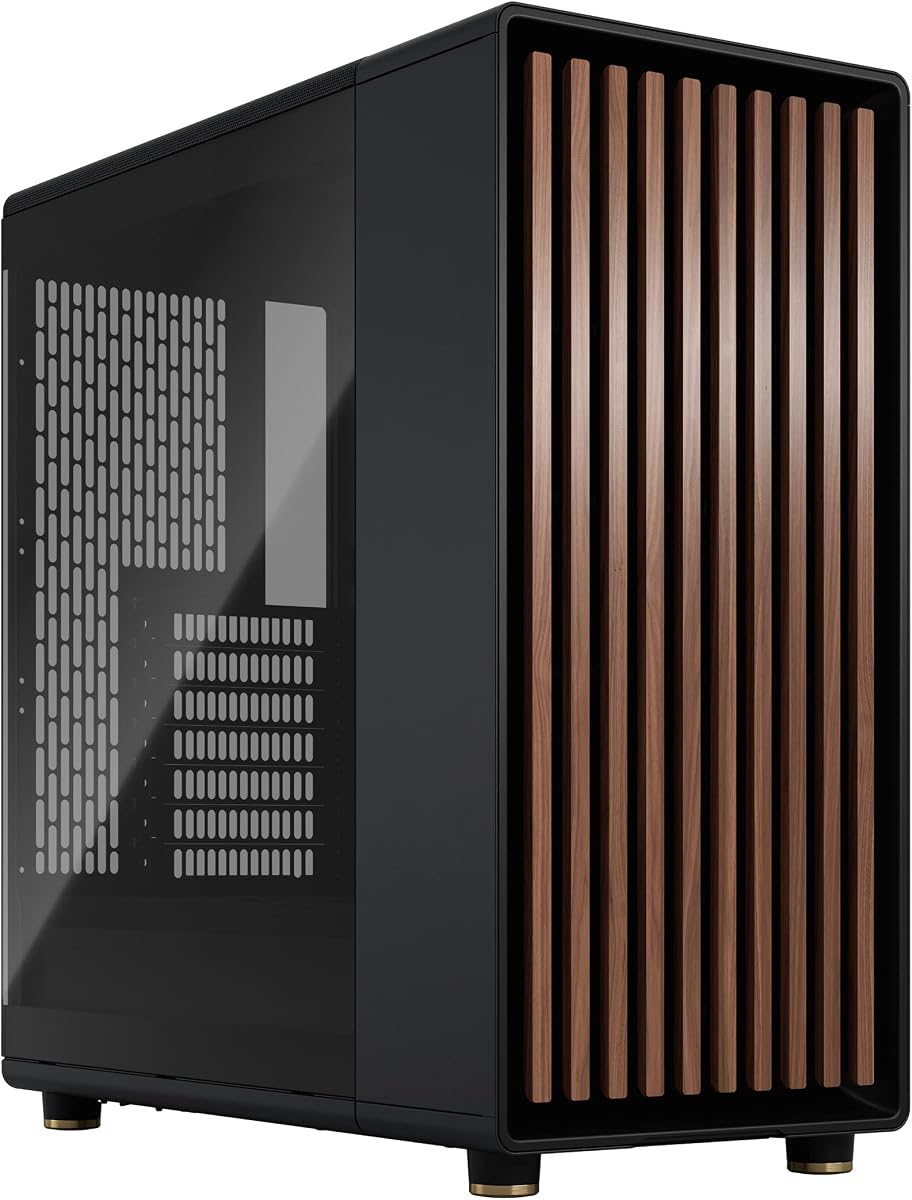
The Fractal Design North combines an open front, genuine walnut or oak accent bars, tempered glass, and front Type-C USB in a distinctive mid-tower. Its 4.7 rating reflects a strong balance of aesthetics and practical features. It is especially appealing when a gaming system should fit naturally into a living space or professional-looking workspace.
We may earn a commission when you buy through this link, at no additional cost to you.
Natural ventilation through the open front is supported by a stylish integrated mesh, and two 140mm Aspect PWM fans are included. Seven bridgeless expansion slots provide flexibility for add-in cards, while the case ships with two combined 3.5-inch and 2.5-inch drive mounts plus two dedicated 2.5-inch locations. Tool-free panel removal helps routine maintenance feel straightforward.
Graphics card clearance reaches 355mm, or 300mm when a 360mm radiator is installed at the front. That is enough for many gaming GPUs, but it is less generous than the 415mm to 420mm limits of several other picks. The open front also has a more decorative character, so buyers who prefer a conventional enclosed, understated chassis may prefer another model.
The North is an excellent front USB-C option for builders who prioritize materials, presentation, and natural styling while retaining solid airflow. It is less suitable for exceptionally long graphics cards or heavily expanded workstation configurations, but for a visually refined gaming build it offers a particularly memorable enclosure.
The wood front bars create a warmer focal point than the usual metal-and-glass enclosure. Combined with the open intake and tempered side glass, the design makes cooling hardware and internal components part of the room's visual character.
The removable side panels, pop-off top panel, integrated tab, and included drive mounts reduce friction during the initial build and later upgrades. These details are valuable even when a case looks primarily decorative.
We may earn a commission when you buy through this link, at no additional cost to you.
The MOROVOL 621-N4 is a conventional airflow mid-tower with four preinstalled 120mm RGB fans, a diamond-shaped mesh front, and a removable tempered glass panel. Its 4.2 rating is the lowest in the group, but the supplied details show a capable foundation for budget-oriented builds. Front USB-C is not listed, however.
We may earn a commission when you buy through this link, at no additional cost to you.
The included fans use fixed RGB illumination rather than addressable lighting, which is an important distinction for anyone planning synchronization with motherboard software. The perforated front is designed to admit air efficiently, and the tempered glass side provides a clear view of the four illuminated fans and other installed components.
Component limits are more modest than those of many competing cases. Graphics cards can measure up to 300mm, power supplies up to 160mm, and CPU coolers up to 155mm. The motherboard formats include ATX, Micro-ATX, and Mini-ITX, while storage support consists of two 2.5-inch SSD positions and two 3.5-inch hard-drive positions.
The 621-N4 makes sense for a colorful first gaming build when the included fan count and mesh airflow are the main priorities. It is not a direct match for the requested USB-C feature because the I/O details list one USB 3.0 port, two USB 2.0 ports, audio connections, reset, and power but no USB-C. Verify that requirement before purchase.
Four preinstalled 120mm RGB fans can form the basis of an intake and exhaust layout immediately, reducing the need to purchase a separate basic fan set before the first startup.
The fixed RGB effect avoids extra control software and synchronization setup. It is less flexible than addressable lighting, but it also means fewer possible points of conflict between lighting utilities.
We may earn a commission when you buy through this link, at no additional cost to you.
The Lian Li V100 is a clean white ATX mid-tower with a high 4.8 rating, four preinstalled ARGB fans, and a 26-LED integrated light strip. It supports substantial hardware, including GPUs up to 420mm and CPU coolers up to 178mm. The supplied specifications do not explicitly mention front USB-C, so that connector requires separate confirmation.
We may earn a commission when you buy through this link, at no additional cost to you.
The fan package includes four PWM-controlled 120mm ARGB units with daisy-chain connectivity. The integrated strip offers full-spectrum color control and synchronization with motherboard software, creating a coordinated appearance without requiring separate lighting controllers. Tool-less mounting on both side panels simplifies initial assembly and later access.
Motherboard support includes ATX, Micro-ATX, Mini-ITX, and qualifying back-connect ATX or Micro-ATX boards, allowing the case to serve both conventional cable-routing layouts and back-connect designs. A 360mm top radiator is supported, although the same 178mm CPU-cooler limit still applies. The white finish will naturally show dust and fingerprints more readily than a dark enclosure.
The V100 is a strong all-white showcase option for a gaming system where coordinated lighting and roomy component support are priorities. Its included fan set reduces early assembly work. It is worth considering even without confirmed USB-C, but it should not be selected solely for the front connector until the exact I/O configuration has been verified.
The included ARGB fans and integrated 26-LED strip create a consistent lighting scheme immediately. Daisy-chain connectivity and motherboard software support simplify control while keeping the visual result coherent.
Tool-less side panels reduce the effort needed to reach internal components, while 420mm GPU clearance provides enough space for large modern graphics cards without requiring a full-tower.
We may earn a commission when you buy through this link, at no additional cost to you.
The ASUS ProArt PA602 is a full-tower E-ATX case aimed at ambitious workstation and creator systems. It combines a high 4.7 rating with a front USB-C port operating at 20Gbps, extensive airflow hardware, and support for large graphics cards. It is the premium choice in this group when expandability matters more than a compact footprint.
We may earn a commission when you buy through this link, at no additional cost to you.
The front grill measures 15.5mm and has 45% porosity, helping air reach the interior through two extra-thick 200 by 38mm front fans and a 140mm rear exhaust fan. Two internal deflectors direct incoming air toward the motherboard and other components. A built-in fan hub centralizes fan management, while the front IR dust indicator provides a timely reminder to clean the filter.
The chassis supports one 420mm radiator for AIO or custom liquid-cooling loops, along with horizontal or vertical graphics card mounting. Its E-ATX full-tower format provides more room than the mid-towers in this guide, but buyers should confirm that the larger chassis will fit the intended desk, entertainment center, or cabinet.
The PA602 is best suited to a professional workstation, ambitious rendering system, or enthusiast build with a very large GPU and liquid cooler. Its confirmed 20Gbps USB-C connection and strong expansion support make it the premium pick, while the thermal and dust-management features justify careful consideration for sustained workloads.
The 20Gbps Type-C port is the standout connectivity feature, providing substantially more bandwidth than conventional USB-A and USB 3.2 connections. It is useful for compatible high-speed storage, docks, and accessories in a frequently used workstation.
E-ATX motherboard support, 420mm radiator capacity, and flexible GPU orientation make the PA602 appropriate for high-end components. The case's size and thermal provisions are intended for builds where stability and serviceability take priority over minimal desk footprint.
We may earn a commission when you buy through this link, at no additional cost to you.
The NZXT H5 Flow is a compact ATX mid-tower centered on tidy presentation, effective airflow, and straightforward cable routing. Its 4.7 rating makes it one of the most polished general-purpose designs listed. The supplied information does not confirm a front USB-C port, so buyers with that non-negotiable requirement should check the current I/O specification.
We may earn a commission when you buy through this link, at no additional cost to you.
Ultra-fine mesh covers the top, front, and side panels to promote airflow and filter dust. Two 120mm Quiet Airflow fans are preinstalled, one at the front and one at the rear. The perforated PSU shroud allows intake from two 120mm fans, although those fans are not included, giving owners another way to improve bottom-of-case airflow.
Radiator support is particularly useful for compact systems, with room for a 360mm radiator at the front and a 240mm radiator at the top. Wide routing channels, hooks, and straps help conceal cables, which supports the clean visual approach. As with every chassis, actual GPU and cooler clearance must be checked against the exact components being installed.
The H5 Flow is ideal for a compact, neat build where cable management and dust-conscious mesh panels are priorities. It offers a strong foundation for liquid cooling and a restrained black appearance. It is a worthwhile general recommendation, but its suitability for the requested USB-C category depends on confirmation of the connector not included in the supplied data.
Wide cable channels, dedicated hooks, and straps make it easier to keep wiring out of sight in a smaller chassis. The result is a more orderly build even when the system contains several cables and front-panel connections.
Support for a 360mm front radiator and a 240mm top radiator allows builders to move beyond the included air cooling. The perforated shroud also creates an optional bottom-intake path using two additional fans.
We may earn a commission when you buy through this link, at no additional cost to you.
The Cooler Master QUBE 540 is a compact ATX mid-tower with a 4.4 rating, front USB-C, a full mesh front, and a reversible I/O panel. Its flexible orientation is unusual: the case can operate horizontally or vertically, and movable handles assist with repositioning. It is a strong fit for builders who want front USB-C without committing to a full-tower.
We may earn a commission when you buy through this link, at no additional cost to you.
The mesh-optimized front maximizes ventilation, and a SickleFlow 120mm fan comes preinstalled. Additional cooling hardware can be added as needed, making the QUBE 540 a practical enclosure for either an air-cooled starter system or a more advanced custom configuration. Tempered glass provides a window into the internals and complements the industrial shape.
Graphics card clearance reaches 415mm when the front fan is not installed, accommodating large cards such as the RTX 5090 and RX 9070 XT listed in the specifications. The chassis supports Mini-ITX, ATX, and E-ATX motherboards up to 11 inches wide despite its ATX form factor. The horizontal and vertical layouts, however, may require different accessory arrangements or mounting considerations.
The QUBE 540 is a compelling option for a compact desk, media unit, or workstation that still needs large-GPU capacity and front USB-C. It falls short of the most fully equipped cases because only one fan is included, but its flexible orientation, broad motherboard support, and documented Type-C connection create a distinctive foundation for a custom build.
The reversible I/O panel and movable handles let the enclosure move between horizontal and vertical positions. That flexibility is useful when a build changes location or when desk space and viewing angle become more important after installation.
Despite its mid-tower format, the QUBE 540 supports E-ATX boards and graphics cards up to 415mm. The main caveat is that achieving the stated maximum GPU clearance requires leaving the front fan position unobstructed.
We may earn a commission when you buy through this link, at no additional cost to you.
Front USB-C should be treated as one requirement within a broader fit-and-compatibility check. Motherboard format, graphics card length, CPU cooler height, radiator placement, drive needs, and preferred airflow arrangement can be just as important as the connector at the top of the chassis.
A front USB-C socket is useful only if it matches the speed and feature level required by your devices. The clearest specifications in this group identify a USB 3.2 Gen 2 port at 10Gbps or a USB Type-C port at 20Gbps. Other cases are described as Type-C ready without giving a data rate, while several listings contain no explicit USB-C mention. Before buying, confirm the actual front-panel port, confirm that it is an input rather than a decorative connection, and check whether an internal header or adapter is required.
Most builders will choose between ATX, Micro-ATX, and Mini-ITX, but some premium cases also support E-ATX and back-connect boards. The Lian Li Vector V100 and V100 support back-connect ATX or qualifying Micro-ATX motherboards, while the Cooler Master QUBE 540 accommodates boards up to 11 inches wide. Micro-ATX and Mini-ITX boards normally fit an ATX chassis, but the reverse is not true, and back-connect support may depend on exact board dimensions.
Modern graphics cards can exceed the clearance of many budget mid-towers. The MOROVOL 621-N4 supports GPUs up to 300mm, while the Fractal Design North reaches 355mm. The DARKROCK EC2 ATX supports 340mm, the Okinos Cypress 7 supports up to 415mm at the front, and both Lian Li models allow 420mm. The ASUS ProArt PA602 and Cooler Master QUBE 540 also target 420mm or 415mm-class hardware. Include the card's actual length and any sag support in your clearance calculation.
Radiator support is useful only when the listed position, dimensions, and mounting pattern match your cooling hardware. Several cases support a 360mm front radiator, but the best top-radiator option in this group appears among the Lian Li models, DARKROCK EC2 ATX, and ASUS ProArt PA602. NZXT supports a 360mm front and 240mm top arrangement. Remember that installing a front radiator can reduce graphics card clearance, as the Fractal Design North documentation demonstrates.
The case and cooler must be considered together because a compact case can still reject a tall tower cooler. The MOROVOL 621-N4 lists a CPU-cooling limit of 155mm, while the Lian Li Vector V100 and V100 support up to 178mm. Other supplied specifications do not state a CPU-cooler height, so do not assume compatibility merely because the motherboard format is supported. A low-profile air cooler or a compatible AIO may be a safer choice when dimensions are not documented.
Included fans can reduce the work required to complete a build, but the number alone does not determine performance. The Okinos Cypress 7 and Lian Li V100 include four PWM or ARGB fans, while the MOROVOL 621-N4 includes four fixed-RGB fans. The DARKROCK supports up to eight 120mm positions, the Lian Li Vector V100 supports up to nine, and the ASUS PA602 includes substantial front and rear fan hardware. Look for mesh openings, dust filtering, rear exhaust, and a clear route for intake air.
Drive requirements can influence the fan layout, especially in cases with dedicated storage positions. The Okinos Cypress 7 supports up to five SSDs, but using the two side locations limits additional fan installation. The Fractal Design North includes two combined 3.5-inch and 2.5-inch mounts plus two dedicated 2.5-inch mounts, while the MOROVOL supports two 2.5-inch SSDs and two 3.5-inch hard drives. Confirm both the quantity and physical bay type before committing.
Full-towers such as the ASUS ProArt PA602 offer maximum room, while ATX mid-towers provide a more manageable footprint. Styling is also highly personal: the DARKROCK uses a conventional mesh-and-glass design, the Okinos and Fractal Design models introduce natural wood, the NZXT favors a restrained organized look, and the QUBE 540 supports horizontal or vertical orientation. Finally, consider panel removal, cable routes, filters, and component access to estimate how often the case will need to be opened.
Begin by comparing the case's front I/O layout with the ports on your motherboard and accessories. Connect the case's USB-C header to the matching motherboard header, and never force a connector into a differently shaped socket. For cases whose documentation only says Type-C ready, use the manufacturer's placement diagram rather than assuming the exact header or port location.
Install the power supply, motherboard, expansion cards, storage, and cooling hardware in the order recommended by the case manual. Keep front and rear cables clear of fans, verify that the top or side panels can close without pressing on tubing, and ensure the graphics card has the clearance and support it needs. Connect case fans to the appropriate PWM and lighting headers, taking care not to connect addressable ARGB equipment to a basic RGB header.
During routine care, power down and unplug the system before opening the case. Clean removable dust filters on a regular schedule, particularly in rooms with carpet, pets, or frequent computer use. Use gentle methods around tempered glass, avoid blocking the front mesh, and check that intake and exhaust fans remain unobstructed. Confirm the front USB-C port still has a firm, damage-free connection before reconnecting any peripheral cable.
No. A Type-C-ready label usually indicates that the chassis is designed to accept a Type-C front-panel connection, but it does not always identify the connector generation, data rate, or whether a separate header is required. The DARKROCK EC2 ATX is described this way in the supplied information. Confirm the full I/O diagram and motherboard compatibility before purchasing.
Not automatically. Speed depends on the USB generation implemented by the case and the connected device. The ASUS ProArt PA602 lists a 20Gbps USB Type-C port, while the Okinos Cypress 7 lists USB-C 3.2 Gen 2 at 10Gbps. Other cases may use a lower-speed implementation, so check the specification rather than judging by connector shape.
Usually not. ATX motherboards are larger than Micro-ATX and Mini-ITX boards, so a smaller chassis generally cannot accept them. Always match the case's supported motherboard formats to the exact board, especially when using a back-connect design whose cable routing and dimensions can differ from a standard layout.
No. GPU clearance and radiator support are separate measurements. A case may accept a graphics card up to 415mm or 420mm while offering a maximum 240mm top radiator, or it may support a 360mm front radiator that reduces available GPU space. Check both dimensions and the position where the radiator is intended to be installed.
Tempered glass is easy to wipe clean and resists scratching, but fingerprints and dust can remain visible on dark and reflective surfaces. Use a soft microfiber cloth and a suitable cleaner, avoid abrasive pads, and support the panel when removing it so it does not twist or fall. A fabric-lined cleaning cloth is preferable to a dry cloth that may leave lint.
A larger included fan set can make the initial build easier, but compatibility and control features matter more than the count. Check whether the fans use PWM control, whether their lighting is addressable, and whether they are placed for intake and exhaust. Cases such as the MOROVOL 621-N4 include four fixed-RGB fans, while the Lian Li models include addressable ARGB alternatives.
A full-tower can offer more room for E-ATX motherboards, long graphics cards, large radiators, and additional cables. The ASUS ProArt PA602 is the relevant full-tower in this guide, with 420mm radiator support and horizontal or vertical GPU mounting. The extra capacity is valuable, but only if the larger footprint fits your workspace.
Clean the filter whenever you notice increased fan noise, reduced airflow, or visible dust, and check it more frequently in dusty environments. The ASUS PA602 includes a front IR dust indicator for timely reminders, while the DARKROCK uses separately mounted magnetic filters. Remove the filter according to the manual, clean it gently, and let it dry completely before reinstalling it.
The Lian Li Vector V100 stands out as the most balanced overall option because it explicitly provides front USB-C while supporting 420mm GPUs, a 360mm top radiator, and several motherboard formats. The DARKROCK EC2 ATX is a strong budget-oriented alternative with abundant fan positions and Type-C readiness, while the ASUS ProArt PA602 delivers the premium combination of 20Gbps USB-C, E-ATX capacity, and workstation-scale expansion.
Before choosing, verify the connector's exact USB generation and confirm the case's I/O diagram. Then check GPU length, CPU-cooler height, radiator position, motherboard format, and drive layout against your parts list. Natural wood styling, integrated ARGB, removable panels, orientation, and full-tower dimensions can then serve as the final tie-breakers for your particular setup.
Product details, configurations, and prices can change over time, so review the current listing and manufacturer information before ordering. If front USB-C is the defining requirement, favor a model that explicitly states both the connector and its data rate rather than relying on a broader Type-C-ready description.