
YIHUA 948DQ-I
4.5Editor score
Front and rear filtration
Adjustable 30-degree tilt
Effective within 10 centimeters
Includes helping fenders
Our soldering fume extractor guide compares ten models for airflow, filtration, noise, capture range, workspace fit, and replacement filter convenience, and
Soldering fumes can spread quickly through a workshop, especially when flux heats, burns, or disperses into the surrounding air. A capable soldering fume extractor captures smoke close to its source, filters particles and odors, and makes routine electronics work more comfortable. The right model should match your bench size, solder types, and ventilation needs.
We compared ten fume extractors using the specifications and features supplied for each product. The evaluation considers airflow, filtration stages, capture distance, noise-control features, adjustability, construction, voltage compatibility, filter replacement, and useful extras. The list covers compact desktop units, adjustable fume fans, and higher-capacity machines for demanding workspaces.
Each review explains the strongest reasons to consider a model, along with practical limitations to keep in mind. The top recommendations range from an economical compact option to a versatile filtered extractor and a premium high-capacity unit. Product availability and pricing can change, so confirm current listing details before purchasing.
4.5Editor score

4.7Editor score

4.3Editor score
The table below compares the ten recommended soldering fume extractors by airflow, filtration, capture distance, and workspace features. It is designed to make the differences between compact, adjustable, portable, and high-capacity models easy to understand at a glance.




The KOTTO Solder Smoke Absorber combines a 3000 RPM fan with a thick activated-carbon filter in a straightforward desktop package. Its 4.7 rating is the highest among the ten products in this guide, while its specified ability to remove fumes from approximately 5-6 inches away makes it suitable for many electronics benches. The design focuses on useful essentials rather than digital controls or complicated accessories.
We may earn a commission when you buy through this link, at no additional cost to you.
The fan is described as low noise and designed to draw solder and flux fumes toward the carbon filter before they disperse. Four heavy-duty rubber feet help prevent movement during use, while the carrying handle makes the unit easier to relocate between work areas. The filter is 0.4 inch thick, and a replacement smoke-trap filter is included, which is helpful for owners who perform enough soldering to make regular filter changes relevant.
Its main limitation is that the filtration system centers on activated carbon rather than a documented multi-stage combination of a pre-filter, HEPA filter, and carbon media. There is also no hose or articulated arm, so the extractor must sit close to the work rather than reaching into a crowded area. These trade-offs are reasonable for a compact, straightforward unit, particularly when compared with more elaborate models.
This KOTTO extractor is a strong recommendation for hobbyists, electronics students, and repair technicians who want effective close-range capture without a large footprint. It is especially appealing for routine soldering of small circuit boards, where a 5-6 inch working range should be practical. Choose it when straightforward suction, easy relocation, and a supplied replacement filter matter more than advanced filtration displays or extensive positioning hardware.
The specified 5-6 inch removal distance gives the extractor a useful operating zone for small electronics work. Place it close to the joint and keep the nozzle facing the active solder tip rather than waiting for smoke to spread across the bench.
A 0.4-inch activated-carbon filter and an included replacement make routine maintenance easier to understand. Check the filter condition regularly and replace it according to the manufacturer's guidance to avoid reducing airflow.
We may earn a commission when you buy through this link, at no additional cost to you.
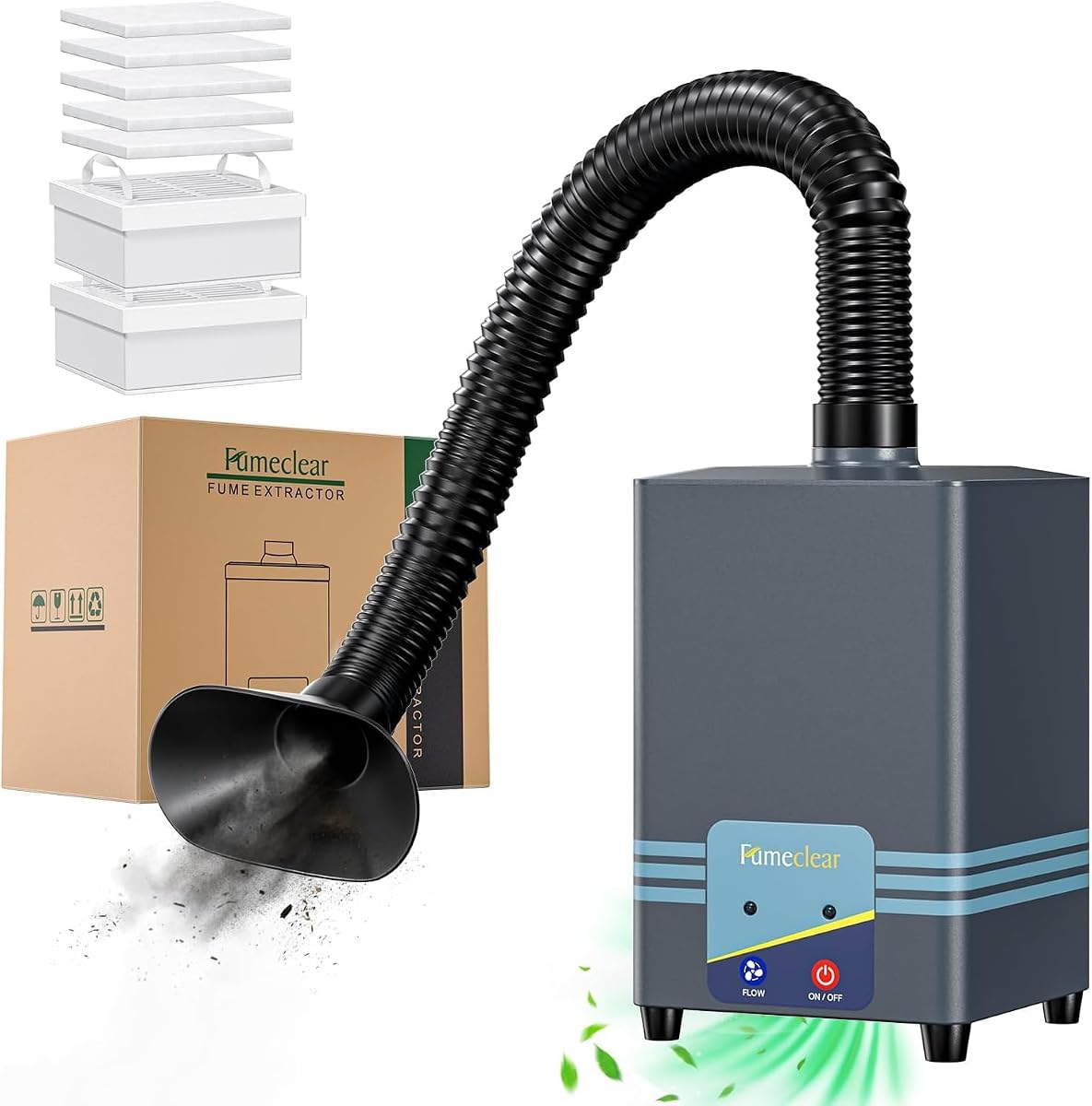
The FumeClear FC-2001S combines a portable enclosure with an extendable hose and a documented three-stage filtration system. It handles solder smoke, iron filings, and dust while offering airflow of up to 128-168m³/h. Its 4.4 rating reflects a broadly capable design intended for hobbyists and professionals working in compact spaces.
We may earn a commission when you buy through this link, at no additional cost to you.
The filtration sequence includes a pre-filter, an H12 HEPA filter, and high-iodine coconut-shell activated carbon. The listed carbon has an iodine value of 500-700mg/g, giving the carbon stage a clearly defined adsorption capacity. The product information also states that the system can capture 99.99% of fine particles and neutralize 99.97% of contaminants, making its filtration sequence more transparent than a basic carbon-only device.
The included extendable hose offers better positioning than a fixed-head desktop fan and allows the nozzle to approach the smoke source. FumeClear specifically recommends aligning the nozzle directly with the source for the strongest effect. The tradeoff is that the filter assembly is sophisticated enough to require sensible maintenance, and the housing and hose may occupy more space than the smallest adjustable fume fans in the guide.
This model suits users who work with varied electronics tasks and want both particle filtration and odor control. It is a sensible pick when a flexible hose and detailed filter specifications are important but a smaller footprint and lower-power motor would better suit the work. Position the hose near the solder joint, maintain a clear exhaust path, and replace components according to their service life.
The extendable hose lets the suction nozzle follow the work rather than forcing the entire unit into one position. This is especially helpful for tall components, awkward boards, and crowded benches where smoke rises from different heights.
A pre-filter handles larger contamination, the HEPA stage targets fine particles, and the activated-carbon layer addresses odors and gaseous compounds. Together, these stages suit soldering tasks that produce more than visible smoke alone.
We may earn a commission when you buy through this link, at no additional cost to you.
This second KOTTO listing offers the same core concept as the leading product: a 3000 RPM extraction fan, a 0.4-inch activated-carbon filter, and close-range capture for solder and flux fumes. Its 4.6 rating is among the strongest in the group. The straightforward format is well suited to technicians who value suction performance and uncomplicated operation.
We may earn a commission when you buy through this link, at no additional cost to you.
The fan is specified to remove fumes from approximately 5-6 inches away, which is a useful distance for conventional bench soldering. Its low-noise operation, four non-slip rubber feet, and integrated carrying handle support regular use. A replacement filter is included, and the stated operating range is -20°C to 60°C, while power consumption is listed at 120V and 30W.
As with the other KOTTO unit, the carbon filter is the principal filtration stage, and there is no documented HEPA layer or flexible hose. Buyers who routinely work with dusty debris, unusual airborne contaminants, or highly visible smoke may prefer one of the three-stage extractors. The fixed form also requires rearranging the entire unit when the solder joint moves considerably.
Choose this model for close-range bench extraction, portable use, and uncomplicated filter service. It fits the needs of most hobby and repair workloads without requiring a large power system. Users who regularly solder inside densely populated circuit boards may need to position the extractor very carefully, while those working across a broad bench would benefit from a hose-equipped alternative.
The integrated handle and compact footprint make it easier to move the extractor to a shared electronics bench or temporary workspace. The rubber feet provide stability wherever it is placed.
The stated 5-6 inch working distance is best used consistently. Bringing the intake closer to the solder joint reduces the distance fumes must travel before capture begins.
We may earn a commission when you buy through this link, at no additional cost to you.
The WEP 948DQ-I is designed as both a fume extractor and a soldering-station accessory. Its 4.4 rating reflects a practical package that combines extraction, filtration, an adjustable tilt, side fenders, and attachable helping hands. At 3.5 by 5.7 by 6.5 inches, it is designed to remain compact on an electronics bench.
We may earn a commission when you buy through this link, at no additional cost to you.
Filtration adsorbers appear at both the front and rear, allowing the unit to filter from two sides. The tilt mechanism changes the extraction angle to suit the work area, while the fenders reduce the effect of disruptive airflow. The stated effective capture distance is 10 centimeters, and the built-in power switch makes daily activation simple.
The included 11.8-inch helping hands can secure a circuit board, wires, or components while the soldering iron is in use. That added utility makes the package appealing to new hobbyists who want a more complete station. Its limitations are the relatively short stated capture range, the absence of a detailed HEPA specification, and operation limited to 110-127V.
This extractor is a good match for hobbyists who value helpful accessories and an adjustable compact form. It works well for routine soldering near the intake rather than high-volume or distant smoke capture. For users outside the US or those needing finer particle specifications, a hose-equipped or multi-stage model may be a better long-term fit.
The attachable helping hands support components while keeping both hands free for tool work. This turns the extractor into a compact soldering aid rather than a standalone fan.
Front and rear filtration adsorbers provide two opportunities to intercept airborne particles. Adjusting the tilt allows the active side to follow the position of the soldered component.
We may earn a commission when you buy through this link, at no additional cost to you.
The FumeClear FC-2001SG provides the same 128-168m³/h airflow range, three-stage filter arrangement, and extendable-hose format as the FC-2001S. With a 4.4 rating, it belongs among the strongest filtered options here. Its core appeal is the combination of portable housing, fine-particle filtration, and high-iodine activated carbon.
We may earn a commission when you buy through this link, at no additional cost to you.
The pre-filter, H12 HEPA filter, and coconut-shell carbon form a staged system that addresses large debris, fine particles, and odors in sequence. The carbon's stated iodine content of 500-700mg/g provides a useful measure of its adsorption capability. The hose can be positioned toward the solder joint, although FumeClear notes that aligning the nozzle directly with the smoke source produces the best result.
The model's universal-voltage design supports both 110V and 220V environments, making it more adaptable than units limited to a single regional supply. Its fixed speed and lack of a digital display may be less convenient than the YC60, which provides real-time speed information and a stepless control. Those trade-offs do not undermine the core function but make it more straightforward to operate.
This FC-2001SG is well suited to precision soldering, PCB repair, and compact workspaces that benefit from a dedicated filtration sequence. It is a practical choice for buyers who prioritize filtration details and hose positioning without needing an articulated arm. Confirm that the supplied accessories and replacement-filter process match your local setup before ordering.
The universal-voltage design allows operation in both 110V and 220V environments. This is useful for workshops that may move equipment between regions or use different outlet standards.
The listed 500-700mg/g iodine value gives buyers a clearer indication of the activated-carbon stage than a generic carbon claim. It is particularly relevant when odor control matters as much as visible smoke capture.
We may earn a commission when you buy through this link, at no additional cost to you.
The FumeClear FC-2001A emphasizes filtration efficiency and a more durable desktop enclosure. It delivers an airflow of 120-180m³/h and uses True H13 HEPA combined with activated carbon rated at 600-800mg/g iodine. Its 4.4 rating places it among the higher-rated products, while the documented filter specifications make it easy to compare with other advanced units.
We may earn a commission when you buy through this link, at no additional cost to you.
Its all-metal housing is intended to contain fumes during purification, and a brushless motor supports the stated suction performance and 15-centimeter effective working range. That range exceeds the 10-centimeter specification of the compact adjustable models. The larger dust-holding capacity is also claimed to extend filter life considerably compared with smaller compact units.
The listing references a brushless motor released in November 2026 and describes voltage-inverter technology for stable operation on 110V and 220V. This adds engineering detail, but buyers may still want to inspect the final package and understand which replacement filters are supplied. The all-metal body and larger filter capacity may also demand more bench space than the smallest extractors.
Choose the FC-2001A for precision electronics work where H13 filtration, odor adsorption, and a somewhat longer capture range are priorities. It is a strong middle-to-premium option for users who want more filtration detail than a carbon-only fan but do not need the Zericuf's very high airflow. Position the intake near the source and keep filter replacement consistent with the manufacturer's schedule.
True H13 HEPA targets fine particles, while the 600-800mg/g activated carbon addresses odors and gaseous contaminants. The two-in-one arrangement makes the unit appropriate for soldering tasks that produce mixed airborne debris.
The stated 15-centimeter working range gives the user more flexibility than compact fixed-head units. It can be useful when the board must remain in a particular position or the solder joint sits farther from the bench edge.
We may earn a commission when you buy through this link, at no additional cost to you.
The NT-M1 balances compact dimensions with high-capacity extraction and flexible positioning. Measuring 5.1 by 5.1 by 6.3 inches and weighing 3 pounds, it is designed for small apartments, home offices, and crowded craft benches. Its 4.4 rating reflects a capable desktop package with H13 filtration and a 168m³/h airflow rating.
We may earn a commission when you buy through this link, at no additional cost to you.
The shape-retaining hose extends up to 25.6 inches and can bend through 360 degrees, allowing the suction head to reach the smoke source without moving the entire unit. A stepless knob adjusts fan speed for heavier fumes or quieter operation. The filter system uses H13 HEPA, a 10-millimeter pre-filter, and distributed carbon intended to reduce light odors.
The high-density pre-filter is designed to catch larger particles and flux splatter before they load the main filter, helping preserve performance over time. The compact body and low weight are meaningful advantages in a small workspace, though the flexible hose can droop or require careful positioning when extended. It also does not offer the rigid, continuously adjustable arm found on the premium high-capacity model.
This extractor is an excellent match for hobbyists, PCB repair users, and makers with limited bench space. Its stated applications also extend to stained glass, woodburning, resin printing, and jewelry work, where a flexible intake and variable speed are useful. It is particularly attractive when H13 filtration and quiet adjustment are wanted without the footprint of a larger industrial machine.
The square 5.1-inch footprint and 3-pound weight make the NT-M1 easier to accommodate than bulkier extractors. These dimensions are useful for compact home workshops where every inch of bench space matters.
The stepless speed control lets users increase airflow during active soldering or reduce it during less demanding tasks. That flexibility can also help lower noise when strong extraction is unnecessary.
We may earn a commission when you buy through this link, at no additional cost to you.
The YIHUA 948DQ-I is a budget-oriented fume extractor with an adjustable stand, dual filtration, and a five-blade fan. Its 4.5 rating is strong for a compact model, and the package includes eight filtration adsorbers, two fenders, and a tiltable stand. These components make it especially appealing to new solderers building a functional bench setup.
We may earn a commission when you buy through this link, at no additional cost to you.
Filtration adsorbers are positioned at the front and rear, helping address particles approaching from two directions. The stand tilts through 30 degrees so the active filtering area can be aligned with the soldered component. Fumes generated within approximately 10 centimeters can be effectively adsorbed, while the side fenders reduce the influence of disruptive airflow around the work area.
The five-blade fan is described as having a longer operating lifespan and relatively low noise. Compared with units that provide detailed HEPA and carbon specifications, the YIHUA's filtration claims are simpler, so it is best viewed as an odor- and particle-control device for ordinary soldering. It is also designed for 110-127V with a US-standard plug, which limits international compatibility.
This is a strong pick for students, hobbyists, and budget-conscious bench builders who value adjustability and helpful accessories. It offers enough structure to keep the intake aimed at the joint while remaining simpler than hose-equipped or digital models. For high-volume work, heavy laser cutting, or applications requiring certified fine-particle specifications, move up to a more advanced extraction system.
The 30-degree tilting stand helps match the intake to the solder joint and nearby fumes. It is a simple way to improve capture without moving or holding the unit by hand.
The package includes multiple adsorption filters and two side fenders. These extras help establish a cleaner soldering area while protecting the component from excessive disruptive airflow.
We may earn a commission when you buy through this link, at no additional cost to you.
The Zericuf is the highest-capacity option in this guide, with 320m³/h airflow, a 180W brushless pure-copper motor, and a stated capture range beyond 30 centimeters. Its 4.3 rating is slightly below several compact models, but the engineering and capacity claims position it for demanding soldering, laser work, and 3D-printer exhaust rather than light hobby use alone.
We may earn a commission when you buy through this link, at no additional cost to you.
Filtration uses double-thickness pre-filter sponges, a True H13 HEPA layer, and high-iodine activated carbon with an iodine value of 800-900mg/g. The pre-filter is intended to stop larger debris before it reaches the main filter, while the carbon stage is advertised for volatile compounds and heavy metals. Ten pre-filters are included, and a buzzer provides a clog alert.
Noise control comes from an all-metal enclosure containing acoustic and damping foam. The stated operating level remains below 58 dB even at maximum airflow. A downward-sloping rear vent directs hot exhaust away from the work surface, while four swivel casters with brakes make the relatively heavy unit easier to move. The tradeoff is that this is substantially more equipment than a small desktop fan.
This premium extractor is recommended for professional electronics benches, shared training spaces, and makers who also use lasers or resin printers. Its articulated arm, long capture range, and mobile base suit an active workstation. Buyers should also note the stated future availability of replacement filters and confirm current availability for their region before committing to the platform.
The 320m³/h airflow and 30-centimeter-plus capture range offer substantial margin over compact units. This is useful when fume generation is heavy, the source is moving, or several tasks share a workshop.
Lockable swivel casters allow the extractor to move around a room and remain fixed once positioned. The articulated arm then maintains the intake near the source without requiring the entire machine to sit directly beside the work.
Thick pre-filters intercept larger particles before they reach the HEPA and carbon stages. Combined with the clog alert, this design can simplify maintenance planning and help preserve effective airflow.
We may earn a commission when you buy through this link, at no additional cost to you.
The YC60 combines strong suction, digital controls, and quiet operation in a desktop-oriented extractor. Its 4.5 rating is among the best in the group. The unit delivers 71 CFM, equivalent to 120m³/h in the supplied description, and uses a three-layer filter arrangement consisting of a pre-filter and a combined H13 HEPA plus activated-carbon stage.
We may earn a commission when you buy through this link, at no additional cost to you.
A heat-resistant arm rotates 360 degrees and locks at the desired position, making it easier to direct the intake toward a solder joint. The real-time digital display shows the current fan speed, while stepless adjustment lets users balance capture strength and sound. The listed operating noise is below 50 dB, which is a notable feature for a product aimed at focused work environments.
The all-metal frame is intended to resist impacts and shield the internal assembly from soldering-related heat. Its 100-240V AC support broadens international compatibility. The filter has a larger dust-holding volume and is claimed to last up to three times longer than filters in smaller devices, while individual filter components are replaceable. However, no explicit working capture distance is provided.
The YC60 is a strong all-around recommendation for users who want modern controls without moving to a large industrial chassis. It suits electronics repair, welding-adjacent tasks, stained glass, pyrography, resin printing, and jewelry work. Choose it when quiet operation, easy positioning, and clear speed feedback are important, particularly in a shared or occupied workspace.
The digital display removes uncertainty about the selected fan speed. Users can raise airflow for active soldering and lower it during pauses or quieter tasks without relying on an uncertain dial setting.
The heat-resistant 360-degree arm keeps the intake near the work and can be locked into place. Its below-50 dB operating claim makes the YC60 appealing where continuous background noise would be distracting.
The stated 100-240V AC range allows operation across many regions without a separate adapter. This is helpful for mobile workshops, training rooms, and international bench setups.
We may earn a commission when you buy through this link, at no additional cost to you.
Choosing a soldering fume extractor requires balancing filtration, suction, noise, positioning, and available space. The right unit should capture fumes close to the solder joint without interfering with the work or creating a difficult maintenance routine.
Activated carbon is especially relevant to the odors and gaseous compounds created when flux heats, while HEPA filtration targets fine particles that may be present alongside solder smoke. A pre-filter adds another useful layer by trapping larger debris and flux splatter before they load the more expensive main filter. Models with clearly documented media, such as an H13 HEPA stage and a stated carbon iodine value, are easier to compare than units that only advertise a generic smoke filter.
Airflow indicates how much air the extractor can move, while capture range describes how far the intake can effectively draw fumes from the source. Both matter because a powerful fan still needs to be positioned correctly. Compact units with a 5-6 inch or 10-centimeter range are suitable for close electronics work, whereas flexible hoses and articulated arms extend practical reach. Higher-capacity extractors are advantageous when smoke is generated quickly, the source moves, or other tasks such as laser cutting share the workspace.
A soldering fume extractor occupies space that may already be needed for tools, components, and a soldering station. Compact square units are convenient for home offices and shared benches, whereas high-capacity machines may need floor space or a dedicated section of the worktable. Consider the base, hose routing, exhaust direction, and whether casters or carrying handles will make the unit easier to move. The most powerful option is not necessarily the most convenient one for a small workspace.
Soldering often requires concentration, so extractor noise can affect comfort and productivity. Some models include speed controls that allow users to reduce airflow when the immediate task is light. Dedicated acoustic chambers and damping materials can also reduce motor sound in higher-capacity machines. Compare the stated operating levels carefully, but remember that the quietest level may occur at a lower fan setting, so control range matters as much as the headline noise figure.
Effective capture depends on keeping the intake near the source without placing it where it blocks the user's hands or obstructs the board. Tiltable stands work well for small fixed benches, flexible hoses accommodate varying board positions, and articulated arms provide the greatest freedom in active workspaces. Helping hands, side fenders, and digital displays can add convenience, but they should not distract from the core priorities of filtration, suction, and maintenance access.
Voltage requirements should be checked before ordering, particularly for international buyers or workshop equipment that may move between locations. Some compact products are restricted to North American 110-127V operation, while others support 110V and 220V or a broad 100-240V range. Universal-voltage support is convenient, but the extractor must still be connected to a suitable, safely installed outlet. Also consider whether the power cord can reach the intended bench position without crossing the work area.
A fume extractor is a maintenance-based appliance because its filters eventually load with particles and adsorb contaminants. Check whether the main filter, carbon layer, and pre-filter are individually replaceable and whether replacement stock is likely to remain available for the selected model. The supplied information includes an availability caveat for one premium product, illustrating why buyers should verify replacement parts before choosing a platform. Replacing filters on schedule helps preserve airflow and consistent filtration.
Plastic housings can be adequate for light hobby soldering, while all-metal construction may be preferable for frequent use, heat exposure, or mobile workshop arrangements. Motor type, filter capacity, and housing design should reflect how often the unit will operate. Consider whether the application remains electronics repair or expands to welding, stained glass, woodburning, laser work, or resin printing. A higher-capacity unit is worthwhile when the extractor must manage several contaminants or sustain longer sessions.
Place the extractor on a stable, level surface with its intake unobstructed and its exhaust directed away from the work area. Position the intake 5-6 inches from the solder joint for compact fixed-head models, within the stated 10-centimeter or 15-centimeter range for other units, or close to the source when using a hose. For flexible hoses and articulated arms, bring the nozzle directly toward the visible fume path and avoid pulling it sharply against the solder joint.
Start the extractor before heating the soldering iron so airflow is established before flux begins to smoke. Adjust the fan speed or suction control according to the amount of visible fume and the noise level that suits the workspace. Keep the intake clean, do not block vents, and avoid placing flammable materials near the exhaust. When changing tasks, move the hose or arm rather than dragging the entire unit across the bench.
Clean the removable pre-filter according to the manufacturer's instructions and replace the HEPA and carbon elements when indicated or when airflow declines. Never operate the unit with a missing or damaged filter. Before cleaning or changing components, disconnect the power. Maintain clear space around the exhaust outlet, inspect the cord and housing periodically, and confirm that replacement parts are compatible with the exact model.
The closer the intake is to the source, the less smoke has to travel through the room. For the listed KOTTO models, the specified capture distance is 5-6 inches, while several competing units are described as effective within 10-15 centimeters. Follow the manufacturer's guidance and position the nozzle directly in the path of the fumes rather than relying on maximum fan speed alone.
A local extractor and general room ventilation serve different purposes. The extractor captures fumes near the solder joint, while room ventilation dilutes contaminants that escape or originate elsewhere. Keeping the intake close to the source improves local capture, but a sensible ventilation plan may still be appropriate in a shared or small workspace.
HEPA media is particularly useful for capturing fine particles and extending the filtration sequence beyond a basic carbon filter. Activated carbon remains important for odors and gaseous compounds, so a pre-filter, HEPA stage, and carbon stage offer the most comprehensive arrangement. If your main concern is heavy visible smoke and routine flux fumes, a dual-side adsorption model may be sufficient.
Replacement timing depends on workload, airflow, filter type, and the condition of the media. Heavy soldering, dusty debris, or declining suction can indicate that a filter needs service sooner. Follow the manufacturer's replacement guidance, inspect the pre-filter regularly, and replace the HEPA and carbon components as a compatible set when required.
Several models in this guide are also marketed for those applications. The Zericuf offers the highest stated airflow and capture reach, while the NT-M1 and YC60 are compact options with flexible positioning. Confirm that the selected filter media is appropriate for the specific material and process, since fumes from different sources can contain very different substances.
A fume fan primarily moves air toward a filter or vent, while a filtered extractor combines airflow with one or more treatment stages. In this list, basic models use activated-carbon adsorbers, while advanced models add a pre-filter and H13 HEPA media. The latter generally offer more detailed particle control and odor treatment, but they also require more deliberate filter maintenance.
Noise commonly comes from the motor, fan, housing vibration, and turbulent airflow through the filter. A partially clogged filter can also reduce airflow and change the sound. If the unit becomes louder or weaker than normal, check the filter condition, ensure vents are clear, and confirm that the fan and housing are seated correctly.
A compact footprint, close-range suction, low noise, and flexible positioning are the most useful features for a small bench. The YIHUA and WEP models prioritize compact adjustable forms, the KOTTO models focus on close-range extraction, and the NT-M1 adds a flexible hose and speed control. Choose the simplest design that reliably brings the intake close to the solder joint.
The KOTTO Solder Smoke Absorber stands out for its 4.7 rating, 3000 RPM fan, and practical 5-6 inch capture range. The YIHUA 948DQ-I is the budget recommendation for buyers who prioritize an adjustable stand, dual-side adsorption, and useful accessories. For premium performance, the Zericuf combines 320m³/h airflow, H13 filtration, quiet operation, and extensive positioning hardware.
For most electronics work, prioritize getting the intake close to the solder joint, choosing filtration that matches the contaminants, and maintaining a clear exhaust path. Filtered units with a pre-filter, HEPA media, and activated carbon offer a more comprehensive approach, while compact fixed-head models can be sufficient for light and consistent bench work. Consider noise, voltage, footprint, and replacement-filter availability before finalizing your selection.
Product specifications, availability, and pricing can change over time, so review the current listing before buying. Confirm the included filters, accessories, voltage requirements, and capture specifications against your workspace, then choose the model that makes consistent source capture and routine maintenance easiest to manage.