
Greenmagic Portable 400 Watt Solar Panel
4.6Editor score
Up to 23.5% conversion efficiency
Four adjustable kickstands
Broad power station compatibility
Compact folding design
Our 400w Solar Panel guide compares ten leading portable, rigid, bifacial, and N-Type options for power stations, RVs, camping, and off-grid use in 2026.
A 400w Solar Panel can provide substantial renewable energy for portable power stations, RV systems, marine installations, and off-grid projects, but the best choice depends heavily on portability, voltage, weather resistance, and intended use. Some models fold for transport, while others use rigid glass construction for long-term outdoor installations.
We compared all ten products using their stated power ratings, cell technologies, efficiency, dimensions, environmental protections, connector systems, mounting features, warranty terms, and compatibility information. The list includes foldable charging panels, paired 200-watt modules, rigid N-Type panels, bifacial designs, and larger systems that exceed the 400-watt class.
Each review explains where the panel stands out, identifies important trade-offs, and clarifies who will benefit most from it. Product configurations and availability can change, so shoppers should confirm current specifications, connector requirements, and compatibility with their power station or battery system before ordering.
4.6Editor score

4.8Editor score

4.0Editor score
This side-by-side comparison highlights each panel's construction, efficiency, portability, electrical configuration, and intended use so readers can identify the most suitable option for portable charging or fixed off-grid installation.




The CTOLITY 400W Portable Solar Panel combines a 23% conversion rate with a foldable 40V design, making it a versatile option for travelers who want meaningful charging capacity without carrying a rigid glass panel. Its 4.4 rating reflects a favorable balance of portability, power, and useful charging features.
We may earn a commission when you buy through this link, at no additional cost to you.
The panel is designed for popular portable power station brands such as Jackery and EcoFlow, and its automatic reboot function helps resume charging after changing light conditions. Smart protection against over-current, over-voltage, and short circuits adds confidence for outdoor and emergency use, while the adjustable kickstand helps maintain a favorable angle toward the sun.
Its IP65 rating applies to the panel's construction, which includes waterproof Oxford cloth and PET lamination. As with other foldable designs, users should still protect the connection area from standing water and verify the voltage and input limits of the intended power station before connecting the panel.
This is a strong general recommendation for campers, RV travelers, hikers, and households preparing a portable emergency kit. It is especially attractive when a compact 40V panel is needed, though buyers with a low-voltage or tightly capped power station should check connector and electrical requirements first.
The foldable construction makes this panel easier to store between trips than a fixed glass module. It offers enough capacity for substantial power-station replenishment while remaining practical for trunks, storage compartments, and gear areas.
Automatic reboot and multi-direction protection reduce the need for manual supervision. The dust-resistant, waterproof lamination and adjustable stand support use in camping, boating, travel, and emergency scenarios.
We may earn a commission when you buy through this link, at no additional cost to you.
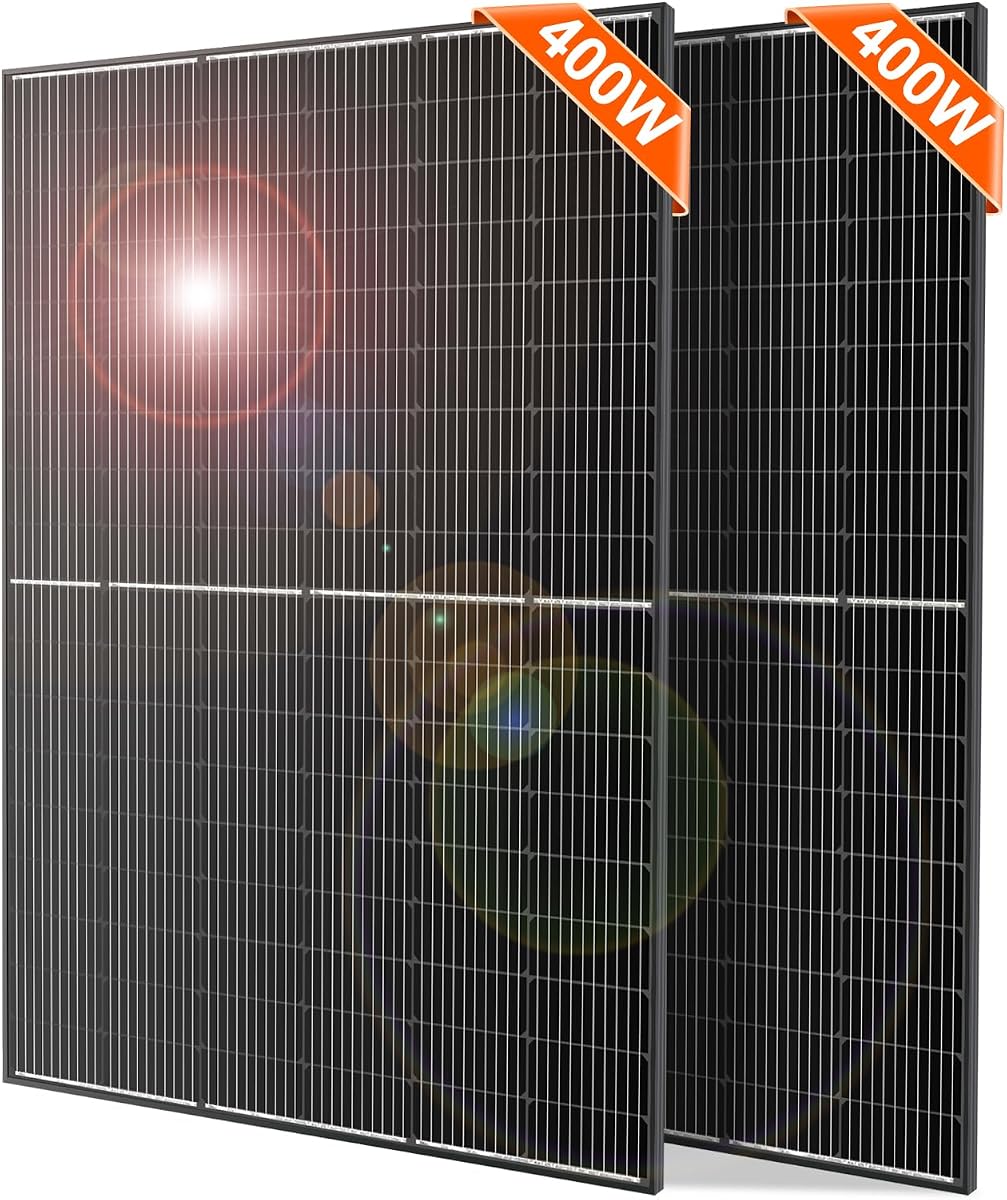
The DOKIO 800W Solar Panels set includes two 400-watt modules rated at 31V, offering 800 watts of total output under standard test conditions. Its 4.1 rating reflects a solid fixed-installation package, particularly for homes, RVs, and larger battery systems where portability is secondary.
We may earn a commission when you buy through this link, at no additional cost to you.
Tempered glass, aluminum frames, and sealed junction boxes make the set more appropriate for year-round backyard deployment than the lightweight folding options in this guide. Each panel includes a 9.84-foot MC4 lead, which helps reduce the number of extension connections required when routing the array toward a controller or combiner.
The panels are compatible with AGM, gel, and LiFePO4 batteries through suitable PWM or MPPT controllers. Parallel wiring is recommended as the default for 12V systems, while series configurations require a compatible controller. Total array current also means buyers must select a controller and inverter that can safely handle the combined output.
Homeowners and serious off-grid builders looking for more than a single portable panel may find this set especially useful. It is less convenient to transport than a foldable charger, and it is not the simplest option for someone who only needs a suitcase-style solar panel for occasional camping.
Two large modules can replace a more complicated collection of many small panels. The supplied cable lengths help create a tidier array with fewer junction points and additional extension connections.
With a suitable charge controller, the set can support common AGM, gel, and LiFePO4 battery configurations. The 12V and 24V guidance makes it relevant to both modest residential systems and larger off-grid installations.
We may earn a commission when you buy through this link, at no additional cost to you.
The Greenmagic Portable 400 Watt Solar Panel pairs a 39V output with a claimed conversion rate of 21.5–23.5%. Its 4.6 rating and extensive compatibility positioning make it a particularly strong choice for users seeking a high-capacity folding panel for RV, camping, or home use.
We may earn a commission when you buy through this link, at no additional cost to you.
Built-in MC4 wiring allows compatibility with power stations from Jackery, Goal-Zero, EcoFlow, Bluetti, Anker, and other major brands. Four independently adjustable kickstands provide more positioning options than many competing portable designs, while four edge hanging loops provide additional mounting options for RV walls and similar surfaces.
The panel folds to a stated 32.09 by 31.30 by 1.97 inches and weighs 21.5 pounds, making it substantial without being as bulky as a conventional rigid array. Laminated construction, 840D Oxford cloth, and a waterproof surface film improve durability, but the junction box is explicitly not waterproof, so prolonged rain and immersion should be avoided.
This panel is well suited to travelers who want one versatile 400-watt module for several compatible power stations and mounting locations. Buyers who require full-weather junction protection or a permanently mounted system should consider a rigid alternative, while those prioritizing compactness and flexible positioning will find this design appealing.
Four separate kickstands allow the panel to be angled more precisely than a basic single-stand design. This can improve the chance of maintaining direct sunlight across uneven ground, vehicle surfaces, and campsite locations.
The built-in handle, compact folded size, hanging loops, and broad power station compatibility create a practical travel package. It is particularly useful for owners who move between campsites and want a single panel to serve multiple compatible devices.
We may earn a commission when you buy through this link, at no additional cost to you.
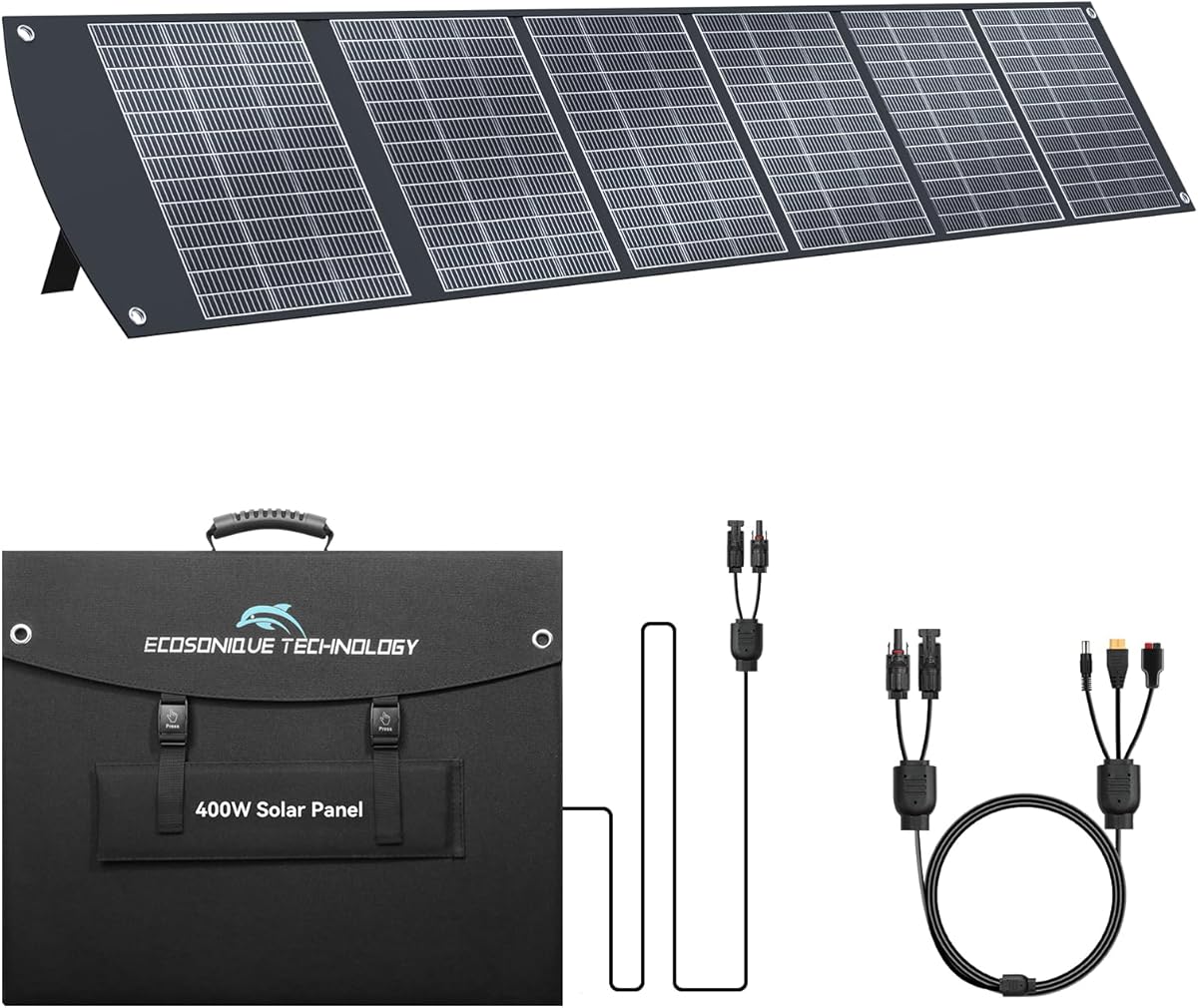
This 400W Portable Solar Panel folds into a compact 26 by 22 by 3-inch package and weighs 20.3 pounds, offering a balanced option for travelers who need a high-output 40V charger. Its 4.4 rating supports its reputation as a practical, well-regarded foldable model.
We may earn a commission when you buy through this link, at no additional cost to you.
The six-fold design includes high-grade Oxford fabric and CPC lamination for tear resistance, dust protection, and water resistance. A six-angle kickstand helps optimize exposure, while automatic restart resumes charging following interruptions. The included MC4 cable and adapter for XT60, Anderson, and DC8020 improve compatibility with popular power stations.
The stated operating range of -4°F to 158°F is another notable strength, though actual charging output still depends on sunlight, temperature, panel orientation, and the power station's maximum input. The claim that a power station can reach 80% in a few hours should therefore be treated as a conditional statement rather than a guarantee.
This panel fits travelers who regularly move their equipment and want a complete 40V charging package. It may be less convenient than a four-fold design for frequent setup, and users should carefully match the connector and voltage to their power station before purchase.
The compact folded format reduces the space required in a vehicle or storage area. A robust handle and segmented folding structure make the panel manageable despite its substantial rated capacity.
Automatic restart and smart protection improve reliability when clouds or temporary shadows interrupt sunlight. The stated temperature tolerance also makes the panel relevant for a broad range of climates.
We may earn a commission when you buy through this link, at no additional cost to you.
The Callsun set combines two 200-watt N-Type panels into a 400-watt system with an efficiency of up to 25.6%. Its 4.8 rating is the highest in the guide, reflecting a compelling combination of advanced cell technology, bifacial construction, shading tolerance, and long-term support.
We may earn a commission when you buy through this link, at no additional cost to you.
Each panel has a dual-module parallel configuration that lets one independently operating section continue producing when the other is partially shaded. The transparent backsheet captures direct, reflected, and diffuse light from the rear, potentially increasing total energy yield where suitable reflective space exists below the installation.
Pairing the panels in series produces a stated 47.48V maximum power voltage and 54.62V open-circuit voltage. That configuration fits many 60V-class solar inputs, but it will not work with every 40V power station. Buyers must also consider the 23.8-pound weight of each rigid module and the need for appropriate mounting hardware.
This is our top recommendation for RV, van, marine, rooftop, and fixed off-grid applications where long-term output and shading performance matter. It is less appropriate for portable charging with a 40V station, but its temperature coefficient, tempered glass, corrosion-resistant frame, IP68 junction box, and 25-year performance commitment make it a durable installed solution.
Bifacial operation can add output when the rear face receives useful reflected or diffuse light. The benefit depends on mounting height, surface reflectivity, spacing, and the amount of obstruction around the array.
The TwinCell anti-shading design reduces the effect of a partial obstruction affecting only one section. This is especially useful near trees, buildings, roof equipment, or other structures that cannot be removed.
We may earn a commission when you buy through this link, at no additional cost to you.
This two-pack of 200-watt N-Type bifacial panels provides 400 watts of nominal capacity for 12V-oriented systems. Its 4.0 rating is the lowest in the group, but the set still presents a compelling technical specification for buyers seeking high-efficiency N-Type cells and durable fixed installation.
We may earn a commission when you buy through this link, at no additional cost to you.
The panels use A+ Grade N-Type cells and 18BB silver-containing full-welding busbars, with a stated electroluminescence-tested cell efficiency of 25%. Reverse-current blocking is also included, while the aluminum frame and polyurethane-filled junction box are designed for extended outdoor service.
Environmental claims are unusually specific: the junction box is rated IP68, the frame resists corrosion, and the panels are stated to withstand 2,400 Pa wind pressure and 5,400 Pa snow loads. The 11 AWG oxygen-free copper cable uses UV-resistant insulation and is rated for currents up to 25 amps, while MC4 connections simplify installation.
This set is most appropriate for RV, marine, rooftop, or off-grid builders who can use two rigid panels and want efficient N-Type construction. It is not the strongest match for a traveler who needs a compact folding charger, and the lower rating suggests reviewing current customer feedback before making a final decision.
N-Type cells and 18BB busbars offer efficient conversion and stronger resistance to certain degradation mechanisms associated with older designs. The result is a capable 400-watt set without relying on a single oversized module.
A sealed IP68 junction box, corrosion-resistant frame, reinforced wire insulation, and substantial wind and snow ratings support permanent outdoor use. Proper mounting and compatible charge controls remain essential.
We may earn a commission when you buy through this link, at no additional cost to you.
The Renogy 400W N-Type panel is designed around 25% efficiency, 16BB cell technology, and a relatively compact format for Class B vans. Its 4.6 rating makes it one of the strongest-reviewed products in the guide and a credible choice for fixed RV or off-grid installations.
We may earn a commission when you buy through this link, at no additional cost to you.
The panel is stated to be 7.5% smaller and 11.7% lighter than its predecessor while maintaining the same power output. That dimensional focus is useful for vehicles with limited roof space, where every inch can determine whether a solar installation is practical.
Its low temperature coefficient helps preserve output when temperatures rise, while the listed degradation rate is no more than 1% in the first year and 0.4% annually thereafter. Compatibility with lithium, AGM, and deep-cycle batteries broadens the range of usable storage systems, provided the charge controller is selected correctly.
This is a particularly sensible option for hot-climate RV owners, van conversions, and installers prioritizing long-term output. It is less suitable for a portable suitcase-style application, and buyers should still verify exact physical dimensions, mounting provisions, and electrical requirements for their installation.
A low temperature coefficient helps limit output loss as cell temperatures climb. That characteristic is particularly valuable in hot summers, when a panel can be much warmer than the surrounding air.
The stated size and weight reductions target Class B van constraints without reducing the 400-watt rating. This makes the panel easier to accommodate on space-conscious recreational vehicles.
We may earn a commission when you buy through this link, at no additional cost to you.
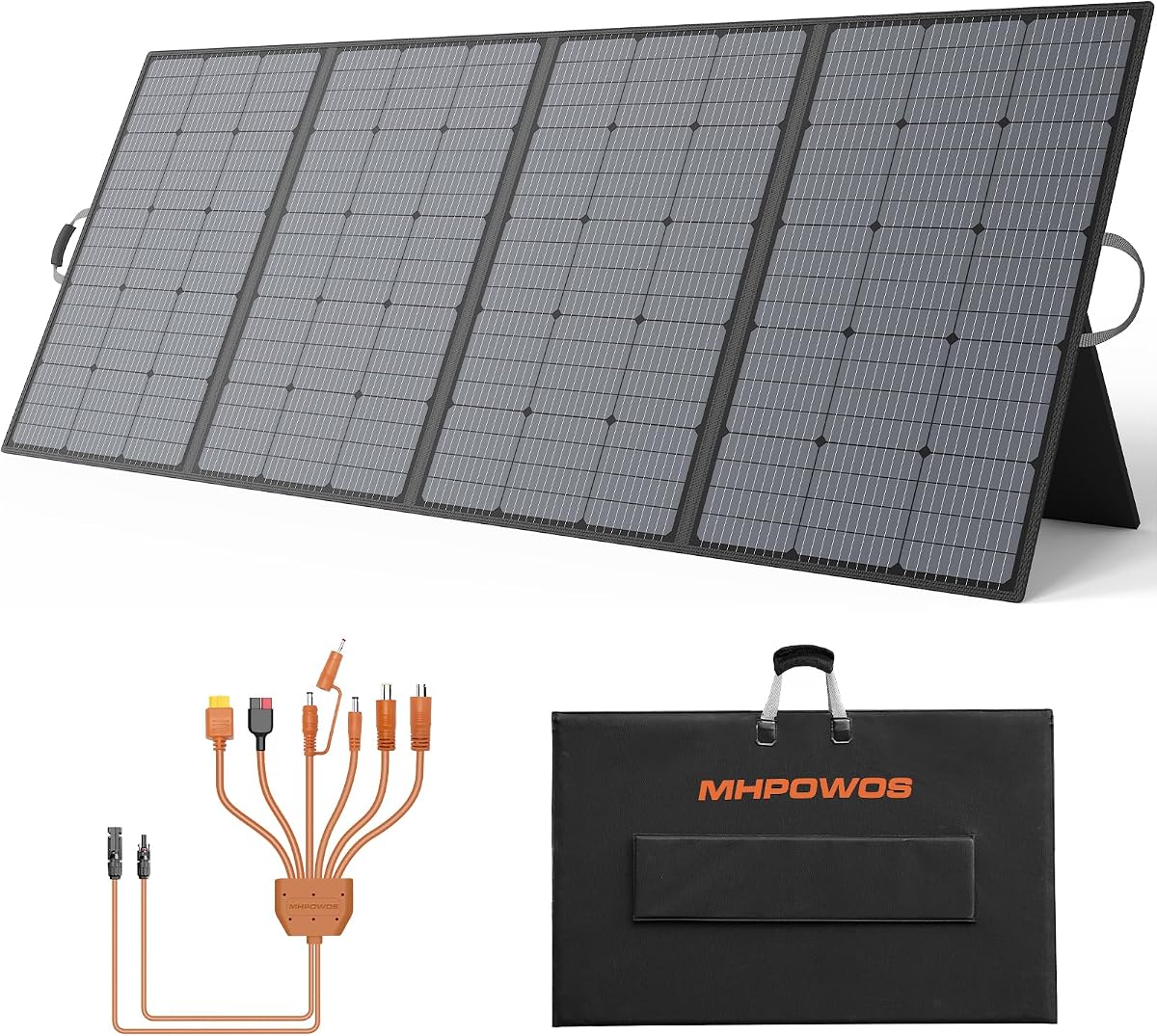
The MHPOWOS 400W foldable panel uses A+ monocrystalline cells with a stated conversion rate of 23.5%. Its 4.1 rating reflects a portable, broadly compatible design aimed at campers, anglers, hikers, and RV travelers who need flexible connection options.
We may earn a commission when you buy through this link, at no additional cost to you.
The standout feature is its connector selection, including Anderson, XT60, DC7909, DC5521, DC8020, DC5525, and DC35135 options. Four built-in kickstands support stable positioning, adjustable hardware allows the panel angle to follow the sun, and a zippered accessory pouch simplifies storage.
IP67 waterproof and dustproof protection makes the panel appropriate for outdoor use, though users should still follow the instructions for exposed connections and weather. A critical compatibility point is that many power stations impose their own maximum solar-input limits, so a panel rated at 400 watts may not deliver 400 watts to every unit.
This panel is a good match for travelers who own different compatible power stations or want more freedom than a fixed MC4 cable provides. The appropriate choice depends on matching the connector and, equally importantly, confirming the power station's accepted input voltage and current.
The unusually broad connector lineup can simplify setup across different brands and model families. It also reduces the need to source separate adapter cables for every device.
Four incorporated kickstands and adjustable angle hardware help create a stable setup on varied terrain. The included pouch and multifold format make the panel easier to pack between outdoor activities.
We may earn a commission when you buy through this link, at no additional cost to you.
The E-POWO 400W portable panel combines a 23.5% conversion rate with an ETFE-coated surface and a folding design intended for outdoor use. Its 4.3 rating makes it a solid middle-ground choice for campers and emergency-preparation buyers.
We may earn a commission when you buy through this link, at no additional cost to you.
The panel folds to 37.76 by 24.96 by 1.3 inches and weighs 15.57 kilograms. Three built-in kickstands provide 40-, 50-, and 60-degree positions, allowing the user to adjust the panel toward the sun while reinforced grommets add RV or tent mounting options.
Its seven-in-one cable supports Anderson, XT60, DC7909, DC5521, DC8020, DC5525, and DC35135 connections. ETFE lamination and IP67 protection improve resistance to dust and weather, while the fiberglass structure adds rigidity and thermal stability. A user guide and accessory pouch round out the package.
This model is well suited to those who want a portable 400-watt charger with extensive adapter support and flexible stand positioning. It is heavier than many competitors, and actual charging will slow under heavy cloud cover or when obstacles interrupt direct sunlight. The 18-month warranty also warrants comparison with longer commitments available elsewhere.
Three selectable angles make it easier to adapt the panel to different campsite surfaces and changing sun positions. Reinforced mounting points add another installation option for travel.
The ETFE layer supports weather resistance and long-term surface durability. As with any portable solar product, connectors should remain protected from standing water during severe conditions.
We may earn a commission when you buy through this link, at no additional cost to you.
The JJN package contains two 425-watt N-Type bifacial panels with a combined nominal output of 850 watts. Although it exceeds the usual 400-watt class, its 4.6 rating and high-efficiency construction make it relevant for buyers who want a compact array with substantial capacity.
We may earn a commission when you buy through this link, at no additional cost to you.
A transparent backsheet allows the rear of each module to collect useful light, potentially increasing efficiency by as much as 25% compared with conventional panels. The 16BB N-Type cell layout is designed to reduce the impact of shading, while an IP65 junction box and IP68 connectors provide solid weather protection.
The black aluminum frames are stated to withstand 2,400 Pa wind pressure and 5,400 Pa snow loads. Pre-drilled mounting holes simplify installation on rooftops, RVs, boats, and off-grid structures. Buyers must size the charge controller, inverter, wiring, and battery bank for the combined 850-watt generation.
This set is best for permanent residential rooftop, marine, RV, or off-grid projects where maximum collection is more important than compact transport. It is not a direct portable substitute for a folding 400-watt panel, and the transferable 30-year power output warranty makes long-term reliability an important selling point.
The pair provides 850 watts of nominal generation, reducing the number of separate panels needed for a larger array. This can simplify layout on limited roof or mounting space, although proper spacing and ventilation remain important.
UL 61730 listing, protected connectors, corrosion-resistant framing, and substantial wind and snow ratings support permanent installation. The 30-year transferable output warranty adds long-term planning value.
We may earn a commission when you buy through this link, at no additional cost to you.
The best 400w Solar Panel depends on whether portability, charging speed, fixed-array performance, or system compatibility matters most. Review the electrical requirements and intended environment before comparing models because a panel that appears powerful on paper may not be accepted by every power station or battery system.
A 400-watt rating alone does not guarantee that a power station will accept the full output. Many portable units include maximum solar-input limits, and some require a particular voltage range or connector. Foldable models in this guide commonly use a 39V or 40V architecture, while rigid systems may operate at 12V, 24V, or higher series voltages. Check the power station manual for its maximum input wattage, voltage window, and required connector before making a selection.
A high-quality match can improve charging speed and prevent the power station from limiting or refusing the panel. Never assume that an MC4 connector alone guarantees compatibility, because the electrical specifications still need to agree.
Foldable panels prioritize transport convenience. Their hinged sections, fabric exterior, and integrated kickstands make them useful for camping, tailgating, boating, and emergency kits. Rigid glass panels generally offer a more permanent installation format, often with pre-drilled holes, stronger weather sealing, and bifacial options. Choose based on how frequently the panel will move and whether it will be mounted permanently.
For travel, folded dimensions, carried weight, and handle placement deserve as much attention as rated output. For fixed systems, glass type, frame corrosion resistance, mounting holes, and wind and snow ratings should guide the decision.
Efficiency indicates how effectively sunlight is converted into electrical energy, but real output also depends on panel size, temperature, orientation, and available irradiance. N-Type cells are highlighted in many of the leading options because of their efficiency and favorable degradation characteristics. 16BB and 18BB busbar layouts can also reduce current loss and resist certain types of cell damage.
Choose a modern cell and busbar design when space is limited or maximum output matters. A slightly less efficient but simpler panel may still be adequate when it will be mounted with ample sunlight and used at a moderate charging rate.
Bifacial panels can collect light from the rear face in addition to the front. The additional output varies with ground reflectivity, mounting height, spacing, and surrounding obstructions, so the advertised percentage should be viewed as a potential rather than a constant. Dual-module parallel designs can reduce the impact of partial shade by allowing independently operating sections to continue generating.
Bifacial construction is especially attractive for rooftop, RV, and ground-mounted arrays with access to reflected light. Anti-shading layouts are particularly useful near trees, buildings, vents, or other unavoidable obstructions.
Look for an IP rating on the panel, junction box, and connectors rather than assuming the entire product is equally protected. The Greenmagic panel, for example, is rated IP65 while its junction box is not waterproof. Rigid products often specify protected junction boxes, and some list wind and snow load ratings that are useful for permanent mounting.
Environmental claims should guide installation decisions without replacing sensible care. Keep connectors dry, use compatible mounting hardware, provide ventilation behind rigid panels, and follow the manufacturer's guidance for cleaning, folding, and storage.
A solar panel does not connect directly to most battery banks without appropriate charge control. Renogy's model supports common lithium, AGM, and deep-cycle batteries, while the DOKIO set also identifies gel and LiFePO4 compatibility. These statements still assume a correctly configured PWM or MPPT controller. For larger arrays, MPPT is often advised because it can improve operating efficiency and help bring the panel voltage into a suitable charging range.
Calculate the expected current, select a controller with adequate voltage and current ratings, and follow the battery manufacturer's charging profile. A controller that is too small can clip output or operate inefficiently, while an unsuitable connection can create safety and warranty concerns.
MC4 is common among solar panels, but portable power stations may use XT60, Anderson, DC7909, DC5521, DC8020, DC5525, DC35135, or proprietary connections. Some models include broad adapter selections, while others provide a smaller set intended for particular brands. The supplied cable length also matters because a short lead may require additional extensions that introduce avoidable connection points.
Confirm both the connector type and the electrical specification. Having the right physical plug does not resolve mismatched voltage, and adding unnecessary extensions can make setup less tidy and create additional potential failure points.
Warranty length can reveal the manufacturer's confidence in long-term performance, although it should be considered alongside product type and installation quality. The Callsun set includes a 25-year performance commitment, Renogy states 25 years of 80% output, and JJN offers a transferable 30-year output warranty. Portable products often provide shorter coverage, such as 12, 18, or 24 months.
For fixed installations, output degradation terms are particularly useful. For portable use, replacement support, included accessories, and accessible customer service may matter more than a long performance schedule.
Before first use, read the manual for the power station, charge controller, and panel. Confirm the input voltage, permitted current, connector type, and whether the station imposes a solar-input wattage cap. Position the panel in direct sunlight with no unnecessary shadows, open the folding sections fully, and use all relevant kickstands to maintain a stable angle.
For rigid systems, mount the panel with compatible hardware on a ventilated surface and follow local electrical requirements. Connect the panel to the charge controller before connecting the controller to the battery bank. Check polarity, grounding requirements, and fuse sizing where applicable. For portable systems, keep the controller and power station protected from standing water and route cables to prevent pinching or accidental disconnection.
Clean the surface gently with a soft cloth and mild, water-based cleaner as permitted by the manufacturer. Avoid abrasive tools, harsh chemicals, and pressure washing. Keep junction boxes and connectors dry, inspect cables for damage, and never use a panel with cracked cells, torn fabric, or a damaged connector. Fold portable panels along their intended hinges, remove excess moisture, and store them in a dry, ventilated place when not in use.
No. The power station must accept the panel's voltage, current, connector, and operating configuration. Many units also impose a lower maximum solar-input limit, so a 400W panel may charge at a reduced rate even in excellent sunlight. Check the power station specifications and manufacturer guidance before purchasing.
The voltage must be compatible with the power station's solar-input range. A nominal 40V panel is designed for many common 40V-class stations, while a higher-voltage panel may require a 48V or 60V-class input. Connecting a mismatched voltage can prevent charging or create safety concerns, so identify the accepted range first.
They serve different purposes. Foldable panels are convenient for travel but have fabric, hinges, and flexible laminations that require careful storage. Rigid glass panels are generally better suited to permanent rooftop, marine, and off-grid installations. Both can be durable when used according to their environmental limits and care instructions.
No. A bifacial panel generates power from both front and rear surfaces, but the additional contribution depends on reflected, diffuse, and direct light reaching the rear. Ground reflectivity, mounting height, nearby objects, and panel spacing can make a substantial difference in real-world output.
Actual output is usually below the standard rated wattage when sunlight is weak or the panel is hot. Clouds, partial shade, incorrect orientation, and a power station's input limit can reduce charging further. The rated value is best understood as a standardized laboratory benchmark rather than a guaranteed every-hour result.
It depends on the battery, panel configuration, and system complexity. An MPPT controller is often beneficial for larger or multi-panel systems because it can improve operating efficiency and regulate charging more effectively. A properly sized PWM controller may work for simpler applications, but the battery chemistry and voltage must always match the controller.
Yes, but the electrical configuration must be designed for the controller, inverter, and battery bank. Panels may be connected in series to increase voltage or parallel to increase current. The combined current and voltage must remain within every component's ratings, and suitable MC4 cables, fusing, and grounding should be used.
Not always. An IP rating for the panel does not necessarily apply to its junction box or cable connections, and some manufacturers explicitly recommend keeping the panel out of rain. Review the complete environmental guidance and protect exposed connectors even when the photovoltaic surface carries a strong water-resistance rating.
The Callsun N-Type 400W Bifacial Set is the strongest all-around choice for fixed installations because of its 25.6% efficiency, anti-shading design, bifacial construction, and long performance commitment. The Greenmagic Portable 400 Watt Solar Panel stands out for travel use, flexible positioning, broad power station compatibility, and a strong 4.6 rating, while the two-panel N-Type set offers a capable value-oriented alternative.
Prioritize the factors that can prevent a disappointing installation: electrical compatibility, intended mobility, available mounting space, battery type, controller requirements, and real-world exposure. Foldable panels are most convenient for camps and emergencies, while rigid N-Type and bifacial modules are better suited to RVs, rooftops, marine use, and permanent off-grid systems.
Finally, check current product availability, recent customer feedback, included accessories, warranty terms, and the exact specifications of your power station or battery system before ordering. Solar equipment prices and configurations can change, and comparing current offers ensures that the selected panel remains a practical fit for the intended system.